Need help?
Do you have a question about the Brinly PRC-241BH and is the answer not in the manual?
User duties for proper product assembly, operation, and maintenance.
Essential safety guidelines for operating the lawn roller and associated equipment.
Instructions for attaching the scraper bar to the roller drum.
Instructions for attaching the frame extension bar to the scraper bar.
Connecting the frame extension bars using a spacer.
Instructions for attaching the clevis plates to the frame.
Securing the clevis with a hitch pin and cotter for specific models.
Attaching the handle and grips for PRC-241BH models.
Instructions for installing the roller plug and tethered plug.
Technical specifications including working width and drum capacity for roller models.
Procedures for attaching and detaching the roller to a towing vehicle.
Proper operation, towing capacity, speed, and filling the roller.
Tips for keeping the roller clean, dry, and in good working order.
Information on available optional accessories like magnetic hitch pins.
Contact information for service and links to online resources and videos.
Procedure for obtaining warranty parts replacements and customer service contact.
Details on warranty coverage, exclusions, and duration for parts.
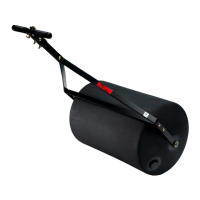
This manual describes the Brinly Lawn Roller, an accessory designed for use with riders, lawn or garden tractors, and ATVs. The primary function of the lawn roller is to flatten uneven ground, creating a smooth and level surface for a healthier lawn. It achieves this by being filled with water (or sand, as an alternative) to provide the necessary weight for compaction.
The Brinly Lawn Roller is a towed implement consisting of a large, cylindrical drum that can be filled with water or sand to increase its weight. This weight, combined with the rolling action as it's pulled across the lawn, compacts the soil and flattens irregularities such as molehills, frost heaves, or uneven turf after seeding. The roller is designed to be attached to the hitch plate of a towing vehicle, such as a lawn tractor or ATV, via a clevis and hitch pin assembly. A scraper bar is integrated into the design, positioned close to the drum to prevent soil and debris buildup, ensuring consistent rolling performance. The drum itself is equipped with a plug for easy filling and draining of water or sand. Some models feature a handle for manual pushing, offering versatility for smaller areas or specific tasks where a towing vehicle might be impractical. The overall design emphasizes durability and ease of use, aiming to provide a dependable solution for lawn leveling.
Operating the Brinly Lawn Roller involves several key steps to ensure effective and safe use. Before operation, it is crucial to read the owner's manual thoroughly to understand all controls and safety precautions. The roller's effectiveness is highly dependent on the ground conditions; best results are achieved when the soil is moist but not muddy. The roller should be filled with water or sand to the recommended capacity, taking into account the towing capacity of the vehicle. Overloading the towing vehicle is a significant safety concern and should be avoided. The plug used for filling must be securely tightened to prevent leaks.
When towing, the operator must maintain awareness of the tractor/attachment and the area being covered, staying alert for holes or hidden hazards. It is important to keep children and pets a safe distance away from the operating equipment. The recommended operating speed for optimal results is less than 3 mph. To calibrate the tractor to this speed, the manual suggests measuring a 20-foot distance and adjusting the throttle and gear to cover it in 4.5 seconds. This slow speed ensures thorough and even compaction of the ground.
Attaching the roller to the towing vehicle involves aligning the clevis plates with the vehicle's hitch plate and securing them with a hitch pin and cotter. For models with a handle, this handle is also attached to the clevis plates. The assembly process is straightforward, with clear instructions provided for connecting the frame extension bars, scraper bar, and bearings to the roller drum. The manual emphasizes not fully tightening lock nuts until later stages of assembly to allow for proper alignment.
Proper maintenance is essential for the longevity and performance of the Brinly Lawn Roller. The key to years of trouble-free service is to keep the roller clean and dry. After each use, it is highly recommended to drain the water from the drum and leave the plug out. This practice, along with hanging the roller when not in use, helps prevent the formation of flat spots on the drum, which can occur if the roller is stored with water for extended periods, especially in varying temperatures.
If a flat spot does develop during storage, the manual provides a solution: first, ensure the roller is empty. Then, leave it out in the sun, preferably on pavement, for at least one day to warm up the material. Once warmed, rolling it around will help reduce the flat area.
Periodically, all moving parts of the roller should be checked for free movement and lubricated with oil as needed. This ensures smooth operation and prevents wear. Fasteners, including nuts, bolts, and screws, should be regularly checked for tightness to maintain the equipment in a safe working condition. If any rust develops on the steel components, it should be lightly sanded and the area painted with enamel to prevent further corrosion.
The manual also advises referring to the towing vehicle's owner's manual for its specific towing capacity and safe operation guidelines, as the added weight of the roller will significantly affect towing and stopping distances. In summary, consistent cleaning, proper storage, and routine checks of moving parts and fasteners will ensure the Brinly Lawn Roller remains a reliable tool for lawn care.
 General
| Category | Farm Equipment |
|---|---|
| Model | PRC-241BH |
| Working Width/Blade Width | 24 inches |
| Material | Steel |
| Color | Black |

 To Next Page