IF THIS SMOKE ALARM SOUNDS
RESPONDING TO AN ALARM
During an alarm, you will hear a loud, repeating horn pattern:
beep, beep, beep... The LED will flash rapidly.
• If the unit alarms and you are not testing the unit, it is warning
you of a potentially dangerous situation that requires your
immediate attention. NEVER ignore any alarm. Ignoring the
alarm may result in injury or death.
• Never remove the batteries from a battery operated Smoke
Alarm to stop an unwanted alarm (caused by cooking smoke,
etc.). Removing batteries disables the alarm so it cannot sense
smoke, and removes your protection. Instead open a window or
fan the smoke away from the unit. The alarm will reset automat-
ically.
• If the unit alarms get everyone out of the house immediately.
WHAT TO DO IN CASE OF FIRE
• Don’t panic; stay calm. Follow your family escape plan.
• Get out of the house as quickly as possible. Don’t stop to
get dressed or collect anything.
• Feel doors with the back of your hand before opening them.
If a door is cool, open it slowly. Don’t open a hot door. Keep doors
and windows closed, unless you must escape through them.
• Cover your nose and mouth with a cloth (preferably damp).
Take short, shallow breaths.
• Meet at your planned meeting place outside your home,
and do a head count to make sure everybody got out safely.
• Call the Fire Brigade as soon as possible from outside.
Give your address, then your name.
• Never go back inside a burning building for any reason.
• Contact your Fire Brigade for ideas on making your home safer.
Alarms have various limitations. See "Limitations of Smoke Alarms"
for details.
USING THE SILENCE FEATURE
The Silence Feature can temporarily quiet an unwanted alarm for up to 15
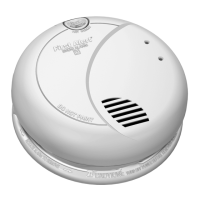
minutes. To use this feature, press the “Push to Test/Silence” button on
the cover. If the unit will not silence and no heavy smoke is present,
or if it stays in silence mode continuously, it should be replaced
immediately.
The LED will flash every 10 seconds while in silence.
The Silence Feature does not disable the unit—it makes it tem-
porarily less sensitive to smoke. For your safety, if smoke around
the unit is dense enough to suggest a potentially dangerous situa-
tion, the unit will stay in alarm or may re-alarm quickly. If you do not
know the source of the smoke, do not assume it is an unwanted
alarm. Not responding to an alarm can result in property loss, injury,
or death.
IF YOU SUSPECT A PROBLEM
Smoke Alarms may not operate properly because of dead, missing or
weak batteries, a build-up of dirt, dust or grease on the Smoke Alarm
cover, or installation in an improper location. Clean the Smoke Alarm as
described in “Regular Maintenance,” and install a fresh battery, then test
the Smoke Alarm again. If it fails to test properly when you use the test
button, or if the problem persists, replace the Smoke Alarm immediately.
• If you hear a “chirp” once a minute, replace the battery.
• If you experience frequent non-emergency alarms (like those
caused by cooking smoke), try relocating the Smoke Alarm.
• If the alarm sounds when no smoke is visible, try cleaning or
relocating the Smoke Alarm. The Alarm may be dirty or dusty.
• If the alarm does not sound during testing, try installing a new
battery, and make sure it is snapped in securely.
If the Smoke Alarm is still not operating properly, and it is still under
guarantee, please see “How to Obtain Guarantee Service” in the Limited
Guarantee.
Do not try fixing the alarm yourself – this will void your warranty!
REGULAR MAINTENANCE
This unit has been designed to be as maintenance free as possible, but
there are a few simple things you must do to keep it working properly.
Use only the replacement batteries listed below. The unit may not
operate properly with other batteries. Never use rechargeable
batteries since they may not provide a constant charge.
• Test your Alarm at least once a week.
• Clean the Smoke Alarm at least once a month; gently vacuum the
outside of the Smoke Alarm using your household vacuum’s soft
brush attachment. Test the Smoke Alarm. Never use water, cleaners
or solvents since they may damage the unit.
• If the Smoke Alarm becomes contaminated by excessive dirt, dust
and/or grime, and cannot be cleaned to avoid unwanted alarms,
replace the unit immediately.
• Relocate the unit if it sounds frequent unwanted alarms. See
“Locations to Avoid For Smoke Alarms” for details.
• When the battery becomes weak, the Smoke Alarm unit will “chirp”
about once a minute (the low battery warning). This low battery
warning should last for 30 days, but you should replace the battery
immediately to continue your protection.
• Test for proper Smoke Alarm operation using the test button
whenever the battery is replaced.
Choosing a replacement battery:
Your Smoke Alarm requires a standard 9V battery. The following
batteries are acceptable as replacements: Duracell #MN1604,
Energizer #522, Eveready #1222. You may also use the Ultralife U9VL-J
lithium battery for longer service life between battery changes. These
batteries are available at many local retail stores.
When using a lithium battery there is a danger of explosion if the
battery is incorrectly replaced. Replace a lithium battery only with
the same or equivalent type.
Most carbon zinc batteries have an average service life of 1 year; most
alkaline batteries have an average service life of 1-2 years; most Lithium
batteries have an average service life of 6-10 years.Actual battery serv-
ice life depends on the Smoke Alarm and the environment in which it is
installed. All the batteries specified above are acceptable replacement
batteries for this unit. Regardless of the manufacturer’s suggested bat-
tery life, you MUST replace the battery immediately once the unit starts
“chirping” (the “low battery warning”).
4



 To Next Page