
 Need help?
Do you have a question about the Brother DCP-L8410CDW and is the answer not in the manual?
Details components included and important notes on cables and country variations.
Instructions for removing packing tape and installing drum and toner assemblies.
Guide on correctly loading paper into the machine's paper tray.
Steps to connect the power cord and power on the machine.
Initial setup for selecting the country or language based on on-screen prompts.
Procedure for selecting the local language via the touchscreen interface.
Instructions for connecting a computer via disc or download for software installation.
Guidance for connecting a mobile device to the machine.
Tips for resolving wireless, wired, or USB connection problems.
Steps for setting up a direct wireless connection without an access point.
Information on using AirPrint and Brother iPrint&Scan for mobile printing/scanning.
This document serves as a Quick Setup Guide for the Brother DCP-L8410CDW, MFC-L8690CDW, MFC-L8900CDW, and MFC-L9570CDW series of multifunction devices. These machines are designed to provide printing, copying, and scanning functionalities, with specific models offering additional features such as fax capabilities (indicated by "MFC" in the model name). The guide outlines the initial steps required to unpack, set up, and connect the device to a computer or mobile device, ensuring a smooth installation process.
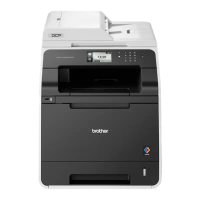
The Brother DCP-L8410CDW, MFC-L8690CDW, MFC-L8900CDW, and MFC-L9570CDW are color laser multifunction devices. They are designed for office and home office environments, offering high-quality color printing, copying, and scanning. The "MFC" models (MFC-L8690CDW, MFC-L8900CDW, MFC-L9570CDW) also include fax functionality, making them comprehensive communication hubs. These devices support various connectivity options, including USB, wired network (Ethernet), and wireless network (Wi-Fi), allowing for flexible integration into different network environments. The machines are equipped with a touchscreen interface, providing intuitive navigation and control over their functions.
The setup process begins with unpacking the machine and verifying all included components. These typically include the main unit, a drum unit (pre-installed), inbox toner cartridges (Black, Cyan, Magenta, and Yellow), a waste toner box, a belt unit, an AC power cord, and for MFC models, a telephone line cord. Some regions may also receive a telephone line cord adapter. Interface cables (USB or network) are not included and must be purchased separately if required. The guide recommends using a USB 2.0 cable (Type A/B) no longer than 2 meters and a straight-through Category 5e (or greater) twisted-pair network cable for optimal performance.
The first operational step involves removing all internal packing materials and installing the drum unit and toner cartridge assembly. This includes removing packing tape and securely seating the components. Following this, paper is loaded into the paper tray. The guide emphasizes adjusting the paper guides to prevent jams and not exceeding the maximum paper fill mark.
Once the physical setup is complete, the AC power cord is connected, and the machine is turned on. For initial setup, users may be prompted to select their country or language via the machine's touchscreen. This is done by navigating through the "Settings" menu (for DCP-L8410CDW and MFC-L8690CDW models), then "All Settings," "Initial Setup," and "Local Language," finally selecting the desired language.
Connectivity options are diverse. Users can connect the machine to a computer via USB, wired network, or wireless network, or to a mobile device wirelessly. For computer connection, an installation disc is provided, or the full driver and software package can be downloaded from the Brother Solutions Center. The guide provides specific URLs for Windows® and Macintosh® users. On-screen instructions and prompts guide the software installation. For Windows®, if the Brother screen does not appear automatically, users are instructed to navigate to "Computer (This PC)," double-click the CD/DVD-ROM icon, and then run "start.exe." For Macintosh®, the guide recommends choosing the CUPS driver for full driver functionality.
If connectivity issues arise, the guide suggests troubleshooting steps such as restarting the wireless access point/router, restarting the machine and computer, or disconnecting and reconnecting the network cable for wired connections.
For wireless setup without a computer, an alternative method is provided. Users need to locate their SSID (Network Name) and Network Key (Password) on their wireless access point/router. These details are then entered directly on the machine's touchscreen by pressing the Wi-Fi icon, selecting "Setup Wizard," and following the prompts to select the SSID and enter the Network Key. If the setup is unsuccessful, restarting the Brother machine and wireless access point/router is recommended.
Mobile device connectivity is also a key feature. Users can print from and scan to their mobile devices using various apps. For Apple device users, AirPrint is available, requiring no additional software download. For other mobile devices, Brother offers the free "Brother iPrint&Scan" application, available on app stores like the App Store, Google Play™, or Microsoft® Store. The Brother SupportCenter mobile app is also available, providing the latest support information for Brother products. Optional apps for printing and scanning from mobile devices are also mentioned, with instructions available in the Online User's Guide.
While the Quick Setup Guide primarily focuses on initial installation and connectivity, it implicitly touches upon maintenance through the inclusion of consumable components. The machine uses a drum unit, toner cartridges, a waste toner box, and a belt unit. These are user-replaceable components, indicating that the device is designed for easy maintenance of its imaging system. The initial installation of these components, as detailed in the guide, sets the stage for future replacement when they reach the end of their lifespan. The guide also mentions that Brother regularly updates firmware to add features and apply bug fixes, encouraging users to check for the latest firmware on the Brother Solutions Center, which is a form of software maintenance to ensure optimal performance and security. The availability of FAQs and troubleshooting resources on the support website further aids users in resolving common issues and performing basic maintenance tasks.
 General
| N-up printing | 2, 4, 6, 9, 16, 25 |
|---|---|
| Print technology | Laser |
| Maximum resolution | 2400 x 600 DPI |
| Economical printing | Yes |
| Time to first page (black, normal) | 15 s |
| Print speed (black, normal quality, A4/US Letter) | 31 ppm |
| Copier resize | 25 - 400 % |
| Maximum copy resolution | 1200 x 600 DPI |
| Maximum number of copies | 99 copies |
| N-in-1 copy function (N=) | 2, 4 |
| Time to first copy (black, normal) | 16 s |
| Time to first copy (color, normal) | 17 s |
| Copy speed (black, normal quality, A4) | 31 cpm |
| Scan to | E-mail, E-mail Server, FTP, File, Image |
| Scan drivers | ISIS, TWAIN, WIA |
| Scanner type | Flatbed & ADF scanner |
| Grayscale levels | 256 |
| Input color depth | 24 bit |
| Maximum scan resolution | 19200 x 19200 DPI |
| Faxing | No |
| Digital sender | - |
| Printing colors | Black, Cyan, Magenta, Yellow |
| Maximum duty cycle | 40000 pages per month |
| Recommended duty cycle | 0 - 3000 pages per month |
| Number of print cartridges | 4 |
| Page description languages | BR-Script 3, PCL 6, PDF 1.7, PostScript 3, XPS |
| Sound pressure level (printing) | 49 dB |
| Sound pressure level (quiet mode) | 44 dB |
| Sustainability certificates | Nordic Swan Ecolabel, Blue Angel, ENERGY STAR |
| Paper input type | Paper tray |
| Total input capacity | 250 sheets |
| Total output capacity | 150 sheets |
| Total number of input trays | 1 |
| Multi-Purpose tray input capacity | 50 sheets |
| Custom media width | 76.2 - 215.9 mm |
| Maximum print size | 215 x 355 mm |
| Custom media length | 127 - 355.6 mm |
| Paper tray media types | Plain paper, Recycled paper |
| Paper tray media weight | 60 - 105 g/m² |
| Non-ISO print media sizes | Executive |
| ISO A-series sizes (A0...A9) | A4, A5, A6 |
| Multi-purpose tray media types | Bond paper, Letterhead, Plain paper, Recycled paper |
| Maximum ISO A-series paper size | A4 |
| Multi-Purpose Tray media weight | 60 - 163 g/m² |
| Auto Document Feeder (ADF) media weight | 64 - 90 g/m² |
| Display | LCD |
| Product color | Black, White |
| Display diagonal | 3.6 \ |
| Market positioning | Business |
| Wi-Fi standards | 802.11b, 802.11g, Wi-Fi 4 (802.11n) |
| Cabling technology | 10/100/1000Base-T(X) |
| Security algorithms | 64-bit WEP, 128-bit WEP, APOP, EAP-FAST, EAP-MD5, EAP-TLS, EAP-TTLS, HTTPS, IPPS, IPSEC, PEAP, SMTP-AUTH, SNMP, SSL/TLS, WPA-AES, WPA-PSK, WPA-TKIP, WPA2-AES, WPA2-PSK, WPA2-TKIP |
| Ethernet LAN data rates | 10, 100, 1000 Mbit/s |
| Mobile printing technologies | Apple AirPrint, Brother iPrint & Scan, Google Cloud Print, Mopria Print Service |
| Supported network protocols (IPv4) | ARP, RARP, BOOTP, DHCP, APIPA(Auto IP), WINS/NetBIOS name resolution, DNS Resolver, mDNS, LLMNR responder, LPR/ LPD, Custom Raw Port/Port9100, SMTP Client, IPP/IPPS, FTP Client and Server, CIFS Client, TELNET Server, SNMPv1/v2c/ v3, HTTP/HTTPS server, TFTP client and server, ICMP, Web Services (Print/Scan), SNTP Client, LDAP |
| Supported network protocols (IPv6) | NDP, RA, DNS resolver, mDNS, LLMNR responder, LPR/LPD, Custom Raw Port/Port9100, IPP/IPPS, SMTP Client, FTP Client and Server, CIFS Client, TELNET Server, SNMPv1/v2c/v3, HTTP/HTTPS server, TFTP client and server, ICMPv6, SNTP Client, LDAP, Web Services (Print/Scan) |
| Standard interfaces | Ethernet, USB 2.0, Wireless LAN |
| Power consumption (off) | 0.03 W |
| Power consumption (ready) | 70 W |
| Power consumption (sleep) | 10 W |
| Power consumption (PowerSave) | 1.3 W |
| Power consumption (average operating) | 580 W |
| Energy Star Typical Electricity Consumption (TEC) | 1.8 kWh/week |
| Mac operating systems supported | Mac OS X 10.10 Yosemite, Mac OS X 10.11 El Capitan, Mac OS X 10.12 Sierra |
| Windows operating systems supported | Windows 10 Education, Windows 10 Education x64, Windows 10 Enterprise, Windows 10 Enterprise x64, Windows 10 Home, Windows 10 Home x64, Windows 10 IOT Core, Windows 10 Pro, Windows 10 Pro x64, Windows 7 Enterprise, Windows 7 Enterprise x64, Windows 7 Home Basic, Windows 7 Home Basic x64, Windows 7 Home Premium, Windows 7 Home Premium x64, Windows 7 Professional, Windows 7 Professional x64, Windows 7 Starter, Windows 7 Starter x64, Windows 7 Ultimate, Windows 7 Ultimate x64, Windows 8, Windows 8 Enterprise, Windows 8 Enterprise x64, Windows 8 Pro, Windows 8 Pro x64, Windows 8 x64 |
| Package depth | 542 mm |
| Package width | 663 mm |
| Package height | 654 mm |
| Package weight | 33300 g |
| Harmonized System (HS) code | 84433100 |
 Weight and Dimensions
| Depth | 526 mm |
|---|---|
| Width | 435 mm |
| Height | 539 mm |



 To Next Page