EasyManua.ls Logo

BRUEL & KJAER System V - Exciter Support; Base; Side Supports; Trunnion Springs

BRUEL & KJAER System V
68 pages
Print Icon
To Next Page IconTo Next Page
To Previous Page IconTo Previous Page
Loading...
If
any
of
these
malfunctions
is
detected
the
Exciter p
rotection
circuit
operates,
cutting
off
the
drive
coil
power
and
field
coil
power
. The
indicator
lamp
"Exciter"
on
the
front
panel
of
the
Power
Amplifier
will
be
lit
to
indicate
that
the
malfunction
is
confined
to
the
shaker.
4.
4.3.
EXCITER
S
UP
PO RT
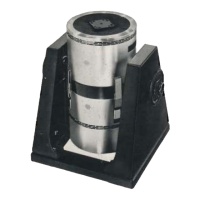
The
Exciter
Support
consists
of
three
large
parts
,
the
Base
and
the
two
Side
Su
pports,
and a
number
of
smaller
parts
associated
with
the
connection
of
the
S
id
e S
upports
to
the
Magnet
Assembly
of
the
Exciter Body.
4
4.3.1.
Base
The
Base,
with
the
two
Side
Supports,
provides
the
frame
for
th
e
excit
er.
15
mm
(0
,
59
in)
holes
are
provided
in
each
corner
of
the
Base
on
a
305
mm
(12
in)
square
(see
Fig.2.4).
These
holes
typically
may
be used
to
attach
the
exciter
to
a
reaction
mass
to
re-
duce
Exciter
Body
motion
,
or
alternatively
,
to
hang
the
exciter
upside
-
down
from
shock
cords
for
structural
testing
.
4.3.2.
Side
Supports
The
Side
Supports
are
bolted
to
the
Base.
These
Side
Supports
provide
the
bearing
sur-
face
for
the
exciter
trunnion
assembly
and
act
as a
protective
cover
for
the
trunnion
springs
.
4.3.3.
Trunn
ion
Sp
ri
ng
s
The
Trunnion
Springs
permit
relative
motion
along
the
axis
of
the
exciter
,
but
restrict
mo-
tion
radially.
When
the
exciter
is used
with
slip
tables,
it
is
important
that
the
table
loca-
tion
is
accurately
repeatable
.
The
high
radial
stiffness
satisfies
this
requirement.
In
the
axial
direction,
th
e
resonance
frequency
of
the
unloaded
e
xciter
on
the
Trunnion
Springs
is
about
14Hz.
4 .3 .4 .
High
Fr
equenc
y
Su
spen
s
ion
E
ng
a
gem
ent
Knob
The
smaller
of
the
two
knobs
in
the
top
centre
of
each
Side
Support
(Fig.4.3)
is
the
High
Frequency
Suspension
Engagement
Knob.
When
both
of
these
controi
knobs
are
at
their
counterclockwise
limit
,
the
low
frequency
suspension
is
engaged.
At
the
clockwise
limit
a
highly
damped
high
frequency
suspension
is
engaged
.
These
knobs
should
both
be
either
fully
clockwise
or
fu
lly
counterclockwise
at all
times
.
There
is
no
advantage
to
be
had
by leaving
them
in
an
intermediate
position
.
NOTE:
The
knobs
should
always
be
fully
clockwise
during
transport.
4.3
.5. Ro
tation
Beari
ng
/Bra
ke
The
Rotation
Bearing/Brake
is a
four
segment
wide
rimmed
wheel
that
acts
both
as
a
bearing
and
as
rotationai
brake.
As
abearing,
it
rotates
freely
in
a
brass
liner
in
the
Side
Support.
30

Table of Contents

Related product manuals