EasyManua.ls Logo

Bryant 548D - User Manual

Bryant 548D
40 pages
Print Icon
To Next Page IconTo Next Page
Loading...
Cancels: II 548D-90-1 II 548D-90-2
10/15/00
CONTENTS
Page
SAFETY CONSIDERATIONS . . . . . . . . . . . . . . . . . . . . . . . . . 1
INSTALLATION . . . . . . . . . . . . . . . . . . . . . . . . . . . . . . . . . .1-27
I. Step 1— Provide Unit Support . . . . . . . . . . . . . . . . . 1
II. Step 2 — Field Fabricate Ductwork . . . . . . . . . . . . . 3
III. Step 3 — Install Condensate Drain Line
and External Trap. . . . . . . . . . . . . . . . . . . . . . . . . . . . 3
IV. Step 4 — Rig and Place Unit. . . . . . . . . . . . . . . . . . . 3
V. Step 5 — Make Electrical Connections . . . . . . . . . . 7
VI. Step 6 — Adjust Factory-Installed Options. . . . . . 11
VII. Step 7 — Adjust Indoor-Fan Speed . . . . . . . . . . . . 19
PRE-START-UP . . . . . . . . . . . . . . . . . . . . . . . . . . . . . . . . . . . 28
START-UP . . . . . . . . . . . . . . . . . . . . . . . . . . . . . . . . . . . . .28-30
I. Unit Preparation. . . . . . . . . . . . . . . . . . . . . . . . . . . . 28
II. Return-Air Filters . . . . . . . . . . . . . . . . . . . . . . . . . . . 28
III. Outdoor-Air Inlet Screen . . . . . . . . . . . . . . . . . . . . . 28
IV. Compressor Mounting. . . . . . . . . . . . . . . . . . . . . . . 28
V. Internal Wiring . . . . . . . . . . . . . . . . . . . . . . . . . . . . . 28
VI. Refrigerant Service Ports . . . . . . . . . . . . . . . . . . . . 28
VII. High Flow Valves . . . . . . . . . . . . . . . . . . . . . . . . . . . 28
VIII. Compressor Rotation . . . . . . . . . . . . . . . . . . . . . . . 28
IX. Adjust Gas Input . . . . . . . . . . . . . . . . . . . . . . . . . . . 29
X. Cooling . . . . . . . . . . . . . . . . . . . . . . . . . . . . . . . . . . . 29
XI. Heating . . . . . . . . . . . . . . . . . . . . . . . . . . . . . . . . . . . 29
XII. Safety Relief . . . . . . . . . . . . . . . . . . . . . . . . . . . . . . . 29
XIII. Ventilation (Continuous Fan) . . . . . . . . . . . . . . . . . 29
XIV. Operating Sequence . . . . . . . . . . . . . . . . . . . . . . . . 29
SERVICE . . . . . . . . . . . . . . . . . . . . . . . . . . . . . . . . . . . . . .30-33
I. Cleaning . . . . . . . . . . . . . . . . . . . . . . . . . . . . . . . . . . 30
II. Lubrication . . . . . . . . . . . . . . . . . . . . . . . . . . . . . . . . 31
III. Outdoor Fan Adjustment. . . . . . . . . . . . . . . . . . . . . 32
IV. Economizer Adjustment . . . . . . . . . . . . . . . . . . . . . 32
V. Refrigerant Charge . . . . . . . . . . . . . . . . . . . . . . . . . 32
TROUBLESHOOTING. . . . . . . . . . . . . . . . . . . . . . . . . . . .34-38
START-UP CHECKLIST . . . . . . . . . . . . . . . . . . . . . . . . . . CL-1
SAFETY CONSIDERATIONS
Installation and servicing of air-conditioning equipment can
be hazardous due to system pressure and electrical com-
ponents. Only trained and qualified service personnel should
install, repair, or service air-conditioning equipment.
Untrained personnel can perform basic maintenance func-
tions of cleaning coils and filters and replacing filters. All
other operations should be performed by trained service per-
sonnel. When working on air-conditioning equipment, ob-
serve precautions in the literature, tags and labels attached
to the unit, and other safety precautions that may apply.
Follow all safety codes. Wear safety glasses and work gloves.
Use quenching cloth for unbrazing operations. Have fire ex-
tinguisher available for all brazing operations.
INSTALLATION
Unit is shipped in the vertical configuration. To convert to
horizontal configuration, remove side duct opening covers.
Using the same screws, install covers on vertical duct open-
ings with the insulation-side down. Seals around duct open-
ings must be tight.
I. STEP 1 — PROVIDE UNIT SUPPORT
A. Roof Curb
Assemble and install accessory roof curb in accordance with
instructions shipped with curb. See Fig. 1. Install insulation,
cant strips, roofing felt, and counter flashing as shown. Duct-
work must be attached to curb. If electric or control power is
to be routed through the basepan, attach the accessory thru-
the-bottom service connections to the basepan in accordance
with the accessory installation instructions. Connections
must be installed before unit is set on roof curb.
IMPORTANT: The gasketing of the unit to the roof curb is
critical for watertightness. Install gasket supplied with the
roof curb as shown in Fig. 1. Improperly applied gasket can
also result in air leaks and poor unit performance.
Curb should be level. Unit leveling tolerances are shown in
Fig. 2. This is necessary for unit drain to function properly.
Refer to Accessory Roof Curb Installation Instructions for
additional information as required.
B. Slab Mount (Horizontal Units Only)
Provide a level concrete slab that extends a minimum of 6 in.
beyond unit cabinet. Install a 6 in. gravel apron in front of
condenser coil air inlet to prevent grass and foliage from
obstructing airflow.
NOTE: Horizontal units may be installed on a roof curb if
required.
WARNING: Before performing service or mainte-
nance operations on unit, turn off main power switch
to unit and tag disconnect with lockout tag. Electrical
shock could cause personal injury.
CAUTION: Ensure voltage listed on unit data
plate agrees with electrical supply provided for the
unit.
installation, start-up and
service instructions
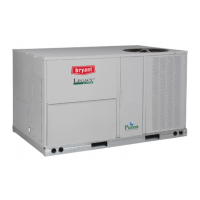
SINGLE PACKAGE ROOFTOP
STANDARD-EFFICIENCY HEAT PUMP UNITS
548D
Sizes 090-120
7
1
/
2
to 10 Tons


Questions and Answers

  • S
    Samantha RobertsAug 26, 2025
    Why does the compressor in my Bryant Heat Pump operate continuously?
    • Z
      zgibsonAug 26, 2025
      If your Bryant Heat Pump's compressor is running continuously, it could be due to a few reasons. You might have a dirty air filter, which needs replacing. Alternatively, the unit might be undersized for the load, so you should decrease the load or increase the unit size. The thermostat might be set too low, and you should reset it. A low refrigerant charge could also be the culprit, so locate the leak, repair it, and recharge the system. Other possibilities include leaking valves in the compressor, which would mean replacing the compressor, or air in the system, which requires recovering the refrigerant, evacuating the system, and recharging it. Finally, the outdoor coil might be dirty or restricted, requiring you to clean the coil or remove the restriction.
  • D
    Daniel BryanAug 28, 2025
    Why is the compressor in my Bryant Heat Pump cycling too often?
    • E
      Elizabeth ArnoldAug 28, 2025
      If the compressor in your Bryant Heat Pump cycles more than it should, it could be caused by a few things. It could be due to refrigerant overcharge or undercharge. In this case, you should recover the refrigerant, evacuate the system, and recharge it to the nameplate value. It may also be a sign of a defective compressor, which would need to be replaced. Other potential causes include insufficient line voltage, a blocked outdoor coil, a dirty air filter, a defective overload, a defective thermostat, or a faulty outdoor-fan (cooling) or indoor-fan (heating) motor or capacitor, all of which would need to be addressed or replaced. Lastly, a restriction in the refrigerant system could be the issue, which would require locating and removing the restriction.
  • M
    Mark WilliamsAug 30, 2025
    How to resolve excessive head pressure in my Bryant 548D Heat Pump?
    • K
      Kyle MortonAug 30, 2025
      If the head pressure in your Bryant Heat Pump is too high, it could be due to a dirty air filter, which you should replace. Another cause could be a dirty outdoor coil, so clean the coil. Also, the system might be overcharged with refrigerant, and you'll need to remove the excess refrigerant. Air in the system could also be the problem, requiring you to recover the refrigerant, evacuate the system, and recharge it. Lastly, the condensing air might be restricted or short-cycling, so determine the cause and correct it.
  • J
    Joshua HallSep 2, 2025
    What to do if my Bryant 548D's compressor won't start but the fan runs?
    • B
      Bryan RhodesSep 2, 2025
      If your Bryant Heat Pump compressor won't start but the outdoor fan runs, it might be due to faulty wiring or loose connections in the compressor circuit, in which case you should check the wiring and repair or replace it. Another possibility is that the compressor motor is burned out, seized, or has an internal overload open, requiring you to determine the cause and replace the compressor. A defective overload could also be the issue, so determine the cause and replace it. Lastly, one leg of the 3-phase power might be dead, so replace the fuse or reset the circuit breaker and determine the cause.
  • C
    Charles BarajasSep 4, 2025
    Why is the suction pressure too low in my Bryant Heat Pump?
    • C
      Charles CohenSep 4, 2025
      If the suction pressure in your Bryant Heat Pump is too low, it could be due to a dirty air filter (cooling) or a dirty outdoor coil (heating), so replace the filter or clean the coil. Another cause could be a low refrigerant charge, so check for leaks, repair them, and recharge the system. Also, the metering device or low side might be restricted, so remove the source of the restriction. Insufficient indoor airflow in cooling mode could also cause this, so increase the air quantity and check the filter, replacing it if necessary. The temperature might be too low in the conditioned area, so reset the thermostat. A field-installed filter drier might be restricted, so replace it. Finally, if the outdoor ambient temperature is below 25 F, install a low-ambient kit.
  • D
    Danielle ConnerSep 6, 2025
    What causes low head pressure in my Bryant 548D Heat Pump?
    • J
      Jacob SantiagoSep 6, 2025
      If the head pressure in your Bryant Heat Pump is too low, it could be due to a low refrigerant charge, so check for leaks, repair them, and recharge the system. Another potential cause is leaking compressor valves, which would require replacing the compressor. Lastly, there might be a restriction in the liquid tube, so remove the restriction.
  • E
    Edward GambleSep 8, 2025
    What causes excessive suction pressure in my Bryant 548D?
    • T
      Travis SmithSep 8, 2025
      If the suction pressure in your Bryant Heat Pump is excessively high, it could be due to a high heat load, so check for the source and eliminate it. Another cause could be leaking compressor valves, which would require replacing the compressor. Also, the system might be overcharged with refrigerant, so recover the excess refrigerant.
  • K
    Kristina CalhounSep 13, 2025
    What causes the economizer damper on my Bryant 548D to not close on power loss?
    • P
      Parker DiazSep 13, 2025
      If the economizer damper on your Bryant Heat Pump does not close on power loss, it could be due to insufficient battery power or an inoperative economizer control board. Check the voltage potential across the batteries. If it's lower than 14 vdc, replace the close-on-power-loss power supply (9-v alkaline batteries). Check this emergency power supply regularly or whenever the filters are changed. If the close-on-power-loss and economizer control board are functioning properly, check for 14 vdc or higher at the blue terminal of the economizer control board (blue wire) when power is disconnected from the unit. If 14 vdc is not present, replace the control board.
  • G
    gmoodySep 15, 2025
    Why won't compressor no. 2 run on my Bryant 548D?
    • J
      john50Sep 15, 2025
      If compressor no. 2 will not run on your Bryant Heat Pump, it may be because the unit is in economizer mode. This is proper operation, so no remedy is necessary.
  • H
    hernandezjenniferNov 18, 2025
    What to do if the damper on my Bryant 548D does not close?
    • J
      Jean GarciaNov 18, 2025
      If your Bryant Heat Pump's damper doesn't close, it could be due to incorrect economizer wiring. Verify that SW2 and SW4 are wired and working properly. Also, check diode D19; if it's not functioning properly, replace the economizer control board. Another cause could be incorrect damper actuator wiring or an inoperative economizer circuit board. After verifying the wiring is correct, modulate the damper to the minimum position and remove the calls for G. If the damper doesn't move, check for 24 vac at PL6-1 (red wire). If 24 vac is not present, check the wiring. If the damper still doesn't move, check for 24 vac at the blue terminal of the economizer control board (blue wire). If 24 vac is not present, replace the economizer control board. A further cause may be incorrect SAT wiring or an ...

Summary

Safety Considerations

Installation Steps

Step 1 - Provide Unit Support

Installing roof curb or slab mount for unit support.

Step 4 - Rig and Place Unit

Rigging, positioning, and leveling the unit on the roof curb or slab.

Step 5 - Make Electrical Connections

Connecting field power supply and internal wiring according to diagrams.

Step 7 - Adjust Indoor-Fan Speed

Adjusting indoor fan speed for proper airflow and static pressure.

Pre-Start-Up Procedures

Compressor Rotation

Verifying correct compressor rotation direction for proper operation.

Cooling Mode Operation

Procedures for starting and operating the unit in cooling mode.

Heating Mode Operation

Procedures for starting and operating the unit in heating mode.

Service and Maintenance

Cleaning Procedures

Instructions for cleaning indoor and outdoor coils, and condensate pan.

Refrigerant Charge

Procedures for checking and adjusting refrigerant charge using charts.

Troubleshooting Guide

Compressor and Outdoor Fan Will Not Start

Troubleshooting steps for when the compressor and outdoor fan fail to start.

Compressor Will Not Start But Outdoor Fan Runs

Diagnosing issues when the compressor won't start but the fan runs.

Scroll Compressor Makes Excessive Noise

Addressing issues causing excessive noise from the scroll compressor.

Start-Up Checklist

Pre-Start-Up Checks

Checklist of pre-start-up inspections for electrical, filters, and level.

Start-Up Readings

Recording electrical, temperature, and pressure readings during start-up.

Bryant 548D Specifications

General IconGeneral
Cooling Capacity2-5 tons
Heating Capacity2-5 tons
SmartSense TechnologyYes
Cooling Capacity (BTU/h)24, 000-60, 000
Heating Capacity (BTU/h)24, 000-60, 000
Voltage208/230V
Phase1
RefrigerantR-410A

Related product manuals