EasyManua.ls Logo

Bryant TSTATBBPQ501 - User Manual

Bryant TSTATBBPQ501
21 pages
Print Icon
To Next Page IconTo Next Page
Loading...
72
72
I2:00
SET
AM
Tu
USERS INFORMATION MANUAL
MODEL TSTATBBPQ501
5+2 DAY PROGRAMMABLE
DIGITAL THERMOSTAT
Heating & Cooling Systems
NOTE TO INSTALLER:
This manual must be left with the equipment user.
Meets California Title 24 Residential
next
run
off
set
prog
SINGLE STAGE HEAT & COOL
THERMOSTAT
5+2 DAY PROGRAMMABLE
Separate programs for
weekdays & weekends
Large, easy to read,
backlit digital display
Installation Flexibility
Batteries required for
4-wire operation
No batteries needed
for 5-wire operation
Question and Answer IconNeed help?

Do you have a question about the Bryant TSTATBBPQ501 and is the answer not in the manual?

Summary

Safety Warnings

Location of Controls

Display

Normal Operation

Manual Operation

Instructions for manual thermostat operation when the program switch is set to OFF.

Programmed Operation

Instructions for operating the thermostat using programmed settings when the program switch is set to RUN.

Clock Set

Time Period Programming

Overview

General guidance and prerequisites for setting up time period programs on the thermostat.

Weekday Programming

Detailed instructions for setting time periods and temperatures for Monday through Friday.

Weekend Programming

Detailed instructions for setting time periods and temperatures for Saturday and Sunday.

Advanced Setup

Battery Replacement

Warranty

Overview

This document is a user information manual for the Bryant Model TSTATBBPQ501 5+2 Day Programmable Digital Thermostat, a single-stage heat and cool thermostat.

Function Description

The Bryant TSTATBBPQ501 is a digital thermostat designed to control single-stage heating and cooling systems. Its primary function is to maintain desired indoor temperatures by automatically turning the heating or cooling system on and off according to a programmed schedule or manual settings. The "5+2 Day Programmable" feature indicates that it allows for separate programming for weekdays (5 days) and weekends (2 days), offering flexibility in managing comfort and energy consumption. The thermostat can operate in either heating or cooling mode, or be set to "off." It also includes a fan control, allowing the fan to run continuously ("on") or only when heating or cooling is active ("auto").

Usage Features

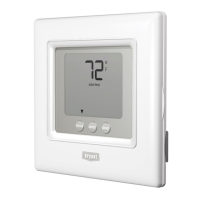
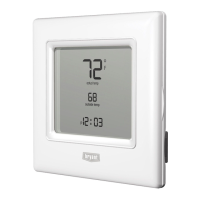
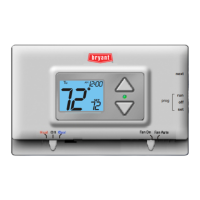
The thermostat features a large, easy-to read, backlit digital display, which shows the current time, day of the week, current room temperature, and the desired set temperature. When programming, it also displays time period indicators (Day, Morning, Night, Evening) to guide the user through the setup process.

For normal operation, the thermostat offers two primary modes:

  1. Manual Thermostat Operation (Program Switch OFF): In this mode, the thermostat functions as a non-programmable device. Users can manually select either heat or cool mode using the mode switch. The fan can be set to "auto" (running only with a heat or cool demand) or "on" (running continuously). The desired set temperature is adjusted directly using the Up or Down buttons. This mode is suitable for users who prefer to control their temperature settings manually without a schedule.

  2. Programmed Operation (Program Switch RUN): This is the core functionality of the 5+2 day programmable thermostat. Users select either heat or cool mode with the mode switch. The fan is typically left in "auto" mode for energy efficiency, but can be set to "on" for continuous operation. The thermostat will then follow the pre-set schedule for temperature control. An optional temporary override feature allows users to adjust the desired set temperature for a short period; the programmed settings will automatically resume in the next time period.

Programming Features:

The thermostat allows for detailed programming of temperature settings across four time periods per day: Morning, Day, Evening, and Night. This programming is done by sliding the program switch to the "SET" position.

  • Clock Set: The first steps in programming involve setting the current time and day. The Up and Down buttons are used to adjust the time (which can be slewed by 10-minute increments by holding the buttons) and the current day.
  • Time Period Programming: For each time period (Morning, Day, Evening, Night) and for both weekdays (MTuWThF) and weekends (SaSu), users can set:
    • A start time.
    • A cool setpoint (the maximum desired temperature when cooling).
    • A heat setpoint (the minimum desired temperature when heating). The "NEXT" button is used to advance through each programming step. It's crucial to program time periods in chronological order to ensure proper operation.
  • Exiting Programming: After programming is complete, users have two options:
    • Slide the program switch to "RUN" to activate the programmed schedule.
    • Slide the program switch to "OFF" to operate the thermostat manually, effectively disabling the programmed schedule.

Advanced Setup:

The advanced setup menu is typically accessed by the installer during initial installation, but users can access it by sliding the program switch to "SET" and then pressing the "NEXT" button for 5 seconds while the clock is flashing. This menu allows for customization of several operational parameters:

  • Deadband Adjustment: Users can adjust the temperature deadband from 1 to 6 degrees, which is the temperature range between when the heating and cooling systems will activate.
  • Cycles/Hour Adjustment: The number of cycles per hour can be set from 2 to 6. There's also an option for "no limit (zoning)" or "no compressor lockout."
  • Backlight Control: Users can choose to have the backlight always on ("YES") or turn off 8 seconds after a button press ("NO").
  • Temperature Scale: The thermostat can display temperatures in either degrees Celsius (C) or Fahrenheit (F). If Celsius is selected, two presses of the Up or Down buttons will be required to change the setpoint. To exit advanced setup, the program switch is moved to "OFF" or "RUN."

Maintenance Features

  • Battery Replacement: The thermostat requires two Alkaline "AA" batteries, which should be replaced at least once every 12 months to ensure proper operation. A "Low Battery" code ("Lb") will appear on the display when it's time to replace them.
    • To replace batteries, the thermostat housing needs to be opened. This involves inserting a small blade screwdriver into two designated slots on the top of the housing and rotating 90 degrees to release the snaps, then pulling the top forward and lifting the bottom out.
    • The manual emphasizes immediate battery replacement when the "Lb" code is displayed, especially in locations prone to freezing temperatures, as exhausted batteries can prevent the heat from turning on.
  • Power Source Flexibility: While batteries are required for 4-wire operation, they are not needed for 5-wire operation if the thermostat is connected to 24V power. However, installing batteries even with 24V power ensures the clock continues to run during line power interruptions.

The manual also includes a warranty section and a programming worksheet to assist users in planning their temperature schedules. The device meets California Title 24 Residential requirements.

Bryant TSTATBBPQ501 Specifications

General IconGeneral
BrandBryant
ModelTSTATBBPQ501
CategoryThermostat
LanguageEnglish

Related product manuals