
 To Next Page
А
АндрейSep 3, 2026
При включении вылезаед ошибка EO 1 и не сбрасывается. Можете подсказать в чем возможна причина данной неисправнгсти?

При включении вылезаед ошибка EO 1 и не сбрасывается. Можете подсказать в чем возможна причина данной неисправнгсти?
Place the instrument on a stable, horizontal plane and consider maximum dimensions. Use a fume hood for distillations.
Ensure socket voltage matches the instrument. Connect to an earthed socket and avoid sparks.
Instructions for placing the heating bath on the Rotavapor base plate and adjusting its position.
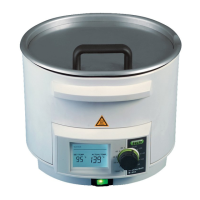
Details the B-495 heating bath delivery status and its function.
Guidance on setting the heating bath temperature and general cautions.
Explains the auto-heating function and emphasizes the need for heating medium.
Step-by-step instructions to change the heating bath mode from water to oil.
Step-by-step instructions to change the heating bath mode from oil to water.
Ensures the heating bath temperature cannot be changed during distillation.
Procedure to modify or disable the set temperature lock.
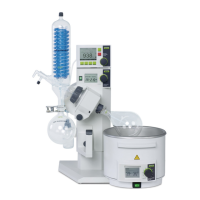
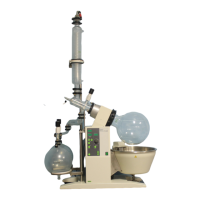
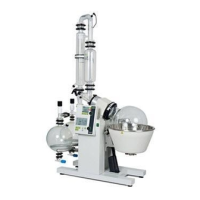
This document describes the installation, operation, and maintenance of a Rotavapor system, focusing on its heating bath components. The Rotavapor is designed for distillation processes, and its proper setup and use are crucial for safe and efficient operation.
The Rotavapor system facilitates distillation, a process used to separate components from a liquid mixture by selective evaporation and condensation. The core of this process involves a heating bath, which provides the necessary heat for evaporation. The system is designed to operate under vacuum, which lowers the boiling point of liquids, allowing for distillation at lower temperatures and preventing thermal degradation of sensitive compounds. The heating bath can be operated in two modes: water bath mode and oil bath mode, each suitable for different temperature ranges and applications.
The instrument should be placed on a stable, horizontal surface, taking into account its maximum product dimensions. For distillations under vacuum, it is recommended to place the Rotavapor under a fume hood to manage exhaust gases from the pump. If a fume hood is not available or space is limited, an optional protective shield can be mounted, and the exhaust gas should still be led into a fume hood.
Before connecting the instrument, it is essential to verify that the voltage of the electrical socket matches the voltage specified on the instrument's type plate. The instrument must always be connected to an earthed socket. External connections and extension cables should also be equipped with an earthed conductor lead (3-pole couplings, cable, or plug equipment) to prevent risks associated with defective wiring. Care must be taken to ensure no electric sparks form in or around the instrument, as this could cause damage.
The heating bath is placed on the base plate of the Rotavapor. Its position can be adjusted by lifting it slightly on the right-hand side and then pulling or pushing it to the desired location.
Several features are incorporated to save energy during heating bath operation. Using floating balls in the water bath significantly reduces water evaporation, which in turn means the bath heating switches on less frequently. This measure can save up to 50% of energy and approximately 70% less water. Additionally, a cover is available to place over the heating bath during operation, further conserving energy between distillations.
It is recommended to turn on the heating bath about 10–15 minutes before starting distillation to allow for a sufficient warm-up time. After distillation, the heating bath should be turned off.
The Heating Bath B-495 comes with a pre-mounted bath replenishment system. The function and water flux of this system are detailed in the manual.
The heating bath can reach temperatures up to 180 °C. To avoid burns, users should ensure that no liquid overflows from the bath when the evaporating flask is submerged. A rotating flask should never be removed from the bath, as splashing oil can cause burns. If a protective shield (optional accessory) is to be installed, it should only be done when the heating bath is cold.
The heating bath can operate in either water bath mode or oil bath mode. To switch from water bath mode to oil bath mode:
In oil bath mode, the bath must always be operated with oil as the heating medium. Water could boil and evaporate, leading to damage. If the oil bath has been left open for an extended period, condensation water may accumulate at the bottom. When reusing the bath, it must be heated above 100 °C with a rotating flask to drive out any water. A setting up to 180 °C is only possible in oil bath mode.
To switch from oil bath mode to water bath mode:
In water bath mode, the heating bath can be operated with either water or oil. A maximum setting of 95 °C is possible in water bath mode.
To prevent accidental temperature changes during distillation, a specific set temperature can be selected:
To change or switch off the set temperature:
Before each operation, the glassware must be inspected for any damages such as cracks, stars, or other imperfections. Only glassware in perfect condition should be used, as damaged glassware can break during operation.
It is crucial to ensure that there is always heating medium (water or oil, depending on the mode) in the bath. As soon as the power plug is connected and the mains switch is turned on, the bath will start heating if the actual temperature is below the set temperature. Operating the bath without heating medium can lead to instrument damage.
If the oil bath has been left open for a prolonged period, condensation water may accumulate at the bottom. Before reuse, it is necessary to heat the bath above 100 °C with a rotating flask to drive out any accumulated water.
The original packaging should be retained for future transportation of the instrument. In case of damages observed during unpacking, a status report should be prepared immediately and submitted to the postal, railway, or transportation company.
 General
| Heating Bath Material | Stainless Steel |
|---|---|
| Type | Rotary Evaporator |
| Rotational Speed | 20 - 280 rpm |
| Power Supply | 230 V, 50/60 Hz |
| Evaporation Flask Volume | 50 mL - 3 L |
| Vacuum System | Requires external vacuum pump |
| Material | Glass |