
 Need help?
Do you have a question about the Buffalo LinkStation 700 Series and is the answer not in the manual?
Information regarding FCC compliance for the device in the United States.
Explanation of warning symbols and icons used on the product for safety.
Essential safety guidelines to follow before operating the LinkStation.
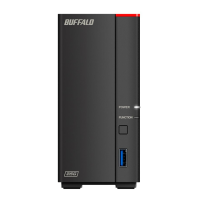
Visual representation of the LinkStation's components and ports.
Instructions for installing necessary software like NAS Navigator2.
Procedure for powering the LinkStation device on and off.
How to access the LinkStation's configuration interface via browser or mobile app.
Viewing system status, notices, and hardware information on the dashboard.
Remotely managing the LinkStation's power state via the settings interface.
Steps to create and manage shared folders on the LinkStation.
Process for adding, importing, and managing user accounts on the LinkStation.
Methods to set permissions for accessing shared folders.
Integrating the LinkStation with an Active Directory environment for centralized management.
Overview of RAID types supported by the LinkStation.
Procedures for managing RAID arrays, including creation and deletion.
Steps to format internal or external drives connected to the LinkStation.
Process to encrypt internal drives and arrays using AES encryption.
Setting storage limits for users and groups on the LinkStation.
Methods for backing up data from the LinkStation to various destinations.
Steps to configure a shared folder or USB drive as a backup destination.
Setting up automated backup tasks with specific sources and destinations.
Procedures for recovering backed-up data from the LinkStation.
How to configure the LinkStation for Time Machine backups from macOS.
Setting up synchronization between the LinkStation and Dropbox cloud storage.
Configuring backup and restore jobs with Microsoft Azure cloud storage.
Setting up synchronization between the LinkStation and Microsoft OneDrive cloud storage.
Accessing LinkStation files remotely via the WebAccess utility.
Enabling and configuring FTP access for remote file transfer to the LinkStation.
Enabling and configuring the DLNA server for media streaming.
Setting up specific folders to be accessible via DLNA.
Information on supported file types for DLNA streaming.
Operations like creating, moving, renaming, and deleting media files and folders.
Backing up LinkStation settings to USB and applying them to other devices.
Migrating settings from one Buffalo NAS device to another.
Resetting the LinkStation to its original factory default settings.
Preparing a USB drive to initialize LinkStation settings or recover the system.
Procedure to recover access if the administrator username or password is forgotten.
Enabling the LinkStation to be turned on remotely over the network.
Configuring SNMP for network monitoring and management.
Setting up proxy server configurations for network connectivity.
Optimizing network performance by configuring Jumbo Frames.
Manually configuring the LinkStation's IP address and network settings.
Setting up email alerts for LinkStation events like errors or status changes.
Configuring the LinkStation to enter a low-power sleep mode to save energy.
Connecting and configuring an UPS for automatic shutdown during power outages.
Securing communication with the LinkStation using SSL encryption.
Displaying, transferring, and managing system and file access logs.
Procedures for manually or automatically updating the LinkStation's firmware.
Configuring basic device identification and time synchronization.
Setting up audible alerts for specific LinkStation events.
Adjusting the brightness of the LinkStation's LED indicators.
Step-by-step guide for replacing a failed hard drive in the LinkStation.
Procedure for replacing a drive that is not malfunctioning.
Procedure to manually repair the LinkStation's firmware if automatic recovery fails.
Explains the meaning of different LED patterns and their corresponding corrective actions.
Lists the default configuration values for various LinkStation features.
Technical details and hardware specifications of the LinkStation device.
 General
| Interface | Gigabit Ethernet (10/100/1000 Mbps) |
|---|---|
| DLNA Certified | Yes |
| Category | NAS (Network Attached Storage) |
| RAID Support | RAID 0, RAID 1 |
| File System | EXT4 |
| Protocols | SMB/CIFS, AFP, FTP, NFS |
| Operating Temperature | 5-35°C |
| Operating Humidity | 20% to 80% (non-condensing) |
| Compatible OS | macOS |
| Storage Capacity | 4TB, 6TB, 8TB |
| Drive Type | Hard Disk Drive (HDD) |


 To Next Page