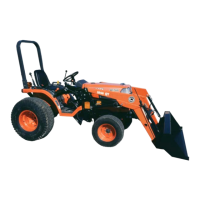
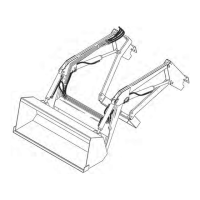
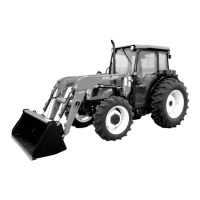
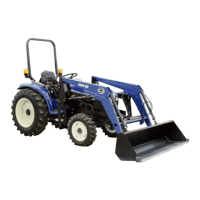
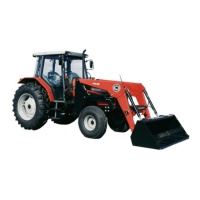
The Bush Hog Front End Loader, available in 1846 QT and 2246 QT models, is an agricultural implement designed for attachment to two-wheel drive and four-wheel drive tractors. Its primary function is to facilitate the lifting and movement of loose materials, typically using a bucket attachment. The loader is engineered for maximum service with minimal downtime, emphasizing ease of operation and maintenance.
Function Description:
The Bush Hog Front End Loader serves to extend the utility of a tractor by providing a robust mechanism for material handling. It is primarily intended for lifting and transporting loose materials such that they can be contained within the bucket. The loader features double-acting cylinders, which allow for both pushing and pulling actions, providing precise control over the boom and bucket movements. An integrated bucket level indicator is a key feature, enabling the operator to gauge the bucket's position accurately even when the bucket itself is not directly visible. This enhances efficiency and safety during loading and dumping operations. The design also incorporates parking stands, which simplify the attachment and detachment process by allowing the tractor to be driven into or out of the loader's frame. The loader's hydraulic system is crucial to its operation, providing the power for all lifting, lowering, and tilting functions. It is designed to integrate with the tractor's hydraulic system, and proper connection and purging of air are essential for smooth and efficient performance.
Usage Features:
Operating the Bush Hog Front End Loader requires familiarity with both the tractor and the loader controls. The manual emphasizes the importance of reading and understanding all safety messages and operating instructions before use. For optimal stability, it is recommended that the tractor be equipped with a Rollover Protective System (ROPS) and that a seat belt be used during all loader operations. Additionally, applying weight to the tractor's rear wheels or using a three-point hitch mounted weight is advised to increase stability, especially when handling heavy loads. The tractor's wheels should be set to their widest recommended settings.
When attaching the loader, the tractor is slowly driven onto the loader, hydraulic hoses are connected to the tractor's auxiliary outlets, and the boom cylinders are carefully extended or retracted to align the cross tube with the front mounting brackets. Once aligned, the cross tube is seated in the front bracket and secured with a pin. The rear subframe of the loader is then lowered and seated on the rear brackets, ensuring equal spacing on both sides, and secured with a cuff. After attachment, the parking stands are removed and stored.
During operation, the tractor engine should run at a moderate RPM (1200-1700 rpm) to prevent excessive speed, which can be dangerous and cause spillage or strain on the equipment. The bucket level gauge rod assists in maintaining a level bucket, which is critical for efficient loading and increased breakaway effort. When filling the bucket, the operator should approach the pile with a level bucket, then ease the lever back to lift and rollback the bucket. For transporting loads, the bucket should be kept as low as possible to maintain stability and visibility, especially when traveling over rough terrain or on slopes. Dumping the bucket involves lifting it high enough to clear the target vehicle and then tilting it to release the material. The float control position is useful for hard surface operations, allowing the bucket to follow the contour of the ground without exerting excessive down pressure, which can cause premature wear. Sidecutting and building ramps are suggested techniques for breaking down large piles.
Detaching the loader involves reversing the attachment steps: installing parking stands, lowering the boom, extending bucket cylinders to firmly ground the bucket's cutting edge, removing pins and clamps, and carefully rolling back the bucket and activating boom cylinders to free the cross tube. Hydraulic hoses are then disconnected, and the tractor is backed out. It is crucial to complete the tractor's hydraulic circuit after disconnecting the loader to prevent pump damage.
Maintenance Features:
Regular maintenance is vital for the longevity and safe operation of the Bush Hog Front End Loader. A maintenance checklist outlines routine inspections and tasks. Before each use, operators should inspect hydraulic lines and fittings for wear or leaks, check all pivot pins for wear and ensure cotter pins are in place, and verify the tightness of all bolts. Lubrication is a critical aspect of pre-use maintenance, requiring the application of multi-purpose grease to boom pivot pins, boom cylinders, bucket cylinders, and bucket pivot pins. After lubrication, the boom and bucket cylinders should be cycled two or three times, and the tractor hydraulic oil level checked.
After each use, the machine should be cleaned of all debris. The manual also provides troubleshooting procedures for common issues such as slow loader operation, chatter or vibration, pump noise, oil leaks, insufficient lift capacity, excessive bucket wear, slow leakdown, and inoperative controls. These procedures guide the operator in identifying possible causes and remedies, such as changing hydraulic oil, cleaning or replacing filters, checking hose connections, replacing seals, or repairing components. For complex issues or replacement parts, contacting an authorized Bush Hog dealer is recommended. When storing the loader for extended periods, it should be cleaned, lubricated, and exposed cylinder rods should be coated with heavy grease to prevent rusting. Safety decals are provided on the machine, and their readability should be maintained; replacements are available from Bush Hog.



 To Next Page
 General