
 Need help?
Do you have a question about the California Air Tools 20040C and is the answer not in the manual?
Guidance on checking the unit for damage before use.
Details on voltage, circuit, and grounding.
Recommendations for using extension cords safely and effectively.
Procedure for the initial operation and check of the compressor.
Steps for starting and operating the air compressor daily.
Instructions for removing moisture from the air tank.
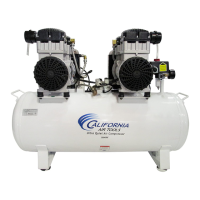
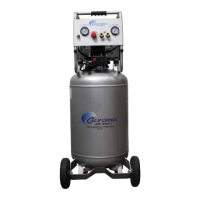
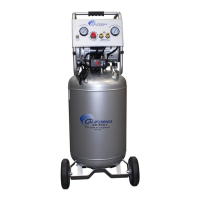
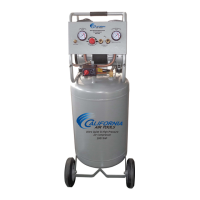
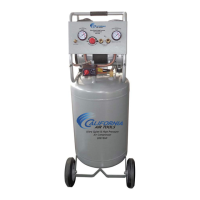
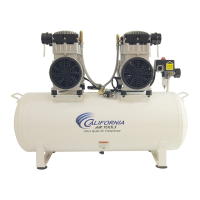
The California Air Tools 20040C is an ultra-quiet and oil-free air compressor designed for a variety of applications requiring clean, pressurized air. Its primary function is to compress ambient air and store it in a tank for later use by air-powered tools or other equipment. The "oil-free" designation means it does not require lubrication for its internal components, which eliminates the need for oil changes and ensures that the delivered air is free of oil contaminants, making it suitable for sensitive applications. The "ultra-quiet" feature indicates that it operates at a significantly lower noise level compared to traditional air compressors, enhancing user comfort and allowing for use in environments where noise reduction is important.
The compressor is designed for straightforward operation, starting with a pre-operation checklist to ensure safety and proper setup. Before initial use, users are instructed to install the four air filters into the motor heads. These filters are crucial for preventing dust and particulates from entering and damaging the compressor, as well as reducing operational noise. The manual emphasizes the importance of inspecting the compressor for any damage before use and saving the original packaging for potential service or repair returns.
For optimal performance, the compressor should be placed on a flat surface with an incline no greater than 15 degrees, ensuring stability. Adequate airflow around the machine is critical, with at least 2 feet of obstacle-free space recommended to prevent overheating. Operating the compressor in areas with clean air is also highlighted as essential for its longevity and proper function, as dust and particulates can damage the motor.
The electrical power requirements specify a dedicated 220 Volt, 60 Hertz circuit. Users are warned against using undersized or excessively long extension cords (more than 25 feet or thinner than 14 gauge), as this can lead to voltage drop, power loss, and motor overheating. Only 3-wire extension cords with a 3-blade grounding plug should be used, and adapters are explicitly prohibited. The product must be properly grounded to prevent electric shock.
A test run is recommended before the first use. This involves plugging in the compressor, turning it on, and allowing the air tank to fill until the pressure switch automatically turns off the motor, typically between 120-125 PSI. This confirms normal operation. If an air leak is detected during this test, users are advised to turn off the power, release air from the tank, unplug the unit, and contact customer support.
Daily operation involves turning the power switch to the OFF position, attaching the air hose to the 1/4" coupler, closing the drain valve, plugging in the power cord, and then turning the power switch to the ON position. The motor will run until the tank is full, after which air tools can be operated. An adjustable regulator allows users to control the air pressure delivered to the hose and air tools. To shut down the compressor, the power switch is turned OFF, the power cord is unplugged, and the pressure in the air tank is reduced via the air supply hose.
Safety is a paramount concern, with numerous warnings provided. Users are cautioned about the risk of cutting from moving parts, electric shock, flying objects, hot surfaces, fire, and explosion. Specific instructions include keeping hands and feet away from rotating parts, wearing approved head and eye protection, never pointing the air stream at people or animals, and maintaining a safe distance from flammable items. The compressor's motor and pressure switch can produce sparks, necessitating operation in well-ventilated areas away from gasoline or solvent vapors. Surfaces of the air compressor, especially the cylinder head and delivery pipe, become hot during operation, and users are advised to allow the unit to cool down before touching it or placing a storage cover on it. Pressurized air can cause injury, so only high-pressure hoses, fittings, and couplings designed for air compressors should be used, and these should be regularly inspected for leaks and wear. The air tank should never be left under pressure when performing maintenance, and the compressor should not be left unattended with the power supply in use and the air hose connected.
Regular maintenance is crucial for the longevity and efficient operation of the California Air Tools 20040C. One of the most important maintenance tasks is draining the air tank. The frequency of draining depends on environmental conditions and operating time, but daily draining is recommended to prevent moisture buildup, which can lead to rust and corrosion. Rust can weaken the air tank, causing leaks or bursting, and if detected, the tank must be replaced immediately without any attempts at repair or modification. To drain the tank, the compressor should be placed over a container, and the drain valve at the bottom of the air tank should be slowly turned to the open position until all accumulated water has drained out. The valve should then be closed to prevent leakage.
Changing the air filter is another essential maintenance task. The air filters are designed to reduce noise and prevent particulates from entering the compressor. Over time, these filters become clogged, which reduces air intake capabilities and impairs performance. Therefore, the air filter elements must be replaced regularly. The process involves opening the lid of the air filter, removing the old element, replacing it with a new one, and closing the lid.
Cleaning the air compressor is also recommended to maintain performance. This can be done with a soft brush or a moistened cloth using a biodegradable solvent. Flammable liquids like gasoline or alcohol should not be used for cleaning. Keeping the parts clean from dirt and dust ensures better overall performance.
Testing for leaks is important to maintain the compressor's efficiency. Even small leaks in hoses or pipe connections can reduce performance. To check for leaks, users can spray soapy water on suspected areas; if bubbles appear, the broken part should be replaced.
For prolonged storage, several steps should be followed: turn off the power supply, disconnect the power cord, pull the relief valve to release all pressure from the air tank, clean the compressor to remove dirt and dust, and cover it to protect against dust and moisture. Stacking or storing items on top of or around the compressor is discouraged to prevent damage.
The manual also includes a troubleshooting guide to help users diagnose and resolve common issues such as pressure drop in the tank, the compressor not starting or making humming noises, noisy operation, or failure to reach maximum pressure. Solutions range from tightening connections and checking electrical supply to replacing specific components like the starter capacitor or contacting customer support for more complex problems.
 General
| Motor | 1.0 HP |
|---|---|
| Horsepower | 1.0 HP |
| Max Pressure | 120 PSI |
| CFM at 90 PSI | 2.20 CFM |
| Pump Type | Oil-Free |
| CFM @ 40 PSI | 3.00 CFM |
| Noise Level | 60 dBA |
| Voltage | 110-120V |
| Amperage | 8.5 amps |
| Phase | Single Phase |
| Tank Size | 4.0 gallons |
| Air Delivery | 2.20 CFM |

 To Next Page