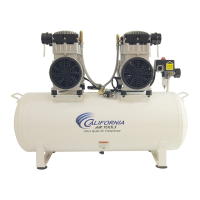
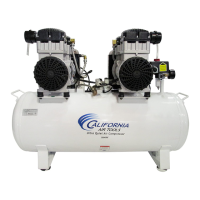
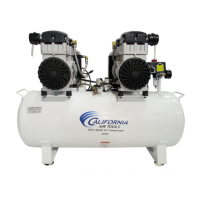
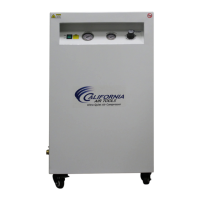
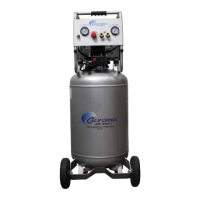
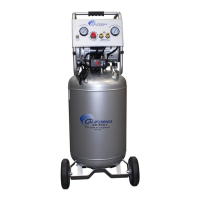
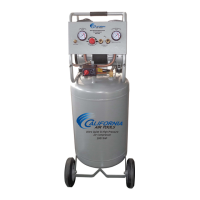
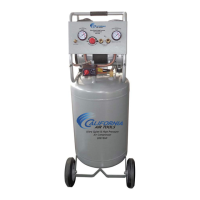
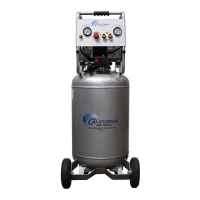
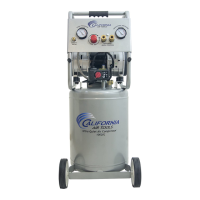
This document serves as the owner's manual for a California Air Tools Ultra Quiet & Oil Free Air Compressor, model 20040CAD. It provides comprehensive instructions for safe operation, assembly, maintenance, and troubleshooting of the device.
Function Description:
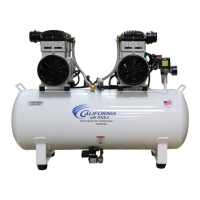
The California Air Tools 20040CAD is an air compressor designed to provide ultra-quiet and oil-free compressed air. Its primary function is to store pressurized air in a 20-gallon steel tank, which can then be used to power various air tools. The compressor features a 4.0 HP motor operating on 220 volts and 60 hertz. A key characteristic is its oil-free design, meaning the air produced is free from oil contaminants, making it suitable for applications requiring clean air. The motor directly drives the pistons, eliminating the need for lubrication or oil for extended periods. This design contributes to its low maintenance requirements and stable performance. The compressor is equipped with a pressure switch that automatically turns the motor off when the tank reaches its maximum pressure (120-125 PSI) and restarts it when the pressure drops, maintaining a consistent air supply. Safety features include a safety valve to prevent over-pressurization and a grounding plug to reduce the risk of electrical shock.
Usage Features:
Before initial use, a pre-operation checklist and test run are recommended. The assembly involves screwing four air filters into the motor heads. For operation, the compressor should be placed on a flat surface with adequate airflow (at least 2 feet of obstacle-free space) and in an area with clean air to prevent damage to the motor. It requires a dedicated 220 Volt 60 Hertz circuit. The manual emphasizes the importance of using undamaged electrical cords and avoiding operation in wet conditions to prevent electric shock. When using extension cords, specific guidelines must be followed: they should be no more than 25 feet long, at least 14 gauge, and be 3-wire cords with a 3-blade grounding plug. Undersized or excessively long cords can cause voltage drop, power loss, and motor overheating.
To start the compressor, the power switch is turned to the OFF position, the air hose is attached to the 1/4" coupler, the drain valve is closed, and the power cord is plugged into a socket. Then, the power switch is turned ON, allowing the tank to fill until the motor turns off automatically. Air pressure to the hose and air tool can be regulated using the regulator knob. To shut down, the power switch is turned OFF, the power supply cord is unplugged, and the pressure in the air tank is reduced through the air supply hose.
Safety precautions are highlighted throughout the manual. Users are warned about the risk of cutting from moving parts, electric shock, and flying objects propelled by air-powered equipment. Head and eye protection are mandatory. The air stream should never be pointed at people or animals. The compressor should not be moved when the air tank is under pressure. Surfaces of the air compressor, particularly the cylinder head, cooling fins, and delivery pipe, become hot during operation, posing a burn risk. Users are advised to allow the unit to cool down before touching hot surfaces or placing a storage cover on it. Caution is also advised regarding fire and explosion risks, as the motor and pressure switch can produce sparks that may ignite flammable materials. The compressor should be operated a safe distance from flammable items in well-ventilated areas, and the maximum rated pressure should never be exceeded.
Maintenance Features:
Regular maintenance is crucial for the longevity and proper functioning of the air compressor.
- Draining the Air Tank: This is recommended daily or after each use to prevent moisture buildup, which can lead to rust and corrosion, weakening the tank and potentially causing leaks or bursting. The drain valve, located at the bottom of the air tank, should be slowly opened to release accumulated water and then closed to prevent leakage.
- Changing the Air Filter: The air filters reduce noise and prevent particulates from entering and damaging the compressor. Over time, filters become clogged, reducing air intake and performance. They must be replaced regularly by opening the lid, removing the old element, and inserting a new one.
- Testing for Leaks: Small leaks in hoses or pipe connections can impair performance. Leaks can be detected by spraying soapy water on suspected areas; if bubbles appear, the faulty part should be replaced.
- Cleaning: The compressor should be cleaned with a soft brush or a moistened cloth using a biodegradable solvent. Flammable liquids like gasoline or alcohol should not be used. Keeping parts clean from dirt and dust ensures better performance.
- Storage: Before prolonged storage, the power supply should be turned off, the power cord disconnected, and all pressure released from the air tank via the relief valve. The unit should be cleaned of dirt and dust and covered to protect it from dust and moisture. No items should be stacked on or around the compressor to prevent damage. The compressor should be stored indoors and not exposed to rain to reduce the risk of electric shock.
The manual also includes a troubleshooting section to address common issues such as pressure drop, motor not starting, noisy operation, or failure to reach maximum pressure, providing possible causes and solutions.


 To Next Page
 General