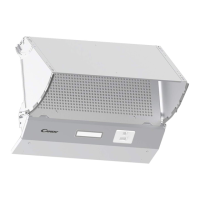
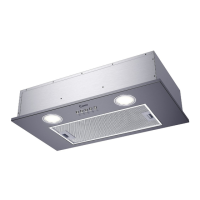
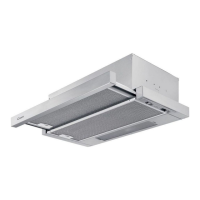
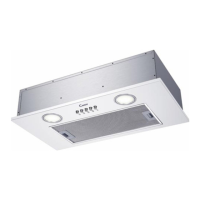
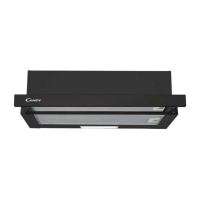
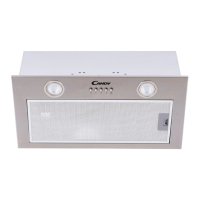
This document provides an instruction manual for the CBP613NGR/S Cooker Hood, detailing its installation, operation, troubleshooting, and maintenance.
The cooker hood is designed for domestic use to extract fumes and odors from the kitchen during cooking. It operates by drawing air from the cooking area and discharging it either to the outside (extraction mode) or filtering it and recirculating it back into the room (recirculation mode, if equipped with carbon filters). The appliance helps to maintain a cleaner and more pleasant kitchen environment by removing airborne grease, combustion products, smoke, heat, and steam.
Usage Features:
The cooker hood features a toggle switch control panel for easy operation. It includes a light control to illuminate the cooking surface and a speed control for the fan. The fan offers three power settings: Low, Mid, and High, allowing users to adjust the extraction intensity based on their cooking needs. The light can be operated independently of the fan.
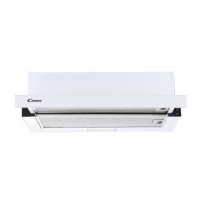
To operate the hood, the front panel needs to be pulled up, and then the desired fan speed can be selected using the slide switch. To turn the unit off, users can either switch off the fan with the slide switch or push down the front panel. If the front panel is pushed down while the fan is still on, the hood will turn off, and the fan speed setting will be retained for the next use.
Installation:
The cooker hood is designed for installation between two cupboards, typically above a cooking surface. For optimal efficiency, it should be placed at a height of 65-75 cm above the cooking surface. If installed above a gas appliance, the minimum distance must be at least 65 cm. The installation process involves drilling and screwing the unit to the sideboards of the cupboards, ensuring the screws are securely fixed. The fan-shaped door frames are then pushed into place, aligning their outer edges with the cupboards. The outlet for air discharge is installed by aligning and inserting its edges into the blower's slots. The manual also provides instructions for installing the door, which should be between 16mm thick, 385-700mm high, and weigh no more than 7KG. The door's sliding mechanism can be adjusted using screws on both sides of the hood to accommodate its weight. Finally, an adjusting plate is installed to cover any gap between the wall and the bottom of the cooker hood.
For external venting, the hood connects to an extraction duct (120mm interior diameter) made of enamel, aluminum, flexible pipe, or non-flammable material, which leads to an outside outlet. Proper ventilation measures must be observed, especially when the hood is in extraction mode, to ensure adequate air supply in the room.
Safety Instructions:
Several safety precautions are highlighted. It is crucial to always switch off the electricity supply at the mains during installation and maintenance. All installation work must be performed by a competent person or qualified electrician. The packing material should be disposed of carefully, as children are vulnerable to it. Users should pay attention to sharp edges inside the cooker hood during installation and cleaning. The ducting should not have bends sharper than 90 degrees to maintain efficiency. Failure to install screws or fixing devices correctly can lead to electrical hazards. Before accessing terminals, all supply circuits must be disconnected.
Users are advised not to use the cooker hood without grease filters or with excessively greasy filters. It should not be installed above a cooker with a high-level grill. Frying pans should not be left unattended, as overheated fats or oils can catch fire. Naked flames should never be left under the cooker hood. If the hood is damaged, it should not be used. Flambéing under the hood is prohibited. Accessible parts may become hot during operation, so caution is advised. The air must not be discharged into a flue used for exhausting fumes from other gas or fuel-burning appliances.
When cooking on a gas cooker, lids should always be placed on pots and pans. Adequate room ventilation is necessary when the cooker hood is used simultaneously with other gas or fuel-burning appliances. The cooker hood is strictly for domestic use. If the supply cord is damaged, it must be replaced by the manufacturer, its service agent, or similarly qualified persons. Children aged 8 years and above, and persons with reduced physical, sensory, or mental capabilities, can use the appliance if supervised and instructed on safe use and understanding of hazards. Children should not play with the appliance, and cleaning/user maintenance should not be performed by children without supervision.
The appliance and its accessible parts can become hot during operation; children under 8 should be kept away unless under constant supervision. There is a fire risk if cleaning is not carried out according to instructions. Regulations regarding air discharge must be followed. Only the recommended size of fixing or mounting screws should be used. When the cooker hood and non-electric appliances operate simultaneously, the negative pressure in the room must not exceed 4 Pa. Items should not be stored on cooking surfaces due to fire risk. A steam cleaner must not be used. In case of fire, never use water; switch off the appliance and cover the flames with a lid or fire blanket.
Maintenance Features:
Regular maintenance and cleaning are essential for the cooker hood's longevity and efficient operation. Before any maintenance or cleaning, the cooker hood must be disconnected from the mains power supply and switched off at the wall socket.
General Cleaning: Cleaning should be performed when the appliance is cold. Alkaline or acid substances (like lemon juice or vinegar) should be avoided on the surfaces.
Stainless Steel: Stainless steel surfaces should be cleaned regularly (e.g., weekly) with a clean, soft cloth. A specialized stainless steel cleaning fluid can be used. Wiping should be done along the grain of the stainless steel to prevent crisscross scratching.
Control Panel Surface: The inlay control panel can be cleaned with warm soapy water and a well-wrung, clean cloth. Any excess moisture should be removed with a dry soft cloth. Neutral detergents should be used, avoiding harsh cleaning chemicals, strong household detergents, or abrasive products, as these can damage the appearance and printing on the control panel, voiding the warranty.
Grease Mesh Filters: The mesh filters can be cleaned by hand. They should be soaked in water with a mild detergent for about 3 minutes, then gently brushed with a soft brush. Excessive pressure should be avoided to prevent damage. The filters should be washed separately from crockery and kitchen utensils, and rinse aid should not be used. After washing, they should be left to dry naturally, away from direct sunlight.
To install grease mesh filters, angle the filter into the slots at the back of the hood, push the button on the handle, and release the handle once the filter is in a resting position. This process is repeated for all filters.
Carbon Filter (Optional): Activated carbon filters are used to trap odors. They typically need to be changed every three to six months, depending on cooking habits. To install a carbon filter, the aluminum filter must first be detached. The carbon filters are then attached to each end of the motor housing by rotating them to lock/undo. It is crucial to ensure the filter is securely locked to prevent it from loosening and causing danger. When an activated carbon filter is attached, the suction power of the hood will be lowered.
Bulb Replacement: The bulb must be replaced by the manufacturer, its service agent, or similarly qualified persons. Before changing the light, the cooker hood must be isolated from the supply mains. Always switch off the electricity supply. When handling bulbs, ensure they have completely cooled down and hold them with a cloth or gloves to prevent perspiration from reducing their life. The light can be pried up with a suitable screwdriver for replacement. The specific LED modules are rectangle LED lamps with a max wattage of 1x2 W and a voltage range of AC 110-240V.
Environmental Protection: The product is marked for selective sorting of waste electronic equipment, indicating it should not be disposed of with household waste. Instead, it should be supported by a selective collection system in accordance with Directive 2012/19/EU for recycling or dismantling to minimize environmental impact. Users should contact local or regional authorities for more information on disposal.
To reduce the total environmental impact (e.g., energy use) of the cooking process, users are advised to install the cooker hood in a place with efficient ventilation, clean it regularly to prevent airway blockage, and remember to switch off the cooker hood light and the hood itself after cooking. The appliance should not be dismantled by the user; at the end of its life, it should be recycled according to local authority advice.



 To Next Page
 General