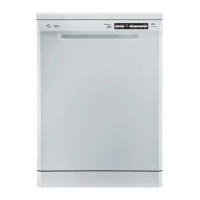
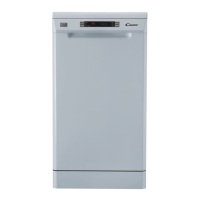
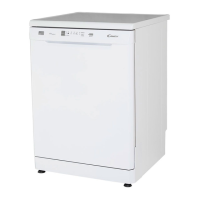
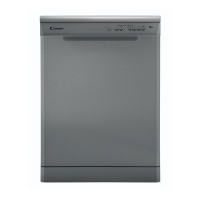
This document is a user manual for a Candy dishwasher, specifically models CDP 2D947W and CDP 2D947X. It provides comprehensive instructions for operation, maintenance, and troubleshooting.
The dishwasher is designed for household use and similar applications, including staff kitchen areas, farmhouses, hotels, motels, and bed and breakfast establishments. It can be used by children aged 8 years and above and persons with reduced physical, sensory, or mental capabilities if they have been given supervision and understand the associated hazards. The appliance is for indoor use only.
Function Description
The Candy dishwasher is an automatic appliance designed to clean dishes, cutlery, and cookware. It features various wash cycles tailored to different levels of soiling and types of items. The appliance includes a water softener system to remove minerals and salts from hard water, preventing deposits on dishes and utensils. It also uses rinse aid, automatically released during the last rinsing cycle, to help dishes dry quickly and prevent spots and stains.
The dishwasher operates through a control panel with buttons for power, program selection, delay start, and an Express option. A display screen shows the selected program, remaining time, and error codes. Indicators for rinse aid and salt levels alert the user when refills are needed.
Usage Features
- Quick Operation Guide: The manual provides a quick guide for common tasks like switching on, filling detergent, checking rinse aid and salt levels, loading baskets, selecting a program, and starting a wash.
- Program Selection: Users can choose from several wash cycles, including Intensive (for heavily soiled items), Normal (for normally soiled loads), ECO (a standard program for normally soiled tableware, optimized for energy and water consumption), Glass (for lightly soiled loads not requiring excellent drying), Daily (a shorter wash for lightly soiled loads), Rapid (for lightly soiled loads not needing excellent drying), and Soak (a prewash for lightly soiled loads).
- Delay Start: The dishwasher allows users to set a delayed start time from 1 to 24 hours.
- Half-Load Function: The dishwasher includes a half-load function, though its specific activation method is not detailed in the provided pages.
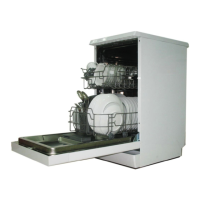
- Loading Baskets: The appliance features upper and lower baskets, along with a cutlery rack. The upper basket is designed for delicate and lighter items like glasses, cups, and small bowls, while the lower basket accommodates larger and more difficult-to-clean items such as pots, pans, and serving dishes. The height of the upper basket can be adjusted to create more space. Folding spikes in both baskets allow for flexible loading of pots and pans. Cutlery should be placed separately in the rack, with sharp points facing down.
- Detergent and Rinse Aid: The dishwasher requires specific detergents (powder, liquid, or tablet form) designed for automatic dishwashers. The detergent dispenser is located inside the door. Rinse aid is essential for effective drying and preventing spots; its dispenser is also located inside the door, and the amount dispensed can be regulated from 1 to 6 positions based on water hardness.
- Salt System: For models with a water softener, dishwasher salt must be added to a dedicated container located beneath the lower basket. The salt consumption can be adjusted based on the local water hardness. A salt warning light indicates when a refill is needed.
- Adding Forgotten Dishes: Dishes can be added during a wash cycle before the detergent cup opens. The user needs to open the door slightly, wait for the spray arms to stop, add the dishes, and then close the door to resume the cycle.
- Changing Programs: A running cycle can be modified if it has been running for a short time. If detergent has already been released or water drained, the detergent dispenser must be refilled.
Maintenance Features
- Filtering System: The dishwasher has a three-part filtering system (main filter, coarse filter, and fine filter) to prevent food particles from entering the pump. These filters must be cleaned regularly to ensure optimal performance. The manual provides step-by-step instructions for removing and cleaning the filter assembly.
- Caring for the Dishwasher:
- Control Panel and Exterior: The control panel can be cleaned with a lightly dampened cloth and dried thoroughly. A good appliance polish wax can be used for the exterior. Sharp objects, scouring pads, or harsh cleaners should be avoided.
- Door: The edge around the door should be cleaned with a soft, warm, damp cloth. Spray cleaners should not be used on the door panel to avoid damage to the door lock and electrical components. Abrasive agents or paper towels should also be avoided to prevent scratching.
- Spray Arms: The spray arms need regular cleaning to prevent clogging from hard water chemicals. Instructions are provided for removing and cleaning both the upper and lower spray arms.
- After Every Wash: After each wash, the water supply should be turned off, and the door left slightly ajar to prevent moisture and odors from being trapped.
- Long Periods of Non-Use: If the dishwasher will not be used for a long time, it is recommended to run an empty wash cycle, remove the plug, turn off the water supply, and leave the door slightly open to preserve door seals and prevent odors.
- Seals: Periodic cleaning of the door seals with a damp sponge helps prevent food from getting trapped and causing odors.
- Frost Protection: In winter, measures should be taken to protect the dishwasher from frost, including cutting off electrical power, turning off and disconnecting the water supply, draining water from the inlet pipe and valve, and soaking up water from the sump.

 Need help?
 General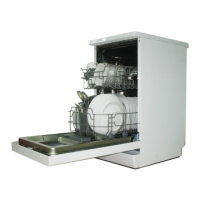

 To Next Page