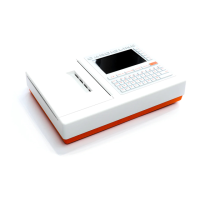
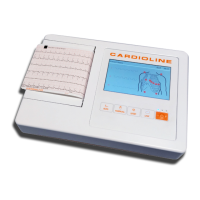
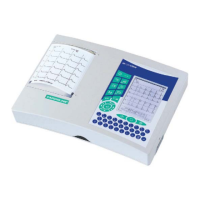
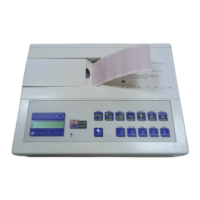
The CARDIOLINE® DELTA 1 Plus is a digital electrocardiograph designed for recording and analyzing ECG signals. It is available in both a base version and an interpretive "I" version, with the latter offering advanced analysis and interpretation features.
Function Description
The device performs electrocardiographic examinations, recording 12 standard leads continuously and simultaneously. It offers various operating modes:
- AUTO 1 Mode: Records single 12 leads sequentially in real-time.
- AUTO 2 Mode: Records 12 leads in a 3-channel format, with leads grouped for synchronous recording.
- MANUAL Mode: Allows continuous, real-time recording of any of the 12 leads, with the ability to modify recording parameters (speed, sensitivity, filters) and change leads during recording.
- AUTO ARRHYTHMIAS Mode (Interpretive Version): Records SPARE leads continuously upon arrhythmia detection, capturing data from 5 seconds before the event.
- AUTO CP/I Mode (Interpretive Version): Records 12 leads in a 3-channel format, followed by a complete analysis of the trace, including averaged complex, measurement tables, patient data, global measures, and interpretation commentary.
The interpretive version also includes an "INTERPRETATION function" that performs analysis on ECGs stored in the buffer memory, providing suggestions for interpretation or diagnosis based on the CARDIOLINE Interpretive Software, developed according to European Standard SCP Indications. However, these suggestions must always be checked and validated by a specialist physician.
The device features a liquid crystal display (LCD) for showing operative status, alarm messages, and various information such as recording mode, memory status, battery status, heart rate, sensitivity, speed, and active filters. A control keyboard allows for text entry (in the "I" version), mode selection, copy printing, freezing and storing ECGs, and accessing the MENU for setup and auxiliary programs.
Important Technical Specifications
- Lead: 12 standard leads with continuous and simultaneous acquisition.
- Channels: 1/3.
- Recording Modes: 2 automatic programs; 1 manual program. Interpretive version adds 1 automatic program for arrhythmia detection and 1 interpretation program.
- Writing System: Thermal head 8 dot/mm.
- Recording Paper: Thermosensitive in roll or Z-Fold of 60 mm x 30 m.
- Recording Speed: 6.25, 12.5, 25, 50 mm/s.
- Sensitivity: 5, 10, 20 mm/mV.
- LCD Display: Alphanumeric display for operative status and alarm messages.
- Digital Filters: 50/60 AC filter, 0.5 Hz anti-drift filter, 3 muscular filters.
- Input-Output: Serial interface RS-232; 2 aux DC input (0.25 - 0.5 - 1 V/cm); 3 aux output (0.25 - 0.5 - 1 V/mV).
- Frequency Response: 0.05 - 120 Hz (-3 dB).
- Time Constant: > 3.2 s.
- C.M.R.R.: > 100 dB.
- Input Impedance: > 100 MΩ.
- Leakage Current: < 10 μA.
- Defibrillation Protection: According to IEC 601-1 requirements.
- Power Supply: 230 V ±10%, 50 Hz or 115 V ±10%, 60 Hz; built-in rechargeable accumulators with selectable automatic switch-off.
- Fuses: 2 fuses type T250 mA, 5x20 mm (230 V) or 2 fuses type T500 mA, 5x20 mm (115 V).
- Power Consumption: 30 VA.
- Autotest: Functions test and printer test.
- Safety Regulations: IEC 601-1 & 62D-17 / class I type CF.
- Dimensions: 313 x 239 x 61 mm.
- Weight: 2 Kg.
Usage Features
- Patient Preparation: Ensure the patient is relaxed, remove all metal objects, and clean the skin thoroughly before electrode application.
- Electrode Application: Apply sufficient conductive gel and secure electrodes with rubber straps to ensure good skin contact.
- Interference and Artifacts: The manual details common disturbances like A.C. interference, muscular tremor, and baseline drift, providing guidance on identifying and resolving their causes. Filters (Notch, Drift, Muscular) can be activated to mitigate these issues.
- Control Keyboard: Keys allow for adjusting paper speed (SPEED), amplitude sensitivity (SENS), inserting calibration signals (CALIB), centering traces (INST), changing leads (< LEAD, > LEAD), and feeding paper (FEED).
- Text Entry (I Version): The TEXT key allows for patient data entry (First Name, Last Name, ID, Birth Date, Age, Weight, Height, Sex) using a multi-press system on the alphanumeric keys.
- Operating Modes: Easily switch between AUTO 1, AUTO 2, MANUAL, AUTO ARRHYTHMIAS, and AUTO CP/I modes using the MODE key.
- Copy Function: Print copies of stored ECGs, with options to modify recording speed, sensitivity, and filters before printing.
- FREEZE Function (I Version): Freeze and store ECGs in memory without immediate printing for later analysis or printout.
- Auxiliary Programs:
- STRESS: Records a group of three leads for stress test applications (II - aVF - V5 or V2 - V4 - V6).
- External Channels Input (Optional Interface Board): Records traces from external equipment (phono, doppler, etc.) alongside the II ECG lead.
- Setup Menu: Access various settings including language, filter activation (Notch, Drift), Autorange, paper type (Z-Fold or Roll), pages per Auto mode, Spare leads activation, Manual 3 leads, Arrhythmias sensitivity, Standby delay, Turn-on configuration, and Height/Weight units.
- Battery Operation: The unit can operate on battery power. Messages like "BATTERY LOW" or "BATTERY ALREADY FULL" indicate battery status.
- Defibrillation Protection: The unit is protected against defibrillation discharge. After defibrillation, the unit automatically performs a temporary saturation on input channels and then resumes ECG recording.
Maintenance Features
- Cleaning and Sterilization: The unit's surface should be cleaned and disinfected with a mild detergent solution. Line power operated instruments must be separated from the power line before cleaning.
- Electrodes: Electrodes must be kept clean and separated from the electrocardiograph.
- Battery Charging: The unit automatically recharges accumulators when connected to AC power. "BATTERY CHARGER" indicates charging, "BATTERY ALREADY FULL" indicates full charge.
- Error Messages: The LCD displays various error and notice messages (e.g., "PAPER EMPTY," "COVER OPEN," "BATTERY OUT OF ORDER," "INTERNAL ERROR"). Users are instructed to press START/STOP to attempt resolution or contact an authorized service technician if problems persist.
- Autotest Function: The MENU offers an autotest function to check the display, keyboard, printer, power supply, and exit autotest.
- Service Setup (I Version): Allows setting a password, and configuring averaging, lead measure, and global data printout in the interpretation document.
- Regular Checks: The manual recommends calling an authorized service representative if disturbances persist after checking common causes.
- User Manual: The manual is an integral part of the instrument and should always be kept close to the equipment for proper operation and safety.

 Need help?
 General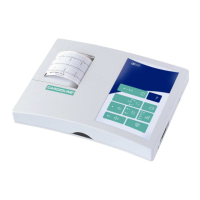


 To Next Page