21
Instructions for Use | Carilex® VT • One
Oeration roceure
5
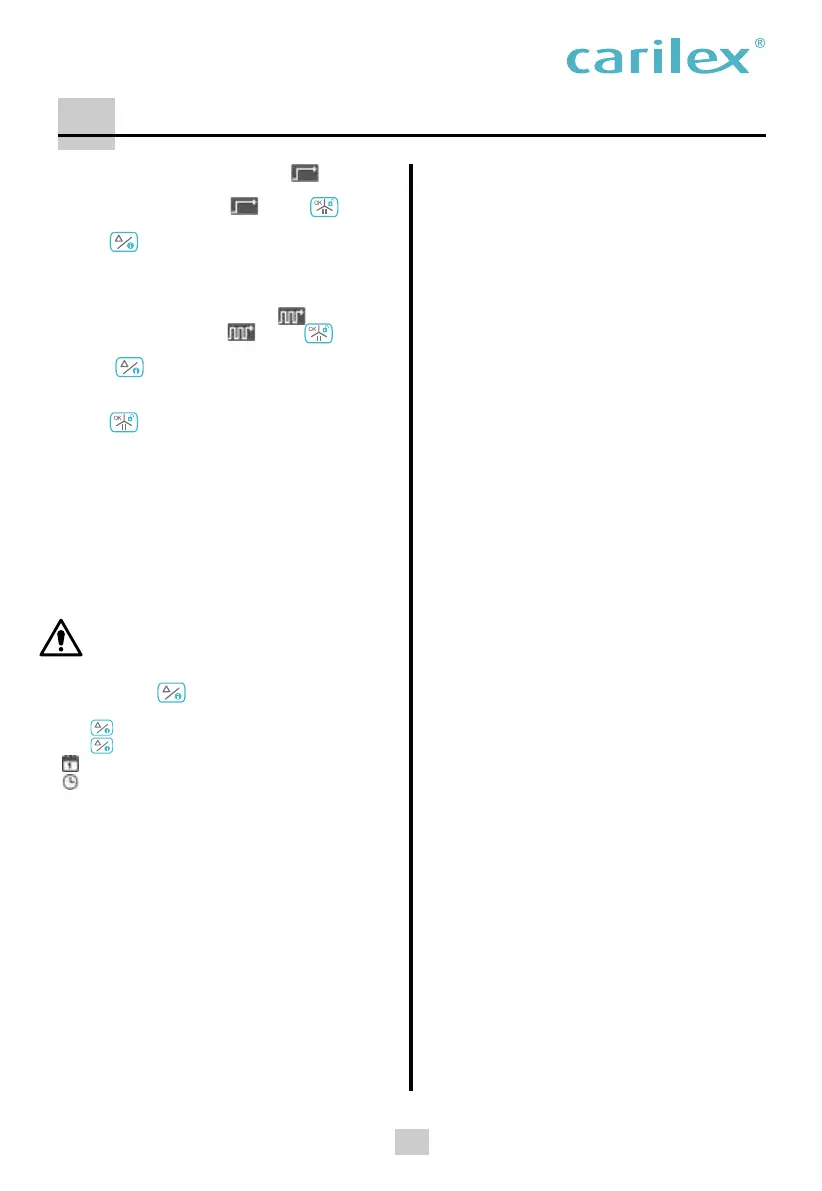
Pressure setting for Continuous mode ( )
(1)When the screen shows , press to choose
continuous mode.
(2)Press to change the constant pressure level from -50
mmHg to -150mmHg. Default pressure for continuous
mode is -125 mmHg.
Pressure setting for Intermittent mode ( )
(1)When the screen shows , press to choose
intermittent mode.
(2)Press to change the high pressure level from
-50 mmHg to -150 mmHg. Default high pressure for
intermittent mode is -125 mm Hg.
(3)Press to conrm high pressure.
(4)After setting the high pressure level, the screen will
start blinking again. Press to select the low pressure
level of intermittent mode from -20 mmHg to -40
mmHg. Default low pressure for intermittent mode is
-20 mmHg.
ote
Intermittent mode is pre-set at xed alternating time for 5
minutes High and 2 minutes Low.
TTTIO
The pressure may only be changed when instructed by a
physician or qualied healthcare professional.
electInfo
Press to select therapy modes and pressure level.
Press for three seconds to see usage time.
Usage time in days
Usage time in hours
locae eaae alert inicator settin oe Otional
The VT• One suction pump provides the option for the
operators to choose the sensitivity for the blockage/leakage
indicator or disable the blockage/leakage indicator. Adjusting
the sensitivity of blockage/leakage indicator may inuence
the VT• One’s function, all setting changed should be under
physician or qualied medical caregiver's order. The physician
or qualified medical caregiver should consider patient and
patient wound's condition to determine the appropriate
sensitivity for patient.
Disable blockage/leakage indicator may increase risk of
exudate accumulation, infection, maceration or loss of
Negative Pressure Wound Therapy (NPWT) as blockage/
leakage occurs in the vacuum system.
Disable blockage/leakage indicator should be under physician
or qualied medical caregiver's order. In the event of disabled
blockage/leakage indicator, regular monitoring and more
frequent dressing changes may be require.
The patient, device and dressing should be carefully
monitored to check if there are any signs of bleeding, exudate
accumulation, infection, maceration or failure of Negative
Pressure Wound Therapy (NPWT). The frequency should be
determined by the physician or qualified medical caregiver
based on individual characteristics of the patient and wound.
The blockage/leakage notification function of VT• One
suction pump may be inuenced by various conditions based
on system conguration, set-up and individual characteristics
of the patient and wound (e.g. exudate characteristics,
wound size). In addition, VT• One is not designed to detect or
issue an alert condition based on the presence of bleeding or
pooling. These conditions may only be detected by frequent
monitoring.
If partial blockage/leakage occurs, the change in pressure
status detected by power unit may not be signicant enough
to activate blockage/leakage indicator. Over time if fully
blockage/leakage occurs, blockage/leakage indicator will be
activated.
If a fully occlusion occurs in the system, but an air leak is
present between occlusion and device, the blockage indicator
may not activate. Ensure all connections are secure and no
air leaks are present in system.
Blockage formation within the wound dressing may not trigger
blockage indicator because it has occurred outside of the
monitored vacuum system; however, it may influence the
pressure status at the wound site. It is highly recommended
that wound dressing should be appropriately frequent
monitored in order to conrm adequate delivery of therapy.


 To Next Page