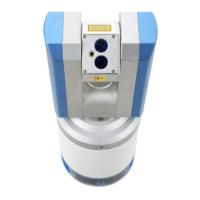
The C-ALS HD is a ruggedized 3D laser scanning system designed for surveying underground voids and cavities. Its compact diameter of 50 mm allows for deployment through boreholes, enabling remote measurement of the three-dimensional shape of the void. The system, coupled with accompanying software, can produce a detailed digital model of the surveyed space.
Function Description
The C-ALS HD employs a 'time-of-flight' laser measurement technique, eliminating the need for reflectors on the target. This enables accurate measurements in inaccessible areas such as ore passes and cavities. A motorized 2-axis scanning head provides a complete 360° scan, covering the entire void up to a range of 150 m.
The C-ALS probe integrates a miniature inertial measurement unit (IMU) containing a triaxial accelerometer, magnetometer, and gyro. This IMU provides accurate heading and inclination data for the probe. An integrated borehole camera, located in the 'nose' of the unit, assists with deployment and precise placement of the scanning head.
During deployment, the main C-ALS cable supplies power to the probe and facilitates two-way data communication between the C-ALS HD and a Windows tablet running Carlson Scan software. Before deployment, the C-ALS probe is aligned against a known orientation using a supplied jig, establishing a reference heading for the gyro. The known coordinate of the borehole collar provides a starting location for the survey.
IMU readings are taken at fixed intervals as the probe is deployed, collecting sensor information and calculating coordinates relative to the collar. This process builds a picture of the probe's path and ensures accurate positioning of the unit during scanning, allowing each point in the resulting 'point cloud' to be correctly geo-referenced.
Carlson Scan software allows remote control of the C-ALS HD from a safe location, with real-time viewing of deployment, borehole video, and all scans. The software also processes data for editing, viewing, and export to third-party modeling and CAD packages.
The laser head, constructed of lightweight aluminum, contains the measuring laser module. Servo-driven gear systems within the probe control vertical and horizontal movement, incorporating a clutch mechanism and firmware to minimize damage from obstructions during scanning. The vertical motor's brake engages only when power is connected; when power is removed, the laser head can swing vertically due to gravity, which does not damage the drive system. A full scan requires at least 20 cm clearance from the vertical pivot. The laser head area around the camera may become hot when powered on with LEDs fully lit.
The probe body is made of robust stainless steel and houses the accelerometers and gyro. A connector at the end opposite the laser head connects to the main C-ALS power/data cable. Alignment holes and a brass tightening nut ensure secure and correct alignment of the extension piece. The C-ALS serial number is located on a label beside the main cable connection.
The integrated camera aids in gauging deployment distance beyond the borehole 'breakout' point, ensuring the laser head and rotating horizontal shaft have unrestricted motion without the probe's full length 'flopping' into the void, which could hinder retrieval. It also helps check borehole conditions for obstructions or cave-ins, assisting deployment management and protecting the probe. Additionally, it allows for basic inspection of voids. While the camera can be used during IMU readings, a separate camera system may be advisable for unstable boreholes to check conditions before deploying the C-ALS HD.
The extension piece, made of stainless steel, increases the probe's length for greater reach into voids and enhances stability during scanning. It includes an adaptor for Boretrak rods. The extension piece connects to the probe by aligning pins with holes, secured by two brass nuts. The main C-ALS cable must be threaded through the extension piece and connected to the probe before the extension piece is attached. The 'scan origin' for all measurements is at the vertical pivot point, 2 m from the rod adaptor hole.
The surface unit, housed in a durable, watertight 'Peli' case, manages communications and power. It features four Mil-Spec connectors for the main C-ALS cable, an Ethernet cable (or Wi-Fi for wireless connectivity), and two power connections for external sources, allowing 'hot-swapping' or simultaneous use. The surface unit is powered by an external 11.5-15 Vdc source, with a mains adaptor (110-240 Vac input) and crocodile clip cables for battery connection. The internal panel includes an ON/OFF switch and LED indicator. It uses T3.15 A anti-surge fuses. The Wi-Fi antenna is internal, offering up to 50 m range with line-of-sight. The lid should remain closed during operation for water ingress protection.
Important Technical Specifications
- Laser Module:
- Certification: Class 1 (IEC / EN 60825-1: 2014), compliant with 21 CFR 1040.10 and 1040.11.
- Type: InGaAs laser diode.
- Wavelength: 905 nm (typically).
- Divergence: <2 milliradians.
- Maximum average power: 20.5 µW.
- Accuracy: +/- 5cm (under Carlson test conditions).
- Resolution: 1 cm.
- Minimum range: 0.5 m.
- Maximum range to passive target: Up to 150 m (to Kodak white card - 90% reflectivity).
- Angle Measurement:
- Accuracy: 0.2°.
- Resolution: 0.1°.
- Range (Vertical): -90° to 90°.
- Range (Horizontal): 0° to 360°.
- Motion: Servo-driven gear systems with manual clutch override.
- IMU Sensors:
- Type: IMU comprising triaxial gyro and accelerometers.
- Pitch-and-roll accuracy: ±0.2°.
- Pitch-and-roll range: 360°.
- Gyro heading drift: Typically, <1° during a 20 minutes deployment.
- Power:
- External power input: 11.5 Vdc to 15 Vdc.
- Mains power adaptor input: 110 Vac to 240 Vac.
- Max current draw during scan: 4.5 A.
- Camera:
- Lighting: 874 Lumens.
- Lens: 10 mm fixed.
- Video signal: AHD.
- Resolution: Full HD (1920 x 1080) @25fps.
- Physical Data:
- Construction: Machined aluminum and stainless steel.
- Environmental protection: IP67 (Probe and Surface unit with lid closed).
- Operating temperature: -10° C to +60° C (Probe), 0° C to 50° C (Surface unit).
- Storage temperature: -25° C to +75° C (Probe and Surface unit).
- Dimensions (Probe): 1110 mm x 50 mm.
- Dimensions (Probe and extension piece): 2189 mm x 50 mm.
- Dimensions (Surface unit): 270 mm x 245 mm x 170 mm.
- Dimensions (Slip ring drum, small): 0.6 m x 0.5 m x 0.5 m.
- Dimensions (Slip ring drum, large): 0.9 m x 0.5 m x 0.5 m.
- Weight (Stainless steel probe): 6 kg.
- Weight (Single-section steel extension piece): 3 kg.
- Weight (Main C-ALS cable): 0.18 kg/m.
- Weight (1 m Boretrak rod): 0.4 kg.
- Weight (Surface unit): 4.1 kg.
- Weight (Slip ring drum, small): 13 kg.
- Weight (Slip ring drum, large): 15 kg.
Usage Features
- Deployment: The C-ALS HD is typically lowered via a load-bearing main cable. The main cable is marked at metre intervals for accurate IMU readings. An unmarked 5 m cable is also provided for short deployments or office tests.
- Slip Ring Drum (Optional): Allows the cable to be reeled in/out while maintaining connection to the surface unit. The Mil-Spec end of the C-ALS cable connects inside the drum, and a short 5 m test cable connects the drum to the surface unit. An ungeared handle winds the cable.
- Winch Attachment (Optional): A winch can be added to the slip ring drum, featuring an inbuilt brake. The handle hub can be unscrewed for free unspooling. The handle detaches to expose a ¼" square connection point for a battery-powered hand drill, allowing faster cable retrieval (approx. 13 m/minute). Gear ratios can be switched between 4:1 (manual) and 24:1 (drill) by sliding a gear lever.
- Battery Pack: A dedicated 7 Ah lead acid battery pack provides up to 2 hours of continuous operation. It connects to the surface unit via a 4-pin Power/Scanner connector. A separate charger is supplied, requiring 12-16 hours for a full charge.
- Alternate Power: The system can also be powered by a mains adaptor (110-240 Vac) or a third-party 11.5-15 Vdc regulated battery source using crocodile clip cables. Car batteries are acceptable as standalone sources but not when connected to a powered vehicle or DC generator.
- Boretrak Rods: Lightweight fiberglass rods, available in 1 m sections, are used to deploy and stabilize the probe, especially in horizontal or uphole boreholes, preventing rotation rates exceeding 400°/sec. Special hinges for uphole deployment lock rods in place.
- Gyro Calibration Jig: Supplied with all systems, this jig holds the probe stable during calibration to monitor gyro drift and define a starting azimuth for geo-referencing. It includes two 360° prisms for surveying the starting heading. The jig can be dismantled for storage, and the bar can be used alone for vertical calibrations.
- Environmental Limitations: The C-ALS HD is waterproof up to 1 m depth but will not produce data in waterlogged environments. The surface unit is not watertight with the lid open. Boreholes should ideally be lined to reduce wear and water flow.
- Gyro Rotation Limits: The gyro measures rotation rates up to 400°/sec. Exceeding this limit (or constant rotations >1.1Hz) will result in an out-of-range error, requiring recalibration. Careful deployment minimizes rotation and jerks.
- Scanning Conditions: Scan data should only be collected when the probe is stationary. Movement during a scan will trigger a warning in Carlson Scan software.
- Laser Ranging Limitations: Maximum range (150 m) can be affected by dark, light-absorbent, dusty, wet, slick, shiny, or very smooth surfaces, and acute laser angles. Minimum range is 0.5 m, with diminished precision at shorter distances.
Maintenance Features
- Cleaning: Thoroughly clean and dry the C-ALS HD and all accessories after each deployment before packing. Use clean water for mud/grit. For metalwork, use Amberclens anti-static foam cleaner or mild dishwashing liquid (0.001% concentration) with a non-abrasive, lint-free cloth. Avoid paint solvents or harsh detergents. Rinse with plain water and dry thoroughly. For lens windows and laser pointer window, use HPLC-grade (> 99.8%) acetone with lint-free cotton wool buds or wipes, wearing appropriate PPE.
- Storage: Store all components within environmental temperature limits (-25 °C to +70 °C). Disconnect power sources if unused for several weeks. Pack all equipment in supplied transit cases to protect against damage, shock, and vibration during transport.
- Battery Disposal: Dispose of used batteries responsibly at designated collection points. Do not burn batteries. All lithium and rechargeable batteries must be fully discharged or protected from short-circuiting prior to disposal.
- Rods and Hinges: Check Boretrak rods and hinges before every deployment for good condition, absence of 'twist', and secure nuts, bolts, and connecting pins. Replace any damaged or non-functional rods.
- Surface Unit Compatibility: The C-ALS HD surface unit should never be used with earlier C-ALS models (Gyro, standard, mk3) that were supplied with a yellow surface unit with a LEMO connector. Doing so voids warranty and can cause serious damage. Always check the probe's serial label or contact Carlson for compatibility information.
- Battery End-of-Life: If batteries or charger approach end-of-life, become non-functional, or are damaged, stop use and request a replacement from a Carlson-approved source. All batteries contain hazardous chemicals.
- Damaged Instruments: Do not operate evidently damaged instruments, as this may void the manufacturer's warranty.
- Laser Safety: Do not stare directly into the laser beam or shine it into eyes. Do not dismantle the unit. Avoid shining the laser at aircraft or vehicles.
- CCD/Infrared Devices: Do not align the C-ALS with lenses of CCD cameras or infrared night vision devices, as this can damage the system.

 Need help?

 To Next Page
 General