HEATING & COOUNG
Visit www.carrier.cmn
Heat
38EYG
12 SEER Split-System
Pump with Puron® Refrigerant
Installation and Start-Up Instructions
NOTE: Read the entire instruction manual before starting the
installation.
This symbol _ indicates a change since the last issue.
SAFETY CONSIDERATIONS
Improper installation, adjustment, alteration, service, maintenance,
or use can cause explosion, fire, electrical shock, or other
conditions which may cause death, personal injury, or property
damage. Consult a qualified installer, service agency, or your
distributor or branch for information or assistance. The qualified
installer or agency must use fiactory-authorized kits or accessories
when modifying this product. Refer to the individual instructions
packaged with the kits or accessories when installing.
Follow all safety codes. Wear safety glasses, protective clothing,
and work gloves. Use quenching cloth for brazing operations.
Have fire extinguisher available. Read these instructions thor-
oughly and follow all warnings or cautions included in literature
and attached to the unit. Consult local building codes and National
Electrical Code (NEC) for special requirements.
Recognize safety information. This is the safety-alert symbol Z_ •
When you see this symbol on the unit and in instructions or
manuals, be alert to the potential for personal injury.
Understand the signal words DANGER, WARNING, and CAU-
TION. These words are used with the safety-alert symbol. DAN-
GER identifies the most serious hazards which will result in severe
personal injury or death. WARNING signifies hazards which
could result in personal injury or death. CAUTION is used to
identify unsafe practices which would result in minor personal
injury or product and property damage. NOTE is used to highlight
suggestions which will result in enhanced installation, reliablitily,
or operation.
¥!_ tVl:1 :]_l_[d
Before installing, modifying, or servicing system, main elec-
trical disconnect switch must be in the OFF position. There
may be more than 1 disconnect switch. Lock out and tag
switch with a suitable warning label. Electrical shock can
cause personal injury or death.
r;_[Rr21lii_] iq
Puron_; (R-410A) systems operate at higher pressures than
standard R-22 systems. Be certain that service eqnipment is
rated for Puron:,P¢. Some R-22 service equipment may not be
acceptable. Check with your distributor.
INSTALLATION RECOMMENDATIONS
NOTE: In some cases noise in the living area has been traced to
gas pulsations from improper installation of equipment.
i. Locate unit away from windows, patios, decks, etc. where unit
operation sound may disturb customer.
2. Ensure that vapor and liquid tube diameters are appropriate to
capacity of unit.
A98525
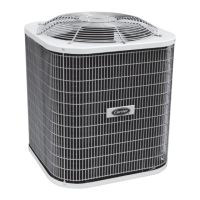
Fig. 1--Model 38EYG
3. Run refrigerant tubes as directly as possible by avoiding
unnecessary tunas and bends.
4. Leave some slack between structure and unit to absorb
vibration.
5. When passing refrigerant tubes through the wall, seal opening
with RTV or other pliable silicon-based caulk. (See Fig. 2.)
6. Avoid direct tubing contact with water pipes, duct work, floor
joists, wall studs, floors, and walls.
7. Do not suspend refrigerant tubing from joists and studs with a
rigid wire or strap which comes in direct contact with tubing.
(See Fig. 2.)
8. Ensure that tubing insulation is pliable and completely sur-
rounds vapor tube.
9. When necessary, use hanger straps which are 1 in. wide and
conform to shape of tubing insulation. (See Fig. 2.)
10. Isolate hanger straps from insulation by using metal sleeves
bent to conform to shape of insulation.
When outdoor unit is connected to fiactory-approved indoor unit,
outdoor unit contains system refrigerant charge for operation with
indoor unit of same size when connected by 15 ft of field-supplied
or factory accessory tubing. Add (or subtract) 0.6 ozift of 3/8
liquid line for lengths greater (or less) than 15 ft. For proper unit
operation, check refrigerant charge using charging information
located on control box cover and.or in the Check Charge section of
this instruction.
IMPORTANT: Maxinmm liquid-line size is 3/8-in. O.D. for all
residential applications including long line.
IMPORTANT: Always install the factory-supplied Puron:R; heat
pump (bi-flow) liquid-line filter drier. If replacing the filter drier,
refer to Product Data Digest for appropriate part number. Obtain
replacement filter driers from your distributor or branch.
Manufacturer reserves the right to discontinue, or change at any time, specifications or designs without notice and without incurring obligations.
PC 101 Catalog No. 533-80094 Printed in USA Form 38EYG-2SI Pg 1 2-03 Replaces: 38EYG-1SI

 Need help?

 To Next Page
 General