Installation Instructions
NOTE: Read the entire instruction manual before starting the
installation.
SAFETY CONSIDERATIONS
Improper installation, adjustment, alteration, service, maintenance, or
use can cause explosion, fire, electrical shock or other conditions which
may cause death, personal injury or property damage. Consult a
qualified installer, service agency, or your distributor or branch for
information or assistance. The qualified installer or agency must use
factory-authorized kits or accessories when modifying this product.
Refer to the individual instructions packaged with the kits or accessories
when installing.
Follow all safety codes. Wear safety glasses, protective clothing and
work gloves. Use quenching cloths for brazing operations. Have fire
extinguisher available. Read these instructions thoroughly and follow all
warnings or cautions attached to the unit. Consult local building codes
and the current editions of the National Electrical Codes (NEC) NFPA
70.
In Canada, refer to the current editions of the Canadian Electrical Code
CSA C22.1.
Recognize safety information. This is the safety-alert symbol . When
you see this symbol on the unit and in instructions or manuals, be alert to
the potential for personal injury.
Understand the signal words DANGER, WARNING and CAUTION.
These words are used with the safety-alert symbol. DANGER identifies
the most serious hazards which will result in severe personal injury or
death. WARNING signifies hazards which could result in personal
injury or death. CAUTION is used to identify unsafe practices, which
may result in minor personal injury or product and property damage.
NOTE is used to highlight suggestions which will result in enhanced
installation, reliability, or operation.
NOTE: Nitrogen can leak out through the needle pierce hole in the
plugs. This does not indicate a leaking coil nor warrant return of the coil.
INTRODUCTION
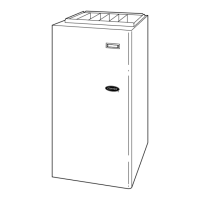
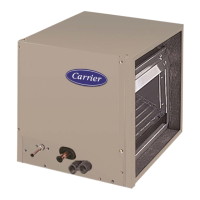
The CNPHP is a horizontal, multi-use furnace coil (Fig. 1). With the use
of field-supplied transition duct, these furnace coils can also be applied
to other similar horizontal furnaces on the market. The coil is available
in sizes 024 through 060. All models are equipped with a
factory-installed TXV and are used with Puron® (R-410A) refrigerant
systems.
CNPHP
Cased N Coil, Horizontal
Heating – Cooling
WARNING
!
ELECTRICAL SHOCK HAZARD
Failure to follow this warning could result in personal injury or death.
Before installing, modifying or servicing system, always turn off main
power to system. There may be more than one disconnect switch. Lock
out and tag switch with a suitable warning label.
CAUTION
!
PERSONAL INJURY HAZARD
Failure to follow this caution may result in personal injury.
This coil contains Nitrogen precharge of 15 PSIG. Release of this
pressure through the center of the rubber plugs is required before
removing the plugs.
CAUTION
!
CUT HAZARD
Failure to follow this caution may result in personal injury.
Sheet metal parts may have sharp edges or burrs. Use care and wear
appropriate protective clothing and gloves when handling parts.
CAUTION
!
UNIT OR PROPERTY DAMAGE HAZARD
Failure to follow this caution may result in property damage.
Take precautions to ensure Aluminum tubes do not come in direct
contact or allow for condensate run off with a dissimilar metal.
Dissimilar metals can cause galvanic corrosion and possible premature
failure.
CAUTION
!
ENVIRONMENTAL HAZARD
Failure to follow this caution may result in environmental damage.
Federal regulations require that you do not vent refrigerant to the
atmosphere. Recover during system repair or final unit disposal.

 Need help?


 To Next Page
 General