EasyManua.ls Logo

Carrier PA4S - User Manual

Carrier PA4S
10 pages
Print Icon
To Next Page IconTo Next Page
Loading...
Installation Instructions
NOTE: Read the entire instruction manual before starting the installation.
SAFETY CONSIDERATIONS
IMPORTANT: This appliance shall only be installed by EPA qualified
personnel having appropriate certification. This appliance is not
intended for use by persons (including children) with reduced physical,
sensory or mental capabilities or lack of experience and knowledge,
unless they have been given supervision or instruction concerning use of
the appliance by a person responsible for their safety.
Improper installation, adjustment, alteration, service, maintenance, or
use can cause explosion, fire, electrical shock, or other conditions which
may cause death, personal injury, or property damage. Consult a
qualified installer, service agency, or your distributor or branch for
information or assistance. The qualified installer or agency must use
factory-authorized kits or accessories when modifying this product.
Refer to the individual instructions packaged with the kits or accessories
when installing.
Follow all safety codes. Wear safety glasses, protective clothing, and
work gloves. Use quenching cloth for brazing operations. Have fire
extinguisher available. Read these instructions thoroughly and follow all
warnings or cautions included in literature and attached to the unit.
Consult local building codes and current editions of the National
Electrical Code (NEC) NFPA 70. In Canada, refer to current editions of
the Canadian electrical code CSA 22.1.
Recognize safety information. This is the safety-alert symbol When
you see this symbol on the unit and in instructions or manuals, be alert to
the potential for personal injury. Understand these signal words;
DANGER, WARNING, and CAUTION. These words are used with the
safety-alert symbol. DANGER identifies the most serious hazards which
will result in severe personal injury or death. WARNING signifies
hazards which could result in personal injury or death. CAUTION is
used to identify unsafe practices which would result in minor personal
injury or product and property damage. NOTE is used to highlight
suggestions which will result in enhanced installation, reliability, or
operation.
GENERAL
NOTE: In some cases noise in the living area has been traced to gas
pulsations from improper installation of equipment.
1. This unit is intended to be installed in a location that is 10,000 feet
(3000 meters) above sea level or lower.
2. Locate unit away from windows, patios, decks, etc. where unit
operation sound may disturb customer.
3. Ensure that vapor and liquid tube diameters are appropriate for unit
capacity.
4. Run refrigerant tubes with no bends with centerline bend radius less
than 2.5 times the external pipe diameter.
5. Leave some slack between structure and unit to absorb vibration.
6. When passing refrigerant tubes through the wall, seal opening with
RTV or other pliable silicon-based caulk. (See Fig. 1.)
7. Avoid direct tubing contact with water pipes, duct work, floor
joists, wall studs, floors, and walls.
8. Do not suspend refrigerant tubing from joists and studs with a rigid
wire or strap which comes in direct contact with tubing (see Fig. 1).
9. Ensure that tubing insulation is pliable and completely surrounds
vapor tube.
10. When necessary, use hanger straps which are 1 in. (25 mm) wide
and conform to shape of tubing insulation. (See Fig. 1.)
11. Isolate hanger straps from insulation by using metal sleeves bent to
conform to shape of insulation.
12. Provision shall be made for expansion and contraction of long runs
of piping.
13. Piping and fittings shall be protected as far as possible against
adverse environmental effects. For example, the accumulation of
dirt and debris.
14. Piping should be installed to reduce the likelihood of hydraulic
shock damaging the system.
15. Certified piping and components must be used in order to protect
against corrosion.
16. Flexible pipe elements shall be protected against mechanical
damage, excessive stress by torsion, or other forces. They should be
checked for mechanical damage annually.
17. Piping material, routing, and installation shall be include protection
from physical damage in operation and service, and be in
compliance with the national and local codes and standards of the
installation site.
18. When setting up refrigerant piping, precautions shall be taken to
avoid excessive vibration or pulsation
PA4S, PA5S
SPLIT-SYSTEM AIR CONDITIONERS
WITH R-410A REFRIGERANT
WARNING
!
ELECTRICAL SHOCK HAZARD
Failure to follow this warning could result in personal injury or death.
Before installing, modifying, or servicing system, main electrical
disconnect switch must be in the OFF position. There may be more than
1 disconnect switch. Lock out and tag switch with a suitable warning
label.
WARNING
!
EXPLOSION HAZARD
Failure to follow this warning could result in
personal injury or death.
Never use air or any gas containing oxygen for leak
testing or operating refrigerant compressors. Never
allow compressor suction pressure to operate in a
vacuum with service valves closed. See service
manual for pump-down instructions.

Question and Answer IconNeed help?

Do you have a question about the Carrier PA4S and is the answer not in the manual?

Overview

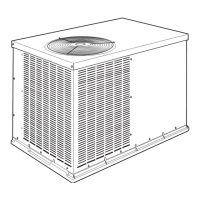
This document provides installation and maintenance instructions for the PA4S and PA5S Split-System Air Conditioners, which use R-410A refrigerant. These units are designed for residential applications and require installation by EPA-qualified personnel.

Function Description

The PA4S and PA5S are split-system air conditioners designed to provide cooling for residential spaces. They operate by circulating R-410A refrigerant between an outdoor unit and an indoor coil, removing heat from the indoor air and dissipating it outdoors. The system's operation is controlled by a thermostat, which energizes the outdoor fan motor and compressor circuit, as well as the indoor unit blower relay, to achieve the desired cooling. Some indoor units may also feature a time-delay relay circuit for the indoor blower to enhance system efficiency.

Important Technical Specifications

  • Refrigerant: R-410A.
  • Installation Altitude: Intended for installation at locations 10,000 feet (3000 meters) above sea level or lower.
  • Tubing Diameters: Vapor and liquid tube diameters must be appropriate for the unit capacity. Recommended diameters are provided in Table 1, with liquid lines typically 3/8-in. OD for all residential applications.
  • Line Set Lengths: Units are factory charged for a 15 ft (4.57 m) lineset. For tubing lengths between 80 and 200 ft (24 and 61 m) horizontal or 35 ft (11 m) vertical differential (total equivalent length), refer to the Residential Piping and Long Line Guideline. Buried line applications are limited to 36-in. (914 mm) maximum.
  • Clearance Requirements:
    • 24 in. (610 mm) clearance to the service end of the unit.
    • 48 in. (1219 mm) above the unit.
    • 6 in. (152 mm) clearance on one side of the unit.
    • 12 in. (305 mm) on all remaining sides.
    • 18 in. (457 mm) between units if no overhang within 12 ft (3.67 m) (for units with wire grille coil guard only).
    • 24 in. (610 mm) between units for units with louver panels.
    • Rooftop applications require the unit to be at least 6 in. (152 mm) above the roof surface.
  • Operating Ambient: Minimum outdoor operating ambient in cooling mode without accessory is 55°F (13°C).
  • Electrical Requirements: Field wiring must comply with local and national fire, safety, and electrical codes. Voltage must be within limits shown on the unit rating plate. Copper wire only is to be used between the disconnect switch and the unit. A branch circuit disconnect of adequate size per NEC is required. Control wiring uses No. 18 AWG color-coded, insulated (35°C minimum) wire, or No. 16 AWG for runs over 100 ft (30 m). Control power requires a 24v/40va minimum transformer.
  • Pressure Proof Check: A nitrogen charge of approximately 200 psi must not decrease in pressure for 1 hour.
  • Vacuum Check: The system must be evacuated to 500 microns. After isolation from the pump, the pressure should not rise above 1500 microns in 10 minutes.
  • Compressor Crankcase Heater: Required if refrigerant tubing is longer than 80 ft (24 m) or if the outdoor unit is 35 ft (6 m) below the indoor unit.
  • 3-Phase Monitor: For 3-phase units, a factory-installed circuit board monitors line voltage. A flashing LED indicates a reversed phase, requiring interchange of two field-wiring leads on the unit contactor.

Usage Features

  • Installation Location: Units should be located away from windows, patios, and decks to minimize operational sound disturbance. Rooftop applications may require wind baffles.
  • Piping Installation: Refrigerant tubes should be run with no bends having a centerline bend radius less than 2.5 times the external pipe diameter. Some slack should be left between the structure and the unit to absorb vibration. Openings where tubes pass through walls must be sealed with RTV or pliable silicon-based caulk. Direct tubing contact with water pipes, duct work, floor joists, wall studs, floors, and walls should be avoided. Hanger straps, 1 in. (25 mm) wide, should conform to the shape of tubing insulation and be isolated from insulation using metal sleeves.
  • Mounting: Units must be installed on a solid, level mounting pad, within ±2° (±3/8 in./ft.±9.5 mm/m). Tie-down bolts can be used through knockouts in the unit base pan if required by local codes or conditions.
  • Refrigerant Charging:
    • Units with Cooling Mode TXV: Charge by the subcooling method. Operate the unit for a minimum of 15 minutes before checking the charge. Measure liquid service valve pressure and liquid line temperature, then compare to the required subcooling temperature from the unit rating plate. Adjust refrigerant if the liquid line temperature is higher or lower than indicated.
    • Units with Indoor Piston: Charge by the superheat method. Operate the unit for a minimum of 15 minutes. Measure suction pressure, suction temperature, outdoor air dry-bulb temperature, and indoor air wet-bulb temperature. Refer to the Superheat Charging table to determine the target superheat. Adjust refrigerant until the charted suction line temperature is reached. Charge in liquid form into the suction service port using a flow-restricting device.
  • System Start-Up: After evacuation, fully open liquid and vapor service valves. Replace stem caps finger-tight and tighten with a wrench an additional 1/12 turn. Close electrical disconnects to energize the system. Set the room thermostat to the desired temperature (below ambient) and the fan control to ON or AUTO. Operate the unit for 15 minutes and check the refrigerant charge.

Maintenance Features

  • Periodic Maintenance: For continued high performance and to minimize equipment failure, periodic maintenance must be performed. The frequency of maintenance may vary depending on geographic areas and coastal applications. Refer to the Owner's Manual for specific information.
  • Filter Drier: A liquid-line filter drier must be installed indoors. It should be wrapped in a heat-sinking material (wet cloth) while brazing. The flow arrow on the drier must point towards the indoor coil.
  • Leak Testing: After piping connections are made, the refrigerant tubing and indoor coil are ready for leak testing, which should include all field and factory joints. Do not use flames or ignition sources for leak checking.
  • Final Tubing Check: Ensure factory tubing on both indoor and outdoor units has not shifted during shipment and is not rubbing against other components or wires. Feeder tubes should be secure and tight.
  • Repairing Refrigerant Circuit: When breaking into the refrigerant circuit for repairs, safely remove refrigerant using a recovery pump certified for flammable refrigerants. Purge the circuit with nitrogen gas, then evacuate to 1500 microns. Break the vacuum with a nitrogen purge, ensuring the vacuum pump outlet is not near a potential ignition source. Then, open the circuit by cutting or brazing.
  • Electrical Connections: Ensure all wiring is routed away from tubing and sheet metal edges to prevent rub-through or wire pinching. All wiring and tubing must be secure in the unit before adding panels and covers. Service valve stem caps must be tightened to 1/12-turn past finger tight.
  • Documentation: Leave the Owner's Manual with the owner and explain system operation and periodic maintenance requirements. Fill out the Dealer Installation Checklist and place it in the customer file.

Carrier PA4S Specifications

General IconGeneral
BrandCarrier
ModelPA4S
CategoryAir Conditioner
LanguageEnglish

Related product manuals