4. Is your youngster wearing the proper protective gear?
5. Has your youngster learned to locate the MINI-Talon controls without help?
6. Does he or she know how to operate the controls smoothly?
7. Does your youngster understand he or she must always drive off-road?
8. Have you stressed to your youngster the importance of keeping his or her feet on the
foot pedals and their hands on the steering wheel?
C. Practice area (to parents)
The best place for learning is a level area 100’ x 200’ that is free from obstacles
such as rocks, stumps, or holes. The learning area may have a loose or hard dirt surface.
A grassy surface is also acceptable. It should not have two different surfaces. Be sure
there is enough room to maneuver, and that no other people or obstacles are close by.
D. Getting used to the vehicle in motion (to parents)
Be sure your youngster is wearing all of the proper protective gear. With the
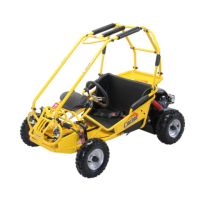
engines still OFF, have your youngster sit in the MINI-Talon. Physically push the
vehicle slowly. Practice this several times until you are sure your youngster’s driving
skill is developed. Remind your youngster to keep his or her head up and look
forward and to keep both feet on foot pedals.
Ready to Drive?
With the engine off, have your youngster practice smoothly moving the foot pedal
throttle control. Your youngster will learn how much pressure it takes to start moving
in a later exercise. Explain that pushing the throttle will increase speed. Releasing
the throttle and applying the brake will slow the kart down. Ask your youngster to
tell you how throttle control and braking affect kart’s speed.
With MINI-Talon stopped, and engine OFF, have your youngster look in the
direction of the turn and turn steering wheel in the direction of the turn. Repeat this
exercise while you are slowly pushing your youngster on the MINI-Talon. Make sure
he or she can turn the vehicle in both directions using this technique.
Pre-Drive Inspection
Check the following items before you allow anyone on the MINI-Talon:
Engine Oil
Check the level and add oil if needed. Check for leaks.
Fuel
Check the level and add fuel if needed. Also make sure the fuel cap is securely fastened.
Check for leaks.
Tires
Use a gauge to check the air pressure. Adjust if needed. Also look for signs of damages
and excessive wear.
11


 To Next Page