EasyManua.ls Logo

Casio CFX-9800G - Page 109

Casio CFX-9800G
206 pages
Print Icon
To Next Page IconTo Next Page
To Previous Page IconTo Previous Page
Loading...
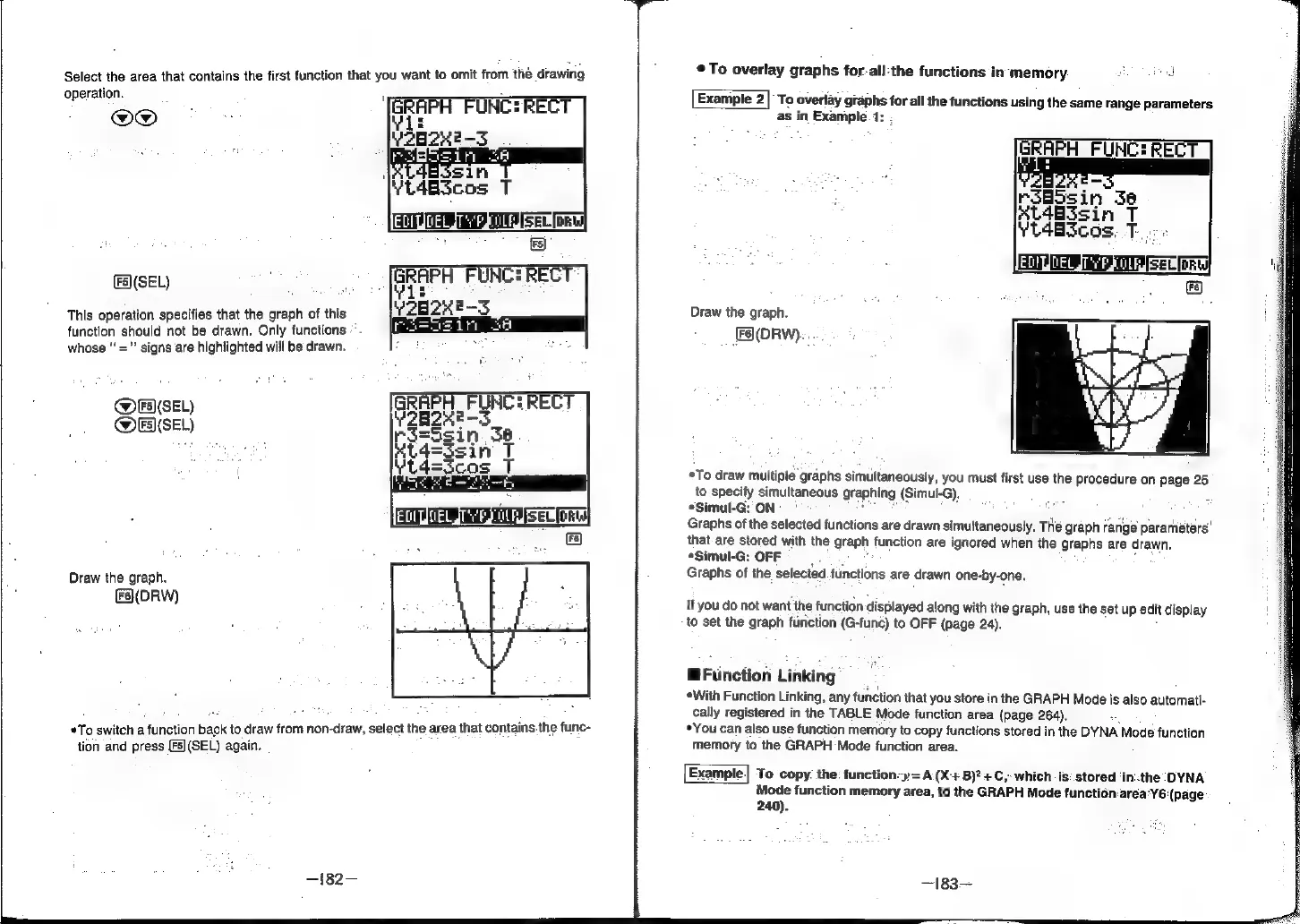
Select
the
area
that
contains
the
first
function
that
you
want
to
omit
from
the
drawing
operation.
@O@
FA\SEL)
This
operation
specifies
that
the
graph
of
this
function
should
not
be
drawn.
Only
functions
whose
=”
signs
are
highlighted
will
be
drawn.
(SEL)
(SEL)
@
@
fle)
Draw
the
graph.
Fe]
(DRW)
YY
*To
switch
a
function
back
to
draw
from
non-draw,
select
the
area
that
contains.the
func-
tion
and
press
(F5](SEL)
again.
®@To
overlay
graphs
for-all:the
functions
in*memory.
To
overlay
graphs
for
all
the
functions
using
the
same
range
parameters
as
in
Example
1:
Draw
the
graph.
FH(ORW)..
To
draw
multipie
graphs
simultaneously,
you
must
first
use
the
procedure
on
page
25
to
specify
simultaneous
graphing
(Simul-G).
nae
cae
*Simul-G:
ON
a
aA
Sakon
Graphs
of
the
selected
functions
are
drawn
simultaneously.
The
graph
range
parameters’
that
are
stored
with
the
graph
function
are
ignored
when
the
graphs
are
drawn.
¢Simul-G:
OFF
on
Sh
:
Graphs
of
the
selected.
functions
are
drawn
one-by-one.
If
you
do
not
want
the
function
displayed
along
with
the
graph,
use
the
set
up
edit
display
to
set
the
graph
function
(G-func)
to
OFF
(page
24).
HFunction
Linking
«With
Function
Linking,
any
function
that
you
store
in
the
GRAPH
Mode
is
also
automati-
cally
registered
in
the
TABLE
Mode
function
area
(page
264).
$
*You
can
also
use
function
memory
to
copy
functions
stored
in
the
DYNA
Mode
function
memory
to
the
GRAPH
Mode
function
area.
Example
To
copy:
the:
function:
=
A
(X+B)?+
C,-
which
is:
stored
‘in:the
DYNA
Mode
function
memory
area,
to
the
GRAPH
Mode
functidn-area‘Y6:(page
240).