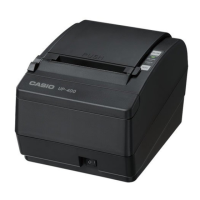
The Casio M-U420 is an impact dot matrix printer, designed for various printing applications, particularly those requiring robust and reliable output. This technical manual provides comprehensive details on its features, operational principles, handling, maintenance, and repair procedures.
Function Description
The M-U420 operates as an impact dot matrix printer, which means it forms characters and images by striking an ink-soaked ribbon against paper with a print head containing a matrix of pins. This method is well-suited for applications requiring multiple copies (carbon copies) and for environments where durability and cost-effectiveness are priorities. The printer supports both roll paper and validation cards, indicating its versatility for different business needs, such as point-of-sale (POS) systems, receipt printing, and transaction validation.
Key operational mechanisms include:
- Transmission Mechanism: This system is responsible for the precise movement of paper and the print head. It comprises a paper feed gear train for advancing paper and a head movement gear train for horizontal movement of the print head across the paper.
- Detection Mechanism: The printer incorporates various sensors for accurate operation. A timing detection mechanism ensures synchronized movements, a reset detection mechanism handles initial positioning, and a validation detection mechanism is crucial for correctly positioning and processing validation cards.
- Print Mechanism: At the core of the printer, the print head unit moves across the paper, and its pins are actuated to strike the ribbon, forming characters. The principle of head printing operation involves precise control over pin activation to create desired patterns.
- Paper Feed Mechanism: This mechanism manages the paper path, including paper transport, paper extension, and a release mechanism for easy paper loading and removal. It ensures smooth and consistent paper feeding.
- Clamshell Mechanism: This design feature likely refers to an easily openable cover or housing that provides convenient access to internal components for maintenance, such as ribbon replacement or paper loading.
- Ribbon Feed Mechanism: The printer uses an ink ribbon, and this mechanism ensures the ribbon is fed consistently past the print head, providing fresh ink for each print.
- Stamp Mechanism: A unique feature, the stamp mechanism allows the printer to apply a physical stamp, which could be used for validating documents or marking receipts. This includes a stamp operation process and provisions for ink refill and stamp face replacement.
- Auto Cutter Mechanism (Selectable Function): For models equipped with this feature, an automatic cutter can perform either partial cuts or full cuts of the paper. This is particularly useful for receipt printing, where clean and consistent cuts are essential. A cutter detector ensures proper operation of this mechanism.
- Paper Take-Up Mechanism: This mechanism is designed to neatly collect printed paper, especially when using roll paper, preventing clutter and ensuring an organized output.
Important Technical Specifications
While specific numerical values for speed, resolution, and interface types are not detailed in the table of contents, the structural breakdown implies a robust design. The mention of "Gear train unit" for both paper feed and head movement suggests a mechanical system built for durability and precision. The inclusion of "Timing carriage drive belt tension adjustment" and "Adjustment of Platen gap" highlights the importance of precise calibration for optimal print quality and longevity. The "Corrention of print skew" further indicates a design focus on maintaining print alignment and quality.
The printer supports different configurations, as evidenced by "Auto cutter models only" and "Manual cutter modes only" for the paper feed cover sub-assembly and cutter unit installation. This suggests variations in models to cater to specific user requirements. The "Journal writing stand" for auto cutter models implies a setup suitable for continuous logging or receipt printing.
Usage Features
The M-U420 is designed with user convenience and operational efficiency in mind:
- Easy Paper Handling: Instructions for "Inserting Paper Roll," "Removing Paper Roll," and "Inserting a Validation Card" indicate straightforward procedures for media loading.
- Release Levers: The presence of "Operating the Release Levers" and "Clamshell Access" suggests an intuitive design for opening the printer and accessing internal components for routine tasks.
- Ribbon Cassette System: The "Installing and Removing the Ribbon Cassette" section implies a user-friendly cassette-based ribbon system, making ribbon changes quick and clean.
- Stamp Assembly: The ability to "Install and Remove the Stamp Assembly," "Stamp Assembly Ink Refill," and "Replace the Stamp Face" provides flexibility for customization and maintenance of the stamping function.
- Precautions: The manual includes sections on "Transport Precautions," "Correct way to Carry and Handling way," "Storage Precautions," and "Usage Precautions," guiding users on safe and proper handling to ensure the printer's longevity and performance.
Maintenance Features
Maintenance is a significant aspect covered in the manual, emphasizing the printer's design for long-term reliability:
- Cleaning: A dedicated section on "Cleaning" indicates that routine cleaning is expected and provides guidelines for maintaining optimal performance.
- Inspection: "Daily Check" and "Periodic Inspection" routines are outlined, suggesting a proactive approach to maintenance to identify and address potential issues before they escalate.
- Lubrication: Detailed information on "Lubricant Types," "Lubrication Standards," "Lubrication Sites," and a "List of Lubricants and Adhesives" highlights the importance of proper lubrication for the mechanical components, crucial for smooth operation and extended lifespan. The "Lubrication Points 1" and "Lubrication Points 2" in the appendix likely provide visual guides for these tasks.
- Repair Procedures: The manual provides extensive guidance for repairs, including "Repair Levels," "Repair Procedure," and "Repair Guidelines." This suggests that the printer is designed to be serviceable, allowing for component-level repairs rather than requiring full unit replacement for every issue.
- Disassembly, Assembly, and Adjustment: A large portion of the manual is dedicated to "Disassembly, Assembly, and Adjustment" procedures for various components, from main assemblies to specific parts like the "Timing detector ass'y" and "Carriage drive belt." This detailed guidance is invaluable for technicians performing repairs or component replacements.
- Exploded Diagrams and Parts Lists: The inclusion of "Exploded Diagram" and "PARTS PRICE LIST" for different models (M-U420(061) and M-U420(071)) is critical for identifying parts, understanding their relationships, and ordering replacements, further supporting maintainability.
- Connector Terminal Arrangement: "Arrangement of Connector Terminal" is a useful reference for troubleshooting electrical connections and ensuring correct reassembly after repairs.
In summary, the Casio M-U420 is a robust impact dot matrix printer designed for reliable performance in various operational settings. Its detailed technical manual underscores a commitment to user-friendliness, comprehensive maintenance, and repairability, making it a practical choice for businesses requiring durable and serviceable printing solutions.

 Need help?

 To Next Page
 General