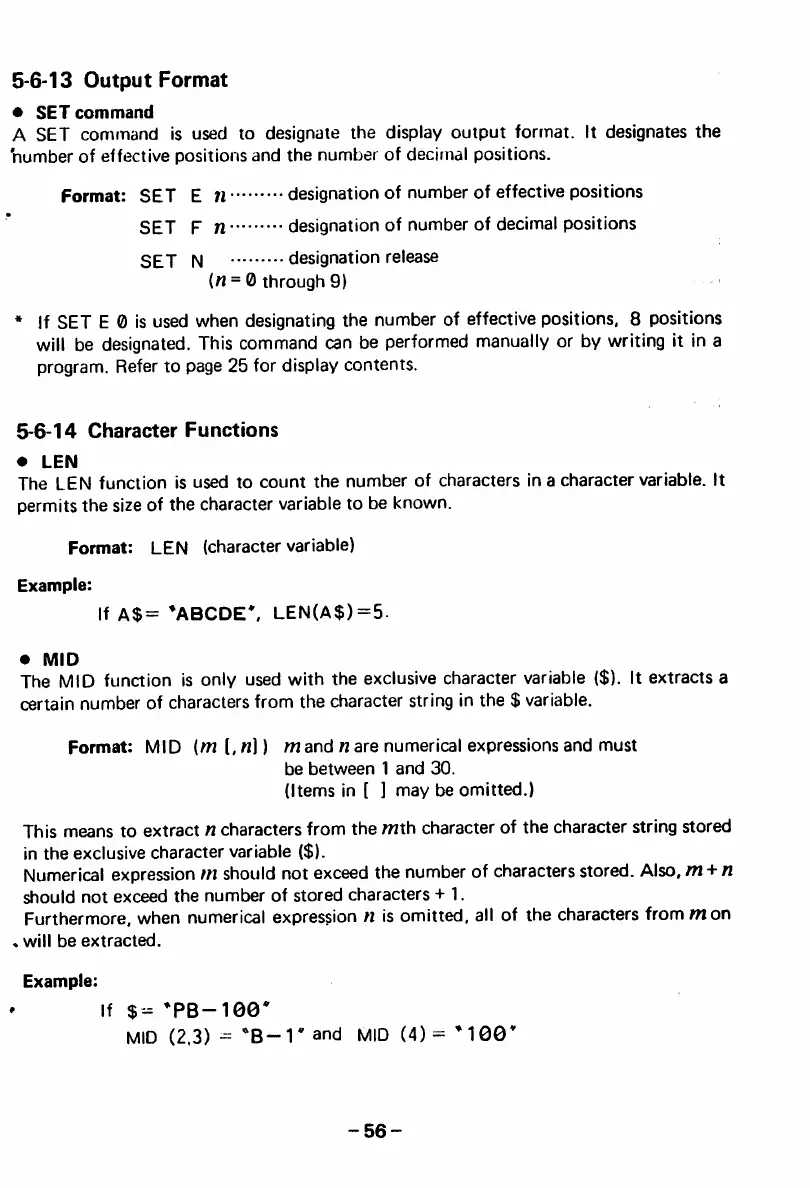
5-6-13 Output Format
• S E T c o m m a n d
A SET command is used to designate the display output format. It designates the
number of effective positions and the number of decimal positions.
Format: SET E 71 designation of number of effective positions
SET F n designation of number of decimal positions
set N designation release
(rt = 0 through 9)
• If SET E 0 is used when designating the number of effective positions, 8 positions
will be designated. This command can be performed manually or by writing it in a
program. Refer to page 25 for display contents.
5 - 6 - 1 4 C h a r a c t e r F u n c t i o n s
• L E N
The LEN function is used to count the number of characters in a character variable. It
permits the size of the character variable to be known.
Format: LEN (character variable)
Example:
If A$= '"ABODE*, LEN(A$)=5.
• M I D
The MID function is only used with the exclusive character variable ($). It extracts a
certain number of characters from the character string in the $ variable.
Format: MID (w I, n]) mand n are numerical expressions and must
be between 1 and 30.
(Items in [ ] may be omitted.)
This means to extract n characters from the mth character of the character string stored
in the exclusive character variable ($).
Numerical expression m should not exceed the number of characters stored. Also, m + n
should not exceed the number of stored characters + 1.
Furthermore, when numerical expression n is omitted, all of the characters from mon
. will be extracted.
Example:
If $--= '"PB-100*
MID (2.3) - ^B-r and MID (4)= *100*
-56-



 To Next Page