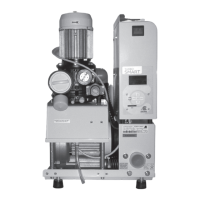
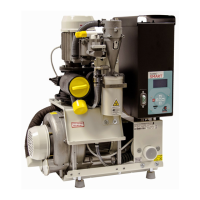
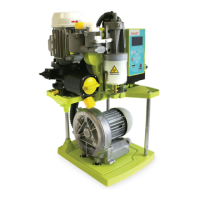
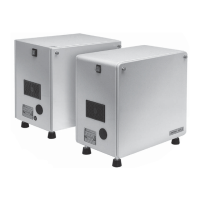
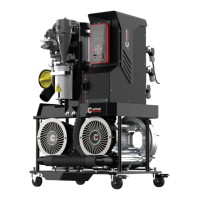
The ASPI-JET 6-7-8-9 γ is a series of dental aspirators manufactured by CATTANI S.p.A. in Parma, Italy. These mobile aspirators are designed to provide efficient aspiration independent of the dental unit, offering flexibility in various working positions within a dental surgery. The series includes different models with varying features to suit specific needs.
Function Description:
The primary function of the ASPI-JET series is to aspirate liquids and air during dental procedures. The aspirated mixture is conveyed through the tip and lifted hose into a canister where liquids are separated from air. The air is then directed to the motor and exhausted, while liquids are collected at the bottom of the canister.
- ASPI-JET 6 γ: This model features a canister that needs to be emptied manually. Its capacity allows for 8-10 hours of continuous service before reaching maximum level, requiring manual emptying every evening after work. Its mobility makes it suitable as an emergency aspirator or to supplement centralized plants or dental unit aspiration systems.
- ASPI-JET 7 γ: This model is equipped with automatic drainage. It must be connected to the building's waste system. A valve at the bottom of the canister remains closed due to depression during suction. When all terminals are in their seats, suction stops, and liquids are automatically drained. If the canister fills during surgical operations, maximum level probes (at approximately 3/4 capacity) activate, opening the electrical circuit, stopping suction, and illuminating a yellow indicator on the front panel to warn that the canister is full. The draining pump (8) then activates, emptying the canister in a few seconds, and suction resumes automatically.
- ASPI-JET 8 γ and ASPI-JET 9 γ: These models offer additional functions beyond those of the ASPI-JET 7 γ. The ASPI-JET 8 γ includes water supply to the tumbler, indicated by a tumbler symbol on the front panel. The ASPI-JET 9 γ provides water supply for rinsing the spittoon (cuspidor), indicated by a tap symbol on the front panel. Both models require connection to a water supply and include a pressure control device to adjust water pressure to a maximum of 4 bar.
The appliance cannot be used in contact with a flammable anesthetic mixture with air, oxygen, or nitrous oxide.
Important Technical Specifications:
- Rated Voltage: 230 V~ (Other available tensions: 240 V~ 50 Hz 2.95 A, 220 V~ 60 Hz 3.5 A, 120 V~ 60 Hz 6.0 A, 110 V~ 60 Hz 7.0 A)
- Rated Frequency: 50 Hz
- Rated Current: 3.1 A
- Insulation Class: Class I
- Type of Appliance: B
- Use: Continuous service
- Protection against liquids: COMMON IP20
- Level of protection against direct or indirect contact: Type B
- Room Conditions (temperature): From +5 °C to +40 °C
- Motor Protection: Thermal device
- Output Power: 0.4 kW
- Maximum Flow: 1250 l/min
- Maximum Operating Head for Continuous Service: 130 mbar
- Sound Pressure Level (tip no. 10 open, others closed): 58 dB(A)*
- Sound Pressure Level (tip no. 20 open, others closed): 62 dB(A)*
*Sound pressure level tested according to ISO 3746-1979 (E) regulation. Parameters: r or d=1.5 - Background noise < 38 dB (A) - Instruments: Brüel & Kjær Type 2232.
Usage Features:
- On/Off Switch: Located on the front panel (1). Pressing it switches the unit on, and aspiration starts when a terminal is lifted from its seat. Opening the cabinet door opens the electrical circuit and stops the aspirator.
- Foam Prevention: During surgical operations, foam build-up from blood and aspirated air can trigger the probes and stop the unit. The use of solid anti-foaming agents (e.g., Disinfecting antifoaming agent for dental aspirators, Puli-Jet plus new with anti-scale agent) is recommended.
- Overheating Protection: The Uni-Jet 75 suction unit and draining pump (8) are protected by a thermal device that opens the circuit if temperatures exceed 120 °C and 90 °C, respectively. The circuit automatically resets when the temperature returns to normal.
- Exhausted Air: In standard assembled units, aspirated air is exhausted through the silencer (2). For conveying exhausted air outside, an extension to hose 3C can be fitted. A certified antibacterial filter for exhausted air is available upon request.
- Water Supply Connection (Aspi-Jet 8 γ and 9 γ): Requires connecting the water supply without removing the antispray tube (15), which protects the Rilsan tube against bursting. Water pressure should be adjusted to a maximum of 4 bar using the pressure control device (12).
Maintenance Features:
Regular maintenance and cleaning are crucial for the longevity and safe operation of the ASPI-JET series. Prior to any servicing, the appliance should be cleaned with Puli-Jet plus new or Puli-Jet 2.0. Disposable gloves, goggles, mask, and overall should be worn during maintenance due to biological and electrical hazards.
- Daily Cleaning:
- After every patient: Replace or disinfect the external hose (preferably with Eco-Jet 1).
- After every surgical or long operation: Rinse the appliance by aspirating hot water (50 °C).
- At noon (before lunch): Clean the system with Puli-Jet plus new or Puli-Jet 2.0 (sanitizing at 4% - disinfecting at 8%).
- After each working day: Clean filters, clean the plant with disinfecting Puli-Jet plus new or Puli-Jet 2.0 and hot water.
- Filter Cleaning: Filters must be cleaned daily to protect the motor and recover particles.
- Aspi-Jet 6 γ: Features a debris filter (9) visible from outside the cabinet. To remove, turn on the unit, aspirate air for a few seconds to dry hoses and manifold, disconnect power, lift terminals, and remove manifold (4) by pulling the filter outwards by its handle.
- Aspi-Jet 7 γ: Has a filter (10) on the canister cover. To check, lift the bent pipe union (11).
- Canister Cleaning:
- Aspi-Jet 6 γ: Every evening, after disconnecting power, loosen the two rubber bands, remove the lid, take out the canister, empty, and clean it.
- Aspi-Jet 7-8-9 γ: The canister must be removed, cleaned, and disinfected fortnightly. Canisters, covers, and probes of all models should be accurately cleaned once a week with a sponge and Puli-Jet plus new or Puli-Jet plus 2.0 diluted in hot water.
- Every evening, after cleaning the filters, aspirate Puli-Jet plus new or Puli-Jet 2.0 diluted in hot water. Disinfection and cleaning should be performed using Pulse Cleaner.
- Lubrication: O-rings (tightening rings) and sliding closures of terminals must be lubricated with Lubri-Jet spray every 15 working days.
- Hose Replacement: It is advisable to periodically replace all hoses of the plant (especially outside the unit) and terminals for sanitary and functional reasons.
- Engineer-Specific Maintenance:
- Periodically check the water filter (13) for Aspi-Jet 8 γ and 9 γ.
- Periodically replace terminals and hoses outside the unit.
- Engineers should check siphons, outlets, all internal piping, plastic, and rubber components for aging.
- Periodically check the capacity of the capacitor with a capacitance meter (max. -5%) and replace if necessary.
- Before servicing used equipment, perform washing operations with Puli-Jet plus new with anti-scale agent or Puli-Jet 2.0.
- Disconnect electric supply and padlock the mains switch if provided.
- Check conditions of tubes carrying aspirated liquid, especially after the draining pump; replace cracked pipes.
- Ensure personnel are instructed on daily maintenance routines.
- Do not alter the equipment or its functioning.
- Transport of Second-Hand Appliances: Prior to packing, cleanse and sanitize with Puli-Jet plus new or Puli-Jet 2.0. Close all internal communications with seal polyethylene plugs. Place the unit in a polyethylene bag, seal, and pack in 3-layer corrugated board.
Certification and Compliance:
The ASPI-JET Models 6-7-8-9 γ are certified as medical equipment according to Directive 93/42/CEE. Servicing must be performed by authorized engineers using original CATTANI spare parts. After any intervention involving part replacement, the equipment must be retested according to IEC EN 62353 standards. Periodic inspections and tests are recommended as per CEI EN 60601-1 (CEI 62-5) standards. The appliance is a WEEE (Waste of electric and electronic equipment) device and is subject to relevant regulations for waste disposal. Improper disposal by the user may result in administrative sanctions.
Electromagnetic Compatibility:
The device complies with EN 60601-1-2:2015 standard for electromagnetic compatibility. However, it can interfere with other nearby equipment. It should not be used in proximity to or stacked on other equipment. Installation should be away from equipment emitting high frequency (short waves, microwaves, electro surgery units, cellular telephones). The customer or operator should maintain a minimum distance between mobile and RF portable communication devices and the medical equipment, as recommended in the manual, based on the maximum output power of radio communication devices.

 Need help?
 General

 To Next Page