EasyManua.ls Logo

CDI 174-8778K 1 - User Manual

Default Icon
4 pages
Print Icon
To Next Page IconTo Next Page
Loading...
Installation and Troubleshooting Guide
This installation is to be completed by an Authorized Dealer or Professional Service
Technician. For questions regarding installation or warranty, call CDI Tech Support
at 866-423-4832. Do not return to the Dealer or Distributor where the part was purchased.
Contact CDI Electronics Directly for Return Material Authorization.
CDI Electronics, LLC 353 James Record Road SW Huntsville, AL 35824 USA
Web Support: www.cdielectronics.com Tech Support: 1-866-423-4832 Order Parts: 1-800-467-3371
All rights reserved. Reproduction or use of content, in any manner, without express written permission by CDI Electronics, LLC., is prohibited.
Rev H 6/19/2023 Page - 1 of 4 QF-358
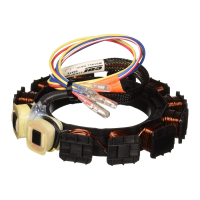
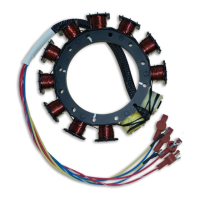
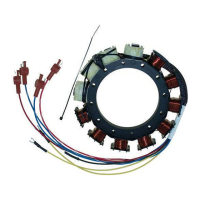
CDI P/N: 174-8778K 1
This unit replaces the following 2, 3, and 4 cylinder P/N's: 398-818535A 3, 5, 8, 9,10,13,14, 15, and 31; 398-8778A6, 10, 16, 17, 18, 21, 22,
23, 24, 25, 26, 27, 28, 29, and F749095.
Warning! This product is designed for installation by a professional marine mechanic. CDI Electronics cannot be held liable for
injury or damage resulting from improper installation, abuse, neglect, or misuse of this product.
It is recommended that dielectric grease (i.e. CDI 991-9705) be used in the bullet nose connectors to help prevent corrosion.
Any sign of leakage out of the high voltage coils or bubbling around the battery charge windings indicate a bad Stator. Check for burned
marks on each pole. If a problem is found on the battery windings, we recommend the Rectifier be closely checked. To replace Stators with
ring terminals, please use the fork terminals enclosed with this Stator.
If this Stator is to be used as a replacement for the Mercury Red Stator, connect all wires to the Switchbox in their designated
position. The Adapter Module used with the Red Stator is no longer needed.
If this Stator is to be used on a 3 cylinder engine, connect the Red/white and Blue/white striped wires to engine ground.
This Stator can be used with either a 9 amp Rectifier or a 16 amp Voltage Regulator.
INSTALLATION
1. Disconnect the Negative battery cable.
2. Disconnect the Stator wires from the Switchbox, engine ground, and the Rectifier.
3. Remove the flywheel according to the service manual for your engine.
4. Mark the position of the mounting screws in relation to where the Stator wires come out of the old Stator and remove the old Stator.
5. Orient and install the new Stator (using a good thread locker applied to the bolts) in the same position as the old Stator on the engine
and install the flywheel, following the service manual instructions.
6. Connect the Yellow wires from the Stator to the Rectifier, ignoring any stripes on the Regulator’s Yellow wires.
7. Connect the Stator leads as follows:
New Stator 2 Cylinder Switchbox 3 Cylinder Switchbox 4 Cylinder Switchbox
Red (High speed Coil) Red (High speed Coil) Red (High speed Coil) Red (High speed Coil)
Blue (Low speed Coil) Blue (Low speed Coil) Blue (Low speed Coil) Blue (Low speed Coil)
Red/White (High speed Coil) Red/White (High speed Coil) Engine Ground Red/White Stripe (High speed Coil)
Blue/White (Low speed Coil) Blue/White (Low speed Coil) Engine Ground Blue/White Stripe (Low speed Coil)
7. If this Stator is to be used on a 3 cylinder engine application, connect the Red/White and Blue/White striped wires to a known good
engine ground.
8. If using this Stator on an application that uses a Switchbox with stud connections, it will be necessary for you to remove the female
bullet connectors attached to the Blue, Blue/White, Red, and Red/White wires that are preinstalled from the factory and install the fork
terminals that come supplied in the kit provided with the Stator. Crimp or solder the fork connectors to the Blue, Blue/White, Red, and
Red/White wires.
9. If your engine used a Mercury Red Stator Kit, it is normal for that application to have NOT used the Red and the Red/White wire (or
Red and Red/White stud post on a studded Switchbox). These are usually either taped up or capped off. With the CDI Electronics 194-
8778K 1 Stator, the Red and Red/White wire WILL be used. Find the Red wire (or Red stud post on a studded Switchbox) and connect
the Solid Red wire from the New Stator to the Switchbox. On a 2 and 4 cylinder application, connect the Red/White wire to the
Switchbox in its appropriate place. On a 3 cylinder application, connect the remaining Red/White and Blue/White striped wires to a
known good engine ground.
10. Replace the flywheel according to the service manual.
11. Connect the Negative battery cable.

Question and Answer IconNeed help?

Do you have a question about the CDI 174-8778K 1 and is the answer not in the manual?

Summary

Installation and Wiring

Wiring Connections for Cylinder Configurations

Specifies how to connect Stator wires to Switchbox for 2, 3, and 4 cylinder engines.

Troubleshooting Engine Performance

Engine Stop Circuit (Kill) DC Voltage Test

Procedure to test the engine stop circuit for DC voltage issues at the Switchbox.

No Spark Diagnosis

Steps to diagnose and resolve no spark issues on any cylinder.

Stator Resistance and DVA Checks

Checks for Stator resistance and DVA values for 2, 3, and 4 cylinder engines.

Engine Operation Troubleshooting

High Speed Misfire or Weak Hole Shot

Troubleshooting guide for high-speed misfires or weak hole shots.

Engine Will Not Stop (Kill) Troubleshooting

Steps to diagnose why the engine will not stop.

Battery Charging System

Battery Charging Issues Diagnosis

Identifies common causes and troubleshooting steps for charging issues.

Maintenance-Free Battery Warning

Warning against using maintenance-free batteries in outboard applications.

Performance Testing

Maximum Output Test Procedure

Steps to test the maximum electrical output of the system.

Tachometer Signal Testing

Procedures for testing tachometer signal generation from the Stator.

Overcharging Troubleshooting

Steps to diagnose and resolve battery overcharging issues.

Summary

Installation and Wiring

Wiring Connections for Cylinder Configurations

Specifies how to connect Stator wires to Switchbox for 2, 3, and 4 cylinder engines.

Troubleshooting Engine Performance

Engine Stop Circuit (Kill) DC Voltage Test

Procedure to test the engine stop circuit for DC voltage issues at the Switchbox.

No Spark Diagnosis

Steps to diagnose and resolve no spark issues on any cylinder.

Stator Resistance and DVA Checks

Checks for Stator resistance and DVA values for 2, 3, and 4 cylinder engines.

Engine Operation Troubleshooting

High Speed Misfire or Weak Hole Shot

Troubleshooting guide for high-speed misfires or weak hole shots.

Engine Will Not Stop (Kill) Troubleshooting

Steps to diagnose why the engine will not stop.

Battery Charging System

Battery Charging Issues Diagnosis

Identifies common causes and troubleshooting steps for charging issues.

Maintenance-Free Battery Warning

Warning against using maintenance-free batteries in outboard applications.

Performance Testing

Maximum Output Test Procedure

Steps to test the maximum electrical output of the system.

Tachometer Signal Testing

Procedures for testing tachometer signal generation from the Stator.

Overcharging Troubleshooting

Steps to diagnose and resolve battery overcharging issues.

Overview

The CDI P/N: 174-8778K 1 is an installation and troubleshooting guide for a marine engine stator, designed to replace several older 2, 3, and 4 cylinder P/N stators. This product is intended for installation by professional marine mechanics, and CDI Electronics disclaims liability for improper installation, abuse, neglect, or misuse.

Function Description:

The CDI 174-8778K 1 stator is a critical component for marine engine ignition and battery charging systems. It generates electrical current for both the ignition system (via the switchbox) and the battery charging system (via the rectifier or voltage regulator). The guide provides detailed instructions for installation and troubleshooting common issues related to the stator, such as no spark, high-speed misfire, weak hole shot, engine not stopping, and battery charging problems.

Important Technical Specifications:

  • Compatibility: Replaces 2, 3, and 4 cylinder P/N stators: 398-818535A 3, 5, 8, 9,10,13,14, 15, and 31; 398-8778A6, 10, 16, 17, 18, 21, 22, 23, 24, 25, 26, 27, 28, 29, and F749095.
  • Rectifier/Regulator Compatibility: Can be used with either a 9 amp Rectifier or a 16 amp Voltage Regulator.
  • Stator Lead Connections (for 2 Cylinder Switchbox):
    • Red (High speed Coil) to Red (High speed Coil)
    • Blue (Low speed Coil) to Blue (Low speed Coil)
    • Red/White (High speed Coil) to Red/White (High speed Coil)
    • Blue/White (Low speed Coil) to Blue/White (Low speed Coil)
  • Stator Lead Connections (for 3 Cylinder Switchbox):
    • Red (High speed Coil) to Red (High speed Coil)
    • Blue (Low speed Coil) to Blue (Low speed Coil)
    • Red/White (High speed Coil) to Engine Ground
    • Blue/White (Low speed Coil) to Engine Ground
    • Note: For 3 cylinder engines, the Red/White and Blue/White striped wires connect to engine ground.
  • Stator Lead Connections (for 4 Cylinder Switchbox):
    • Red (High speed Coil) to Red (High speed Coil)
    • Blue (Low speed Coil) to Blue (Low speed Coil)
    • Red/White (High speed Coil) to Red/White Stripe (High speed Coil)
    • Blue/White (Low speed Coil) to Blue/White Stripe (Low speed Coil)
  • Resistance and DVA (Disconnected) Specifications (2 Cylinder Engine):
    • Blue (Low speed Coil) to Blue/White (Low speed Coil): 500-700 Ω, 180 V Minimum DVA
    • Red (High speed Coil) to Red/White (High speed Coil): 28-32 Ω, 25 V Minimum DVA
    • Purple (#1 Trigger) to White (#2 Trigger): 0.8-1.4K Ω, 4 V Minimum DVA
    • Purple (#1 Trigger) to Engine Gnd: Open, 1 V Minimum DVA
    • White (#2 Trigger) to Engine Gnd: Open, 1 V Minimum DVA
  • Resistance and DVA (Disconnected) Specifications (3 Cylinder Engine):
    • Blue (Low speed Coil) to Engine Gnd: 500-700 Ω, 180 V Minimum DVA
    • Red (High speed Coil) to Engine Gnd: 28-32 Ω, 25 V Minimum DVA
    • Brown (Trigger) (a) to White/Black (or Black) (Trigger): 0.8-1.4K Ω, 4 V Minimum DVA
    • White (Trigger) (a) to White/Black (or Black) (Trigger): 0.8-1.4K Ω, 4 V Minimum DVA
    • Purple (Trigger) (a) to White/Black (or Black) (Trigger): 0.8-1.4K Ω, 4 V Minimum DVA
    • Brown (Trigger) (a) to Engine Gnd: Open, 1 V Minimum DVA
    • White (Trigger) (a) to Engine Gnd: Open, 1 V Minimum DVA
    • Purple (Trigger) (a) to Engine Gnd: Open, 1 V Minimum DVA
  • Resistance and DVA (Disconnected) Specifications (4 Cylinder Engine):
    • Blue (Low speed Coil) to Blue/White (Low speed Coil): 500-700 Ω, 180 V Minimum DVA
    • Red (High speed Coil) to Red/White (High speed Coil): 28-32 Ω, 25 V Minimum DVA
    • Purple (#1 Trigger) to White (#2 Trigger): 0.8-1.4K Ω, 4 V Minimum DVA
    • Brown (#3 Trigger) to White/Black or Black (#4 Trigger): 0.8-1.4K Ω, 4 V Minimum DVA
    • Purple (#1 Trigger) to Engine Gnd: Open, 1 V Minimum DVA
    • White (#2 Trigger) to Engine Gnd: Open, 1 V Minimum DVA
    • Brown (#3 Trigger) to Engine Gnd: Open, 1 V Minimum DVA
    • White/Black (#4 Trigger) to Engine Gnd: Open, 1 V Minimum DVA
  • Cranking RPM: Minimum 250 RPM for proper spark.
  • Battery Charge Wires DVA (Connected to Rectifier): 8-25 DVA at idle.
  • Battery Charge Wires DVA (Disconnected from Rectifier): 17-50 DVA at idle.
  • Tachometer Gray Wire DVA (from Rectifier to engine ground): 8 DVA or more at 800-1,000 RPM.

Usage Features:

  • Direct Replacement: Designed to directly replace specific older stator models, simplifying the upgrade process.
  • Adapter Module Elimination: When replacing a Mercury "Red" Stator, the adapter module is no longer needed.
  • Fork Terminals: Includes fork terminals for applications using switchboxes with stud connections, requiring removal of preinstalled female bullet connectors.
  • Wiring Flexibility: Specific wiring instructions are provided for 2, 3, and 4 cylinder engine configurations, including grounding for 3-cylinder setups.
  • Troubleshooting Guides: Comprehensive guides for diagnosing various issues:
    • No Spark: Covers visual inspection, kill circuit checks, rectifier checks, cranking RPM, and stator/trigger resistance and DVA tests.
    • High Speed Misfire or Weak Hole Shot: Involves DVA testing of stator wires, rectifier checks, and stator rotation tests.
    • Engine Will Not Stop (Kill): Focuses on checking the kill circuit and related components (key switch, harness, shift switch).
    • Battery Charging Issues: Addresses overcharging and undercharging, emphasizing battery type, connections, and stator DVA.
    • Maximum Output Test: Procedure to verify the stator's charging output using an ammeter and load bank.
    • Tachometer Tests: Steps to diagnose tachometer signal issues by checking DVA on stator and rectifier gray wires.

Maintenance Features:

  • Dielectric Grease Recommendation: Use CDI 991-9705 dielectric grease on bullet nose connectors to prevent corrosion.
  • Visual Inspection: Regularly check for signs of stator failure such as leakage from high voltage coils, bubbling around battery charge windings, burned marks on poles, browning, or varnish dripping.
  • Battery Type Emphasis: Strongly recommends using single (NOT more than one) 850+ CCA dual purpose or cranking/starting non-maintenance-free, lead-acid flooded cell batteries for outboards. Warns against using maintenance-free batteries due to shortened lifespan and risk to the regulator.
  • Connection Integrity: Stresses the importance of tight, corrosion-free battery connections, especially at engine ground, and advises against using wing nuts.
  • Thread Locker: Recommends applying thread locker to stator mounting bolts during installation.
  • Service Manual Adherence: Directs users to follow the engine's service manual for flywheel removal and installation.

CDI 174-8778K 1 Specifications

General IconGeneral
BrandCDI
Model174-8778K 1
CategoryMarine Equipment
LanguageEnglish

Related product manuals