STAR HOPPING
The easiest way to find your way around the sky is by a technique called star hopping. The first thing you will need to do is measure the field of
view of your finderscope. Look in the sky and locate a constellation with bright stars. You can use your planisphere or astronomy app to help
identify it. Now find the map in your star atlas that shows this constellation. Center your finderscope on any bright star that you can recognize on
the star map. Hold your head 12 inches behind the reflective window of your StarPointer finderscope and move the telescope so that the bright
star is at the edge of the field if view of the window (it does not matter which direction you pick). Without moving the telescope, look through
the finderscope window and locate another star near the opposite edge of the field of view. Locate this second star on the chart. Measure the
distance between these two stars on the chart using a ruler. This distance is represents one finderscope field of view on your atlas. You can
now use this measurement to locate celestial objects.
CARE AND CLEANING OF THE TELESCOPE
While your telescope requires little maintenance, there are a few things to remember that will ensure your telescope performs at its
best. Occasionally, dust and/or moisture may build up on the objective lens. Special care should be taken when cleaning any instrument
so as not to damage the optics.
If dust has built up on the optics, follow these steps, in order, to clean your scope:
1. Use a camel hair brush to gently remove the larger particles.
2. Use a photographer’s squeeze bulb to blow away any loose debris. You can also use a can of compressed air, such as those sold for
cleaning computer keyboards, but you need to be careful. Avoid using cans that are almost empty and be sure to hold the air can vertically.
Failure to do this can result in the can spitting propellant out onto the optics. Hold the optical surface at an angle to the spray from the can
for approximately two to four seconds.
3. Use an optical cleaning solution of over-the-counter isopropyl alcohol and distilled water in a 50/50 mixture. Apply this solution to a white
unscented tissue, then apply the tissue paper to the optics. Low pressure strokes should go from the center of the lens (or mirror) to the outer
portion in straight lines like spokes on a wheel. Do not rub in circles!
You may experience dew build-up on the optics of your telescope during an observing session. If you want to continue observing, the
dew must be removed, either with a hair dryer (on low setting) or by pointing the telescope at the ground until the dew has evaporated. If
moisture condenses on the inside of the optics, remove the accessories from the telescope. Place the telescope in a dust-free environment
and point it downward until the moisture evaporates.
To minimize the need to clean your telescope, replace all lens covers once you have finished using it. Since the telescope tubes are not
sealed, the covers should be placed over the openings when not in use. This will prevent contaminants from entering the tubes. Internal
adjustments and cleaning should be done only by the Celestron repair department. If your telescope is in need of internal cleaning,
please call the factory for a return authorization number and price quote.
COLLIMATION OF A NEWTONIAN TELESCOPE
While your telescope requires little maintenance, there are a few things to remember that will ensure your telescope performs at
its Collimation is the process of aligning the mirrors of your telescope so that they work in concert with each other to deliver properly
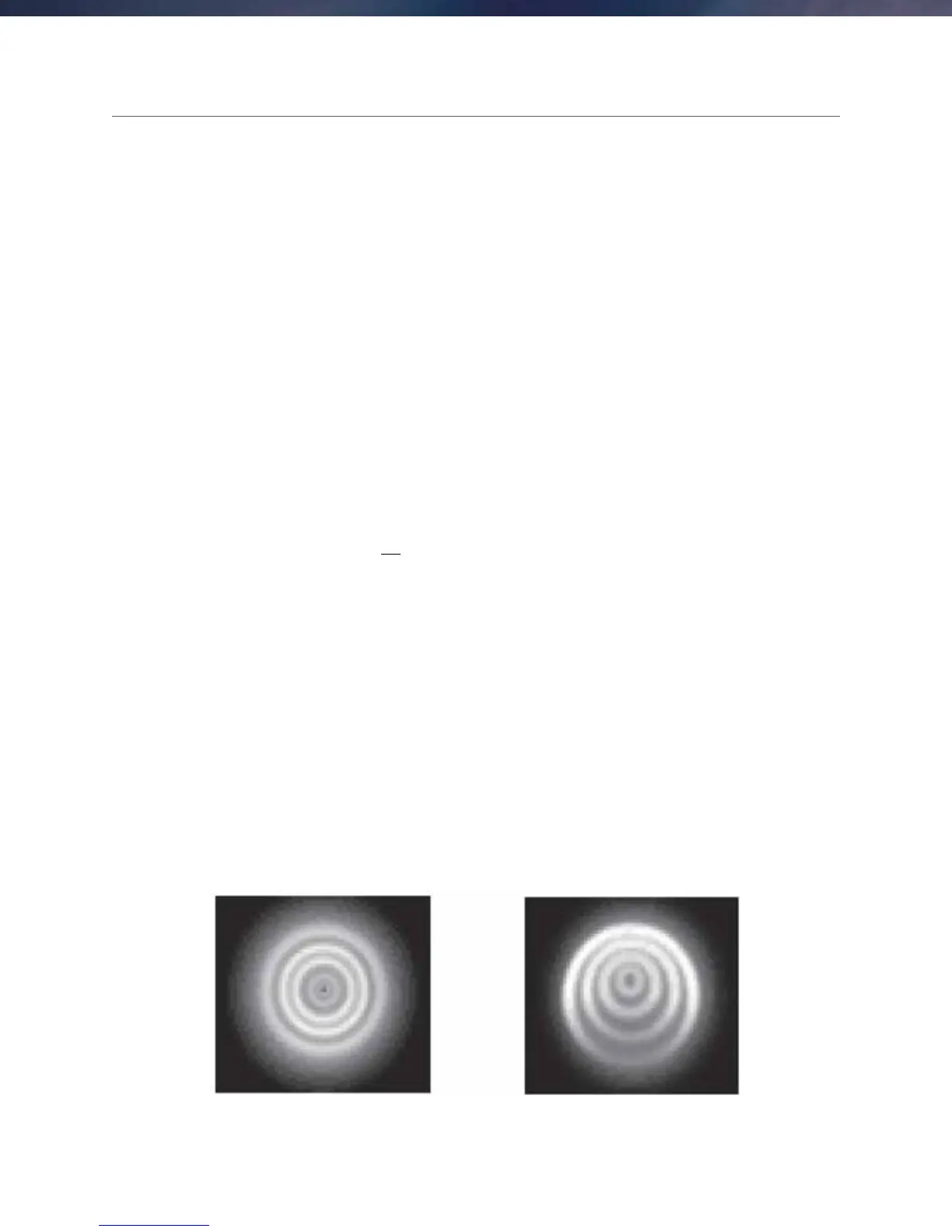
focused light to your eyepiece. By observing out-of-focus star images, you can test whether your telescope’s optics are aligned. Place
a star in the center of the field of view and move the focuser so that the image is slightly out of focus. If the seeing conditions are good,
you will see a central circle of light (the Airy disc) surrounded by a number of diffraction rings. If the rings are symmetrical about the Airy
disc, the telescope’s optics are correctly collimated.
Correctly Aligned Needs Collimation
30 I ENGLISH



 To Next Page