
 Need help?
Do you have a question about the Celestron AstroMaster LT and is the answer not in the manual?
Step-by-step instructions for assembling the telescope's tripod for a stable base.
How to point and lock the telescope using the pan handle and azimuth lock.
Procedure for securely mounting the optical tube onto the telescope's alt-azimuth mount.
Guide for inserting the diagonal and eyepieces into refractor telescope focusers.
Instructions for attaching eyepieces to the focuser of Newtonian telescopes.
Explains how images appear inverted or reversed based on telescope and eyepiece setup.
How to use the focus knob to achieve a sharp and clear image.
Steps to align the finderscope with the main telescope for accurate object acquisition.
Formula to determine telescope magnification based on eyepiece focal length.
Method to calculate the angular and linear field of view for observing.
Practical tips for improving the observing experience and image quality.
Explains the celestial coordinate system (RA and Dec) for locating sky objects.
Describes how stars appear to move in the sky due to Earth's rotation.
Guidance for viewing the Moon, including optimal phases and details to observe.
Tips for viewing planets, detailing features of major planets like Jupiter and Saturn.
Instructions for safe solar observation, emphasizing necessary protective measures.
Information on viewing celestial objects beyond our solar system.
A method for navigating the night sky to locate specific deep-sky targets.
Factors affecting atmospheric stability and their impact on viewing quality.
Introduction to capturing celestial images directly through the telescope.
Using specialized cameras for improved planetary and lunar image capture.
Overview of CCD cameras for detailed deep-sky object imaging.
Utilizing the telescope as a telephoto lens for landscape and wildlife photos.
Essential procedures for cleaning telescope lenses and mirrors to preserve optical quality.
Instructions for aligning optical components to optimize image clarity and reduce aberrations.
Steps to adjust the secondary mirror for proper optical alignment in Newtonian telescopes.
Procedure for adjusting the primary mirror to achieve concentric alignment.
Fine-tuning telescope collimation using stars for optimal performance.
 General
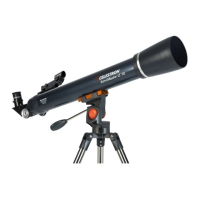
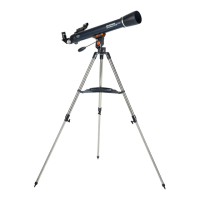
| Aperture | 70 mm |
|---|---|
| Optical Design | Refractor |
| Mount Type | Altazimuth |
| Eyepiece 1 | 20 mm |
| Eyepiece 2 | 10 mm |
| Finderscope | StarPointer |
| Eyepiece Barrel Size | 1.25 inches |
| Weight | 6.08 kg |
| Tripod | Pre-assembled tripod with 1.25" steel tube legs |





 To Next Page