EasyManua.ls Logo

Celestron FIRSTSCOPE 80 EQ - Using the Setting Circles

Celestron FIRSTSCOPE 80 EQ
15 pages
Print Icon
To Next Page IconTo Next Page
To Previous Page IconTo Previous Page
Loading...
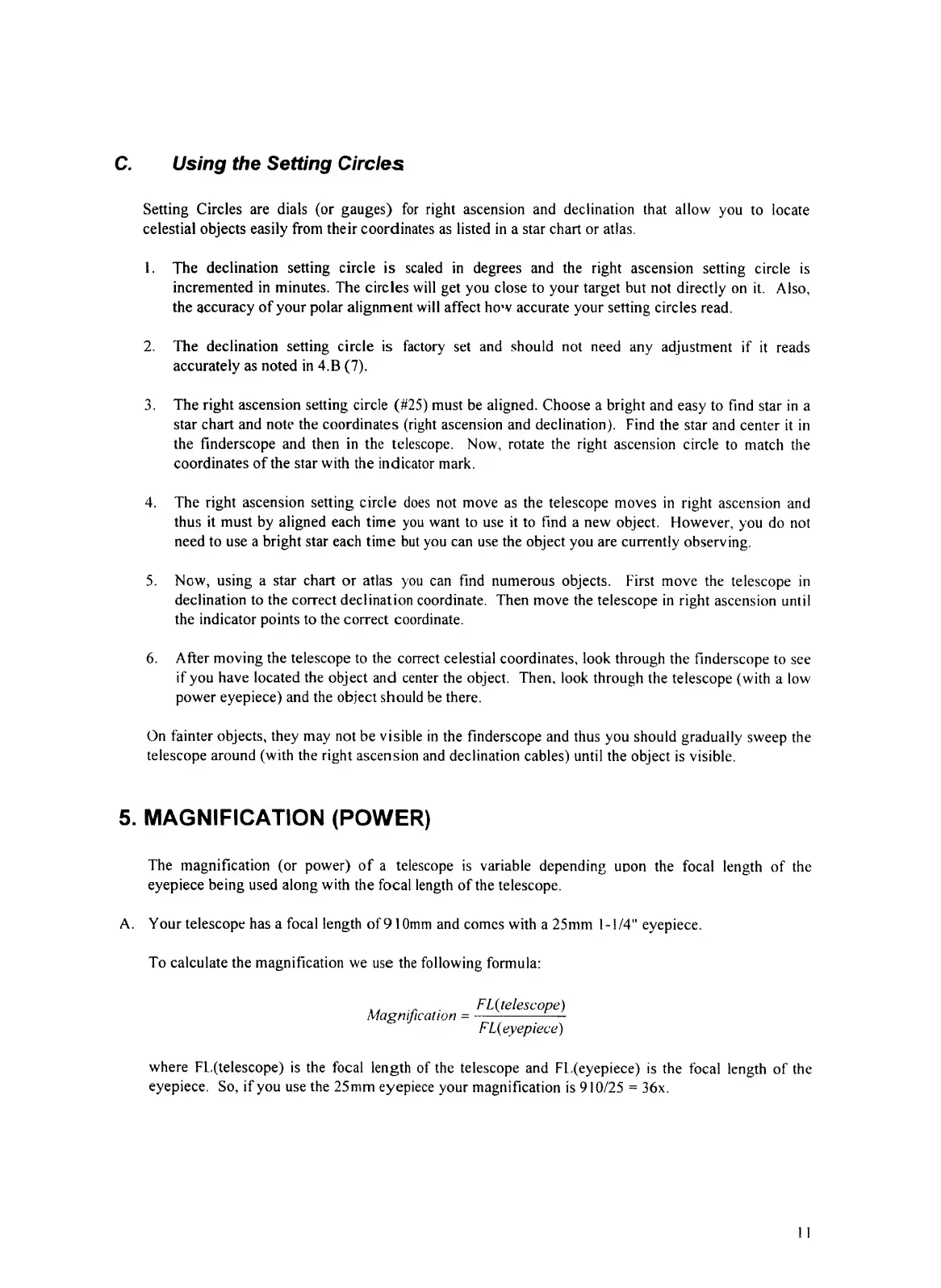
c.
Using
the
Setting
Circles
Setting
Circles
are
dials
(or
gauges)
for
right
ascension
and
declination
that
allow
you
to
locate
celestial
objects
easily
from
their
coordinates
as
listed
in
a
star
chart
or
atlas.
1.
The
declination
setting
circle
is
scaled
in
degrees
and
the
right
ascension
setting
circle
is
incremented
in
minutes.
The
circles
will
get
you
close
to
your
target
but
not
directly
on
it.
Also,
the
accuracy
of
your
polar
alignment
will
affect
how
accurate
your
setting
circles
read.
2.
The
declination
setting
circle
is
factory
set
and
should
not
need
any
adjustment
if
it
reads
accurately
as
noted
in
4.B
(7).
3.
The
right
ascension
setting
circle
(#25)
must
be
aligned.
Choose
a
bright
and
easy
to
find
star
in
a
star
chart
and
note
the
coordinates
(right
ascension
and
declination).
Find
the
star
and
center
it
in
the
finderscope
and
then
in
the
telescope.
Now,
rotate
the
right
ascension
circle
to
match
the
coordinates
of
the
star
with
the
indicator
mark.
4.
The
right
ascension
setting
circle
does
not
move
as
the
telescope
moves
in
right
ascension
and
thus
it
must
by
aligned
each
time
you
want
to
use
it
to
find
a
new
object.
However,
you
do
not
need
to
use
a
bright
star
each
time
but
you
can
use
the
object
you
are
currently
observing.
5.
Now,
using
a
star
chart
or
atlas
you
can
find
numerous
objects.
First
move
the
telescope
in
declination
to
the
correct
declination
coordinate.
Then
move
the
telescope
in
right
ascension
until
the
indicator
points
to
the
correct
coordinate.
6.
After
moving
the
telescope
to
the
correct
celestial
coordinates,
look
through
the
finderscope
to
see
if
you
have
located
the
object
and
center
the
object.
Then,
look
through
the
telescope
(with
a
low
power
eyepiece)
and
the
object
should
be
there.
On
fainter
objects,
they
may
not
be
visible
in
the
finderscope
and
thus
you
should
gradually
sweep
the
telescope
around
(with
the
right
ascension
and
declination
cables)
until
the
object
is
visible.
5.
MAGNIFICATION
(POWER)
The
magnification
(or
power)
of
a
telescope
is
variable
depending
upon
the
focal
length
of
the
eyepiece
being
used
along
with
the
focal
length
of
the
telescope.
A.
Your
telescope
has
a
focal
length
of910mm
and
comes
with
a
25mm
1-1/4"
eyepiece.
To
calculate
the
magnification
we
use
the
following
formula:
.
.
-
FL(telescope)
Magnification
=
-
FL(eyepiece)
where
FL(telescope)
is
the
focal
length
of
the
telescope
and
FL(eyepiece)
is
the
focal
length
of
the
eyepiece.
So,
if
you
use
the
25mm
eyepiece
your
magnification
is
910/25
=
36x.

Related product manuals