EasyManua.ls Logo

Celestron FIRSTSCOPE 80 EQ - The Celestial - Coordinate System

Celestron FIRSTSCOPE 80 EQ
15 pages
Print Icon
To Next Page IconTo Next Page
To Previous Page IconTo Previous Page
Loading...
4.
UNDERSTANDING
THE
SKY
A.
The
Celestial
-
Coordinate
System.
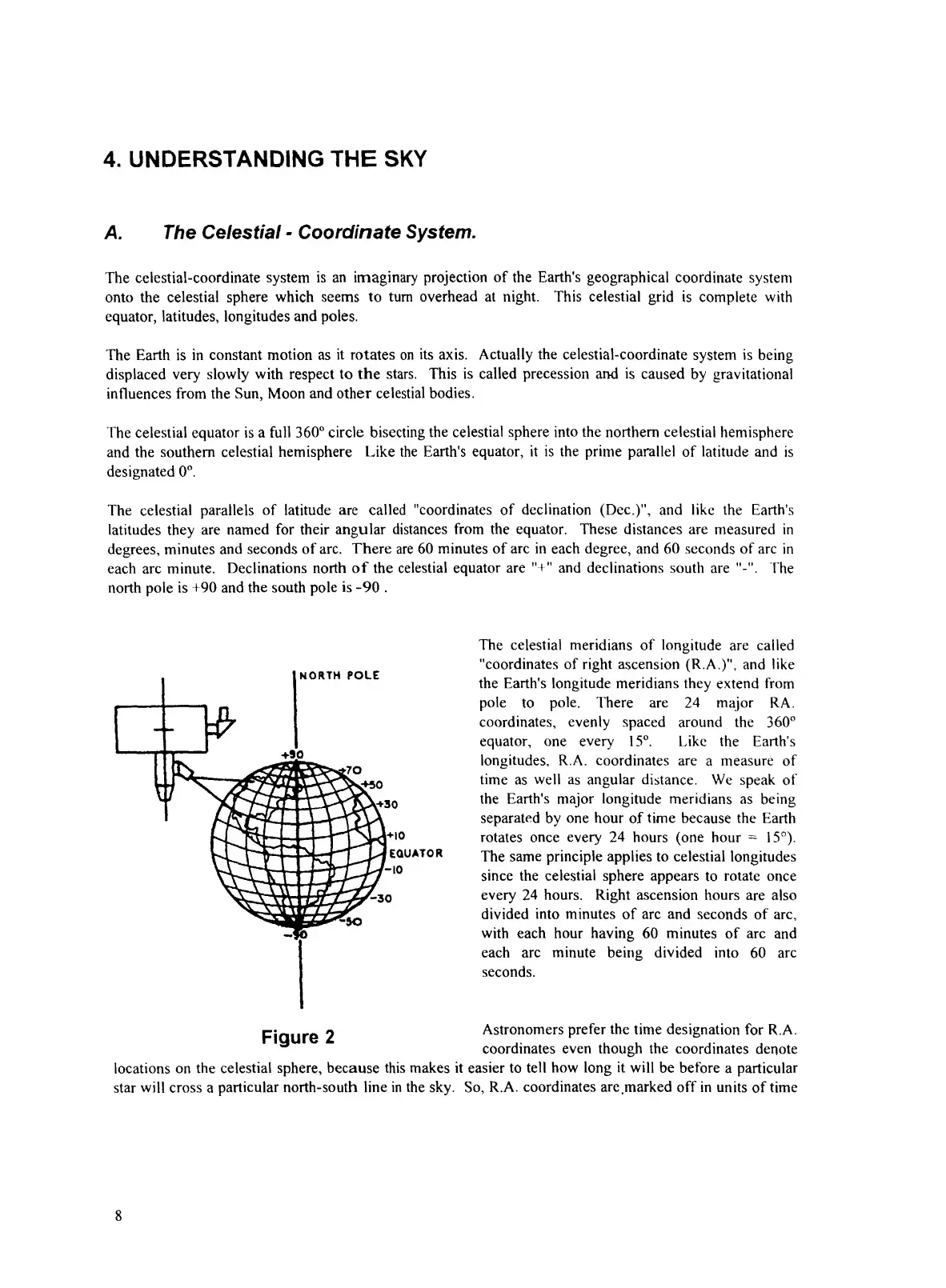
The
celestial-coordinate
system
is
an
imaginary
projection
of
the
Earth's
geographical
coordinate
system
onto
the
celestial
sphere
which
seems
to
turn
overhead
at
night.
This
celestial
grid
is
complete
with
equator,
latitudes,
longitudes
and
poles.
The
Earth
is
in
constant
motion
as
it
rotates
on
its
axis.
Actually
the
celestial-coordinate
system
is
being
displaced
very
slowly
with
respect
to
the
stars.
This
is
called
precession
and
is
caused
by
gravitational
influences
from
the
Sun,
Moon
and
other
celestial
bodies.
The
celestial
equator
is
a
full
360°
circle
bisecting
the
celestial
sphere
into
the
northern
celestial
hemisphere
and
the
southern
celestial
hemisphere
Like
the
Earth's
equator,
it
is
the
prime
parallel
of
latitude
and
is
designated
0°.
The
celestial
parallels
of
latitude
are
called
"coordinates
of
declination
(Dec.)",
and
like
the
Earth’s
latitudes
they
are
named
for
their
angular
distances
from
the
equator.
These
distances
are
measured
in
degrees,
minutes
and
seconds
of
arc.
There
are
60
minutes
of
arc
in
each
degree,
and
60
seconds
of
arc
in
each
arc
minute.
Declinations
north
of
the
celestial
equator
are
"+"
and
declinations
south
are
The
north
pole
is
+90
and
the
south
pole
is
-90
.
The
celestial
meridians
of
longitude
are
called
"coordinates
of
right
ascension
(R.A.)",
and
like
the
Earth's
longitude
meridians
they
extend
from
pole
to
pole.
There
are
24
major
RA.
coordinates,
evenly
spaced
around
the
360°
equator,
one
every
15°.
Like
the
Earth's
longitudes,
R.A.
coordinates
are
a
measure
of
time
as
well
as
angular
distance.
We
speak
of
the
Earth's
major
longitude
meridians
as
being
separated
by
one
hour
of
time
because
the
Earth
rotates
once
every
24
hours
(one
hour
=
15°).
The
same
principle
applies
to
celestial
longitudes
since
the
celestial
sphere
appears
to
rotate
once
every
24
hours.
Right
ascension
hours
are
also
divided
into
minutes
of
arc
and
seconds
of
arc,
with
each
hour
having
60
minutes
of
arc
and
each
arc
minute
being
divided
into
60
arc
seconds.
Figure
2
locations
on
the
celestial
sphere,
because
this
makes
Astronomers
prefer
the
time
designation
for
R.A.
coordinates
even
though
the
coordinates
denote
it
easier
to
tell
how
long
it
will
be
before
a
particular
star
will
cross
a
particular
north-south
line
in
the
sky.
So,
R.A.
coordinates
are
marked
off
in
units
of
time
8

Related product manuals