
 Need help?
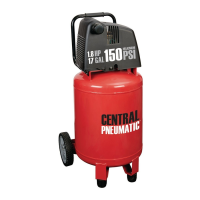
Do you have a question about the Central Pneumatic CentralPneumatic 17 GAL and is the answer not in the manual?
Provides general safety precautions for operating the compressor, including work area, electrical, and personal safety.
Avoid spraying flammable liquid in confined areas; keep compressor away from explosive vapors.
Do not adjust the regulator higher than the marked maximum pressure of the attachment.
Do not direct air stream at people or animals; do not use to supply breathing air.
Guidelines for using extension cords, including wire gauge recommendations based on amperage and length.
Notifies about lead content in brass components and handling of cords causing cancer or birth defects.
Details requirements for grounding compressors with three-prong plugs to prevent electric shock.
Defines common symbols used in the manual, such as PSI, CFM, SCFM, NPT, NPS, UL, CSA.
Specifies the voltage, frequency, and amperage for the air compressor (120V~/60Hz / 13.5A).
Lists shut-off and restart pressure ratings for the air compressor, typically 150 PSI and 125 PSI.
Indicates the air output in SCFM at different PSI ratings (e.g., 4 SCFM @ 90 PSI).
Specifies the noise level of the compressor at a given distance (91 dB @ 3').
Read safety information and unplug compressor before assembly or adjustments to prevent accidental operation.
Steps to break in the new air compressor, including running it for 30 minutes with air expelled.
Connect regulator, shut-off valve, and air hose; consider optional components like oilers or filters.
Diagram illustrating portable air supply setup for lubricated and non-lubricated tools with component descriptions.
Diagram illustrating stationary air supply setup for lubricated and non-lubricated tools with component descriptions.
Designate a clean, well-lit work area with adequate space and locate the compressor on a flat, level surface.
Step-by-step guide for operating the compressor, including closing valves, plugging in, and turning on.
Explains automatic operation based on internal pressure switch, turning on at 125 PSI and off at 150 PSI.
Procedure to quickly release stored air pressure by pulling the ring on the safety valve.
Troubleshoots automatic compressor shut-off before normal cutoff pressure, citing possible causes like extension cords or air leaks.
Emphasizes that procedures not explained in the manual must be performed only by a qualified technician.
Instructions for pre-use inspection, post-use cleaning, and checks for damage or leaks.
Provides a schedule for daily, weekly, and monthly maintenance checks, including draining the tank and inspecting the air filter.
Daily procedure to release trapped air and moisture from the tank to prevent corrosion.
Weekly check of the air filter for replacement, especially in dirty environments.
Lists possible causes like power issues, thermal overload, or circuit problems and their solutions.
Covers causes such as incorrect power supply, cold environment, leaking valves, or small cord size.
Addresses issues like dirty filters, check valve service, undersized compressor, or loose fittings.
Troubleshoots overheating due to dirty filters, dusty environments, extension cords, or unlevel surface.
Identifies causes like loose fittings, undersized compressor, or improper level surface.
Addresses causes of excessive noise like loose or damaged belt guard, loose fittings, or unlevel surface.
Suggests installing an inline air filter/dryer or relocating to a less humid environment.
Instructs to pull the test ring; if it still pops, the valve needs replacement.
Check all fittings with a soap solution for air leaks and tighten as needed.
Indicates a defective or rusted tank, requiring replacement by a qualified technician.
Comprehensive list of all parts with their corresponding numbers, descriptions, and quantities.
Space to record the product's serial number or month and year of purchase.
Exploded view diagram showing the assembly of all compressor parts with corresponding numbers.
Covers defects in materials and workmanship for 90 days, excluding damage from misuse or lack of maintenance.
Procedure to return product with proof of purchase and explanation for warranty claims.
 General
| Brand | Central Pneumatic |
|---|---|
| Model | CentralPneumatic 17 GAL |
| Category | Air Compressor |
| Language | English |

 To Next Page