The Centrodyne Z059 OBD VSS is a converter designed to extract Vehicle Speed Sensor (VSS) signals from a vehicle's On-Board Diagnostics (OBD) system, primarily for use with taximeters. This device acts as an interface, translating the digital communication protocols of modern vehicles into a usable VSS signal for external equipment.
Function Description:
The Z059's core function is to provide a reliable VSS output from a vehicle's OBD-II port. It supports various communication protocols, including CAN (Controller Area Network) and ISO standards, making it compatible with a wide range of vehicles. The device comes in two main models: a "CAN Only" model and a "CAN/ISO" model, catering to different vehicle communication architectures. It connects to the vehicle's OBD-II 16-pin connector and outputs a VSS signal via a dedicated white wire, which is then connected to the taximeter's VSS input. An optional green wire can be used for ignition detection, enabling a standby mode to minimize battery drain when the engine is off.
Important Technical Specifications:
- Supported Protocols:
- CAN Only Model: ISO 15765-4 CAN (11/29 bit)
- CAN/ISO Model: ISO 9141-2, ISO 14230-4 KWP, ISO 15765-4 CAN (11/29 bit)
- Vehicle Connectors: OBD 16-pin, fully populated with a locking tab.
- Ignition Detect Wire: 12 volts nominal (active when Z059 is active).
- VSS Signal Output: 0-5V, 5mA max.
- Current Consumption:
- CAN Only Model: 15 mA
- CAN/ISO Model: 50 mA
- VSS Frequency Output:
- 14400 pulses/Km
- 23175 pulses/mile
- LED Indicators:
- C1 & C2 LEDs: Indicate protocol search (flashing) and protocol found (solid). C1 for 29-bit CAN (CAN Only) or ISO protocol (CAN/ISO), C2 for 11-bit CAN (both models).
- P1 LED: Indicates speed pulse (flashing with pulses, solid at very low speeds, off when no speed).
Usage Features:
- Easy Installation: The device plugs directly into the vehicle's OBD-II port, typically located near the driver's seat. The VSS output (white wire) connects to the taximeter.
- Automatic Protocol Detection: The Z059 automatically searches for and identifies the vehicle's communication protocol. The C1 and C2 LEDs flash during the search and become solid once a protocol is established.
- Standby Mode (Optional): By connecting the green ignition detect wire to a switched ignition circuit, the Z059 can enter a standby mode when the engine is off, reducing battery drain. If this feature is not desired, the green wire can be left unconnected and safely clipped off.
- Real-time VSS Output: The P1 LED provides visual confirmation of speed pulses, flashing with each pulse, even at very low speeds.
- Fixed Pulse Output: The converter outputs a fixed value of 14400 pulses per Km or 23175 pulses per mile, simplifying taximeter calibration.
- Operation Notes: For the CAN/ISO model, the ISO protocol connection may take 5 to 10 seconds to activate after the engine starts, meaning VSS pulses might not be immediately available to the taximeter. The status LEDs will extinguish approximately 2 minutes after the engine is turned off.
Maintenance Features:
- Troubleshooting Guide: The manual provides a basic troubleshooting section for common issues:
- LEDs C1 and C2 Always Flashing: Suggests incompatibility with the vehicle model or year if communication isn't established after two minutes of searching.
- No Taximeter Increment: Advises verifying wiring (especially ensuring the VSS line is not shorted) and checking if the P1 LED consistently indicates vehicle speed.
- No LEDs On: Prompts the user to check if the engine is running and to verify the vehicle's fuse to the OBD connector.
- Removable Design: The installation instructions recommend securing the Z059 but allowing for its removal, which is useful for vehicle maintenance or diagnostic procedures.
- Calibration: While the Z059 provides a fixed pulse output, the taximeter still requires calibration due to vehicle-specific characteristics. The manual directs users to the relevant taximeter documentation for calibration procedures.

 Need help?
 General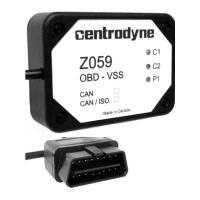

 To Next Page