
 Need help?
Do you have a question about the CERTIFIED 212cc and is the answer not in the manual?
General warnings for accident prevention.
User obligations for safe engine operation.
Safety guidelines for refueling gasoline.
Precautions regarding the hot muffler and exhaust.
Warning about poisonous carbon monoxide gas.
Safety for equipment powered by this engine.
Identifies and labels various engine parts with numbers.
How to use the engine switch to start/stop the engine.
How to operate the fuel valve for starting and stopping.
Adjusts fuel mixture for cold/warm engine starting.
Methods for manually or electrically starting the engine.
Supplies extra fuel for starting in low temperatures.
Recommended operating temperature range for the engine.
Importance of pre-operation checks for safety and longevity.
Visual inspection for leaks, dirt, damage, and loose parts.
Verifying engine oil and fuel levels before startup.
Reviewing associated equipment precautions before startup.
Reviewing safety information before initial engine operation.
Step-by-step guide to starting the engine.
Procedure for safely stopping the engine under normal/emergency conditions.
Explains why regular maintenance is crucial for the engine.
Crucial safety precautions to follow during maintenance.
Essential safety rules for performing maintenance tasks.
Instructions and safety precautions for adding fuel to the engine.
Guidelines on the type of gasoline and octane rating to use.
Procedure for checking the engine oil level.
Step-by-step guide for draining and refilling engine oil.
Advice on suitable oil types and viscosities for different temperatures.
Instructions for inspecting, replacing, and gapping spark plugs.
Proper method for installing a spark plug to avoid damage.
Steps to ensure the engine is ready for storage.
How to clean the engine exterior before storage.
Information on fuel deterioration and its effects during storage.
Adding fuel stabilizer to prevent deterioration during storage.
Procedure for emptying the fuel system before storage.
Steps like changing oil and preparing cylinders for storage.
Steps to take when taking the engine out of storage.
Guidelines for safely transporting the engine.
Lists possible causes and corrections for starting failures.
Lists possible causes and corrections for reduced engine power.
Section covering serial number and engine type.
Shows where to find the engine's serial number.
Details about engine emissions and their control.
Explains the origins of engine exhaust emissions.
Warnings against modifying emission control systems.
Symptoms related to emission control system issues.
Recommendations for using genuine or equivalent replacement parts.
Specifications for spark plug gap and valve clearance.
Details on available publications and parts catalogs.
Summary of engine oil and spark plug data.
Detailed technical specifications for the 210F(D)S engine model.
Clarification of net power output testing and measurement standards.
Diagrams for 120V electric start engine connections.
Schematic of the engine's electrical control system.
This document is an instruction manual for a 212cc gasoline engine, specifically the 210F(D)S model, manufactured by CERTIFIED. It provides comprehensive information on the engine's operation, maintenance, and safety.
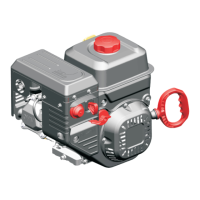
The 212cc engine is a single-cylinder, 4-stroke, forced air-cooled, OHV25° gasoline engine designed to power various equipment, particularly snow blowers. It is capable of both electric and manual starting. The engine's primary function is to convert the chemical energy of gasoline into mechanical energy to drive machinery.
The engine incorporates several controls for safe and efficient operation:
The manual emphasizes the importance of regular maintenance for safe, economical, and trouble-free operation, as well as to reduce air pollution.
The manual also includes a troubleshooting guide for common issues like the engine not starting or lacking power, providing possible causes and corrections. Wiring diagrams for the 120V electric starter and general circuit are also included.

 To Next Page
 General