EasyManua.ls Logo

Cessna 172P - Page 202

Cessna 172P
358 pages
Print Icon
To Next Page IconTo Next Page
To Previous Page IconTo Previous Page
Loading...
1
FLOATPLANE
MODEL
172P
PILOT'S
OPEN,ATING
HANDBOOK
SI]PPLEMENT
AMPLIFIED
PROCEDURES
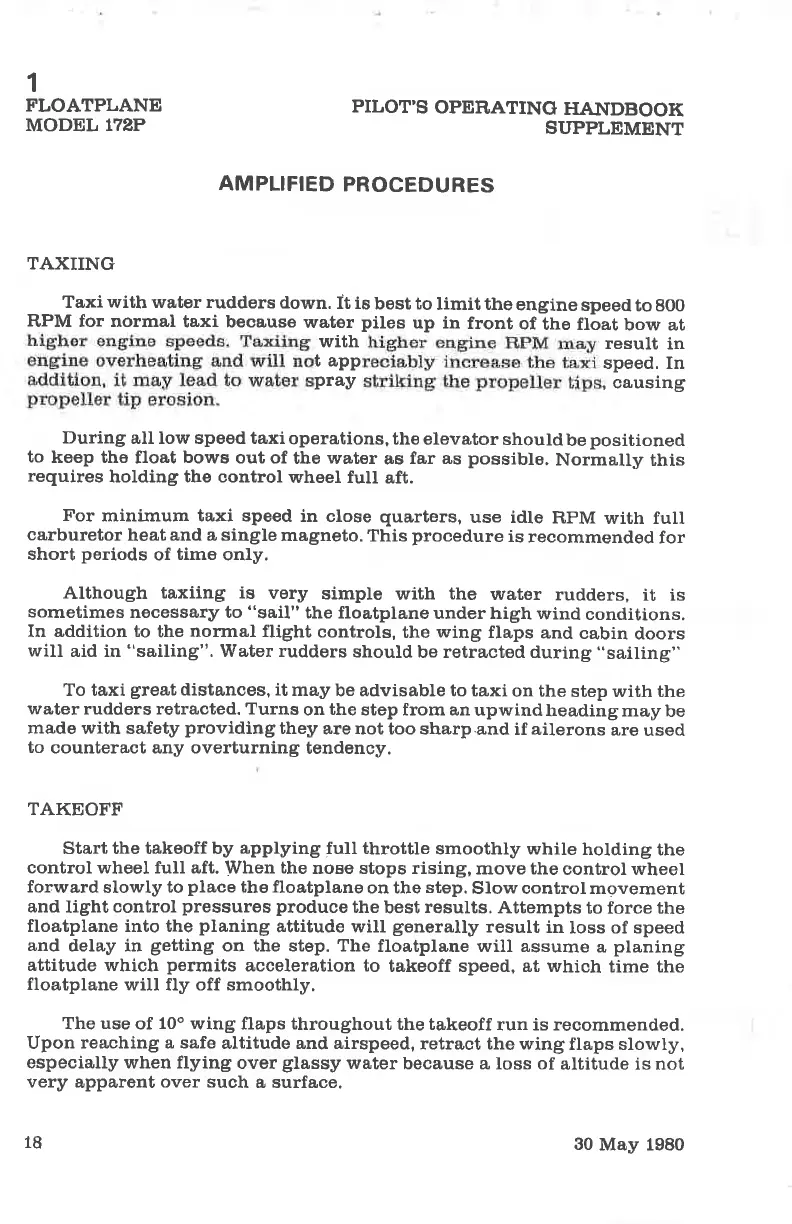
TAXIING
Taxi with water rudders
down.
lt is
best to
limit the
engine
speed
to
gO0
RPM for normal
taxi because
water
piles
up in
front
of
the float
bow at
with
result
in
t aPP
speed. In
PraY
,
causing
During
all low speed taxi
operations,
the elevator
should
be
positioned
to
keep the
float
bows
out of
the water
a,s
fa,r as
possible.
Normally
this
requires
holding the control
wheel full
aft.
For
minimum taxi speed
in close
quarters,
use idle
RpM
with full
carburetor
heat
and a single
magneto.
This
procedure
is
recommended
for
short
periods
of
time
only.
Although
taxiing is
very
simple
with
the
water
rudders,
it is
sometimes
necessa,ry to
"sail"
the floatplane
under high
wind
conditions.
In addition to
the
normal flight
controls,
the
wing
flaps
and
cabin
doors
will
aid in
"sailing".
\lVater rudders
should
be retracted during "sailing"
To taxi
great
distances, it
may
be advisable to taxi
on the
step with the
wa,ter rudders retracted. Turns
on
the
step from an
upwindheadingmay
be
made
with safety
providing
they
a,re not too sharp.and
if ailerons
are
used
to
counteract any overturning
tendency.
TAKEOFF
Start the takeoff by
applying
full throtüle
smoothly while
holding
the
control wheel full aft. When the
nose stops risíng,
move the
control wheel
forward
slowly
to
place
the floatplane
on the
step.
Slow control movement
and
light
control
pressures produce
the
best
results.
Attempts
to force the
floatplane into the
planing
attitude will
generally
result
in
loss of speed
and
delay in
getting
on the step. The
floatplane will assume
a
planing
attitude which
permits
acceleration to
takeoff speed, at which
time the
floatplane
will fly off smoothly.
The
use
of
10o
wing flaps throughout
the takeoff
run is recommended.
Upon
reaching a safe
altitude and airspeed,
retract the wing
flaps slowly,
especially when flying
over
glassy
water
because a loss of
altitude is not
very
a,pparent
over such
a surface.
18
30
May 1980

Table of Contents

Other manuals for Cessna 172P

Related product manuals