EasyManua.ls Logo

Cessna 172P - Page 204

Cessna 172P
358 pages
Print Icon
To Next Page IconTo Next Page
To Previous Page IconTo Previous Page
Loading...
I
FLOATPLANE
MODEL
172P
PILOT'S
OPERATING
HANDBOOI{
SUPPLEMENT
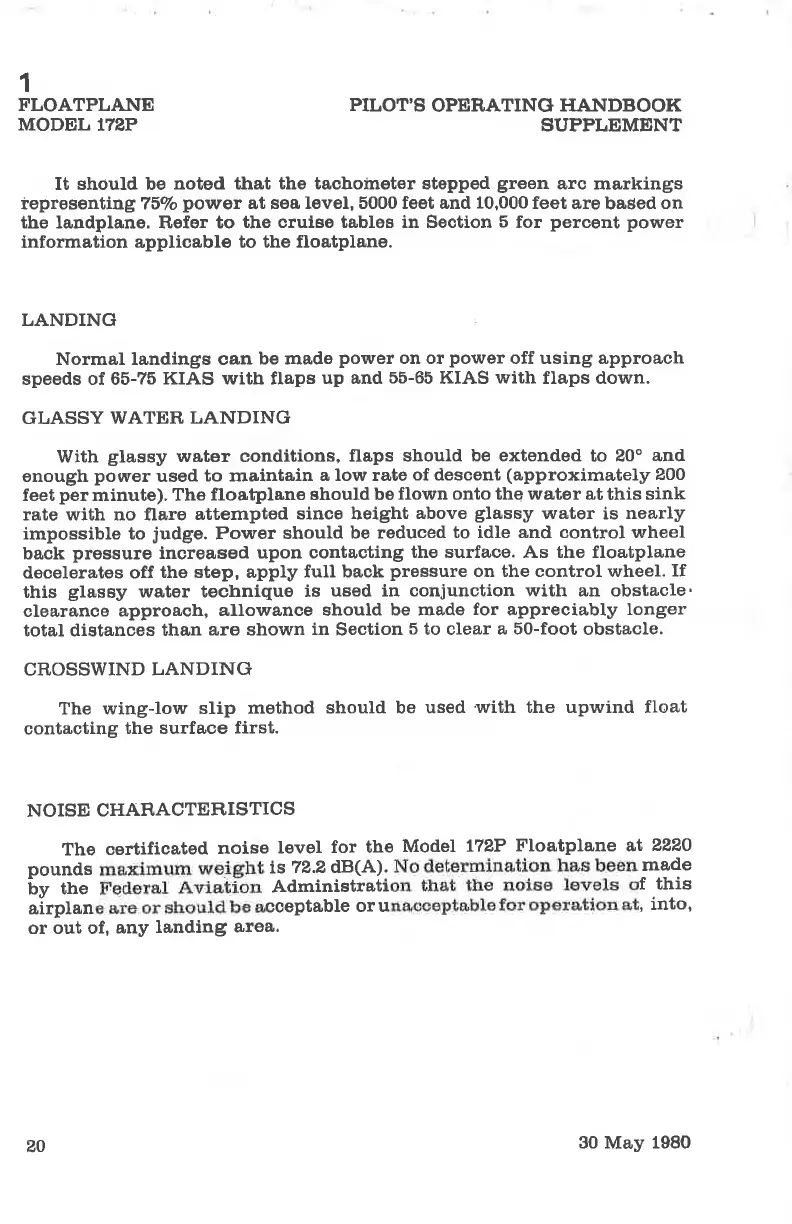
It should be
noted that the tachoineter stepped
green
arc markings
iepresentingTóVo
powor
at sea
level, õ000 feet and
10,000
feet are
baded
on
the landplane. Refer to
the cruise tables in Section
5
for
percent power
information appÌioable
to the floatplane.
LA'NDING
Normal landings can
be made
power
on or
power
off using approach
speeds of 6õ-75
KIAS with flaps
up and
õ5-6õ
KIAS
with
flaps down.
GLASSY
WATER I,ANDING
With
glassy
water conditions,
flaps should
be extended
to 20o
and
enough
power
used
to maintain
a low rate
of descent
(approximately
2OO
feet
per
minute). The
floa@lane
should bo
flown onto the water at
this
sink
rate with no flare
attempted
sinco height
above
glassy
water
is
nearly
impossible to
judge.
Power
should
be reduced
to idle and control wheel
back
pressure
inoreased
upon contacting
the surface. As the floatplane
decelerates off
the step, apply
full back
Pressure
on the control wheel.
If
this
gtassy
water technÍque
is
used in conjunction with an obstacle'
clearance
approach,
allowance should
be made
for
appreciably
longer
total distances
than
are shown
in
Section
5
to clear
a 5O-foot
obstacle.
CROSSÏVIND
LANDING
The wing-low
slip
method should be
used
with the upwind float
contacting
the surface
first.
NOISE
CHARACTERISTICS
The
certificatod
noise
level
for the
Model
172P
Floatplane at
2220
pounds
is72.2
dB(A).
made
Ëy the
Administrati
f this
airplan
ccePtable
oru ,
into,
or out of,
any
landing
area.
20
30
May
1980

Table of Contents

Other manuals for Cessna 172P

Related product manuals