EasyManua.ls Logo

Cessna 172P - Page 42

Cessna 172P
358 pages
Print Icon
To Next Page IconTo Next Page
To Previous Page IconTo Previous Page
Loading...
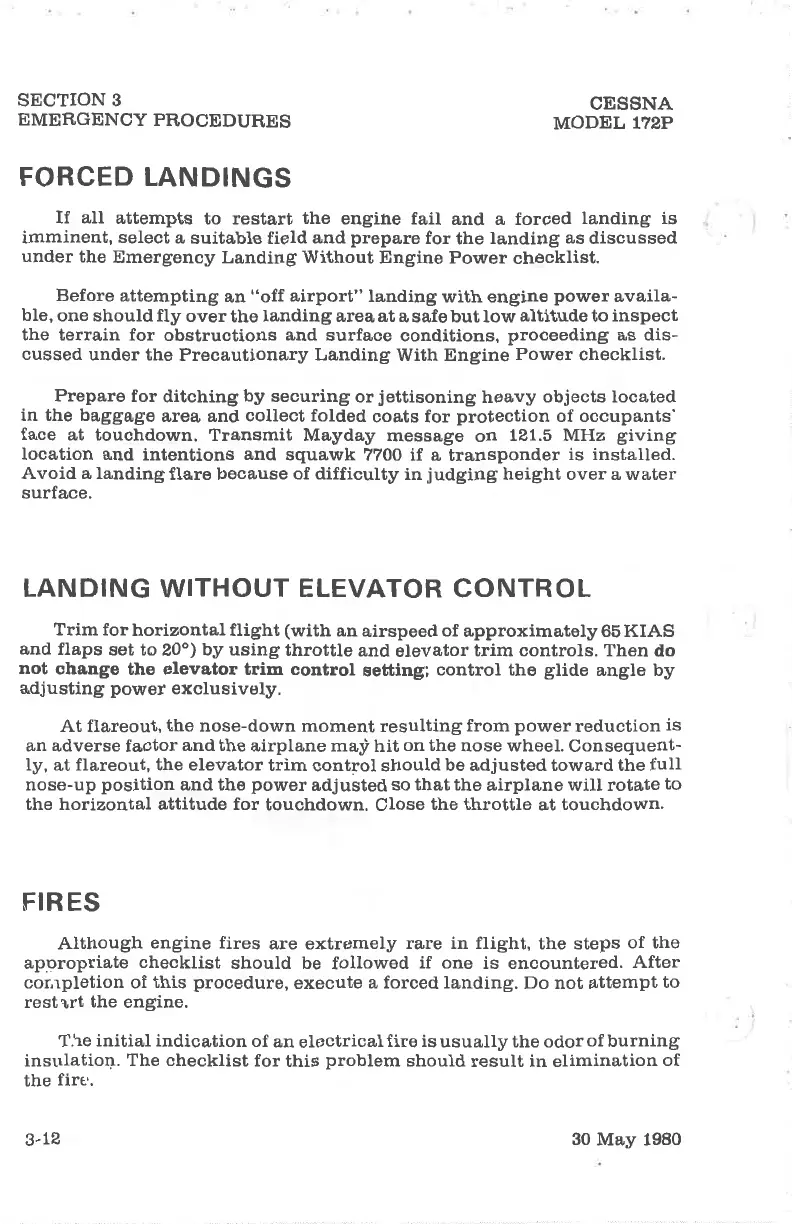
SECTION
3
EMERGENCY
PR,OCEDURES
CESSNA
MODEL
172P
FORCED
LANDINGS
If all
attempts
to restart
the
engine fail
and a forced landing is
imminent,
select
a
suitable field
and
prepare
for
the
landing
as
discussed
under
the
Emergency
Landing
Without
Engine Power
checklist.
Before
attempting
an
"off
airport"
landing
with engine
power
availa,-
ble,
one should fly
over
tho landing
area at
a safe but tow altitude
to
inspect
the terrain for
obstructions
and
surface
conditions,
proceeding
as dis-
cussed
under the
Precautiona,ry
Landing
With Engine Power
checklist.
Preparo
for
ditching by
securing
or
jettisoning
heavy
objects located
in the baggage
area and
collect folded
coats for
protection
of occupants'
face
at touchdown.
Transmit
Mayday
messa,ge
on 121.5 MHz
giving
location and
intentions
and
squawk
7700 if
a transponder is installed.
Avoid a landing
flare because
of difficulty
in
judging
height over a, wa,ter
surface.
LANDING
WITHOUT
ELEVATOR
CONTROL
Trim for
horizontal
flight
(with
an
airspeed
of
approximately KIAS
and flaps
set to
20o)
by using
throttle
and
elevator
trim controls. Then
do
not
change
the elevator
trim control
setting; control the
glide
angle by
adjusting
power
exclusively,
At
flareout, the
nose-down moment
resulting
from
power
reduction
is
an adverse
factor and the
airplane ma¡i
hit on the
nose wheel.
Consequent-
ly,
at
flareout,
the elevator
trim
control should
be adjusted toward the
full
nose-up
position
and the
power
adjusted
so that the
airplane will rotate
to
the horizontal
attitude for
touchdown.
Close the throttle
at
touchdown.
FIR ES
Although engine fires
are extremely
rare in flight,
the steps of the
aporopriate checklist
should be
followed if one
is encountered. After
cor,rpletion
of
this
procedure,
execute
a forced landing.
Do not
attempt
to
resttrt
the
engine.
T.Ie
initial indication
of
an
electrical fire is
usually the odor of
burning
insulation.
The checklist
for
this
problem
should
result in elimination of
the fire,.
3-L2
3O
May 1980

Table of Contents

Other manuals for Cessna 172P

Related product manuals