EasyManua.ls Logo

Cessna 172P - Page 59

Cessna 172P
358 pages
Print Icon
To Next Page IconTo Next Page
To Previous Page IconTo Previous Page
Loading...
CESSNA
MODEL
1?2P
SECTION
4
NOR,MAL
PR,OCEDURES
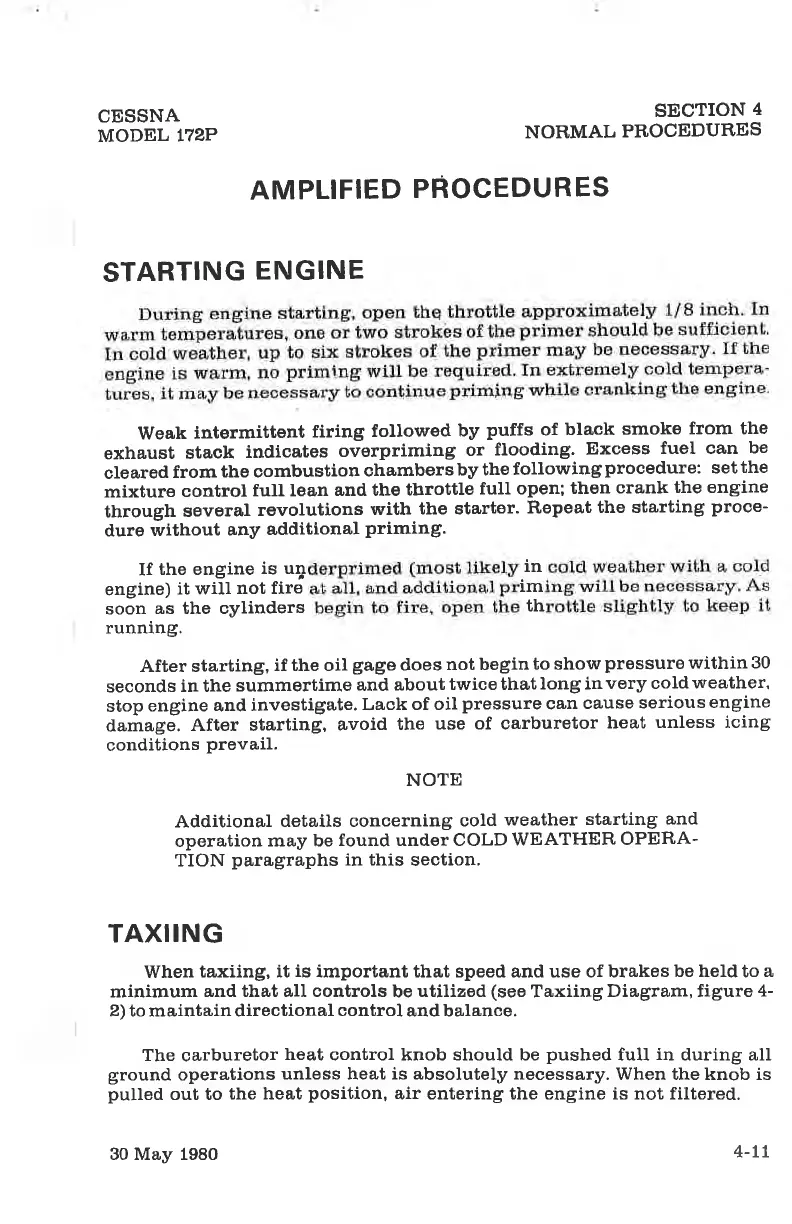
STARTING
ENGINE
AMPLIFIED
PROCEDURES
weak
intermittent
firing
followed
by
puffs
of
btack
smoke
from the
exhaust
stack
indicates
overpriming
or
flooding.
Excess
fuel can
be
cleared
from
the oombustion
chambers
by the
following
procedure:
set
the
mixture
control
full lean
and the
throttle
full operu
then
crank
the engine
through
several
revolutions
with
the starter.
Repeat
the starting
proce-
dure
without
any
additional
priming.
If
the engine
is ug
in
engine)
it will
not fire
im
soon
as the cylinders
th
running.
After starting,
if the oil
gage
does
not begin
to show
pressure
within
30
seconds
in the
summertime
and
about
twice that
long in
very cold
weather,
stop
engine and
investigate.
Lack of oil
pressure
can
cause
serious
engine
damage.
After starting,
avoid
the
use of carburetor
heat
unless icing
conditions
prevail.
NOTE
Additional
detaits concerning
cold
weather
starting
and
operation
may be
found under COLD
WEATHER,
OPERA-
TION
paragraphs in this
section.
TAXIING
When
taxiing, it
is
important that speed and use of brakes
be held
to
a
minimum
and that aII controls
be
utilized
(see
Taxiing
Diagram, figure
4-
2) to maintain directional
control
and balance.
The
carburetor
heat
control knob should be
pushed
full
in
during all
ground
operations
unless heat is absolutely necessary.
When the knob is
pulled
out to
the heat
position,
air entering the engine is not filtered.
30 May 1980
4-rt

Table of Contents

Other manuals for Cessna 172P

Related product manuals