SECTION
4
NORMAL PROCEDURES
CESSNA
MODEL
172P
The
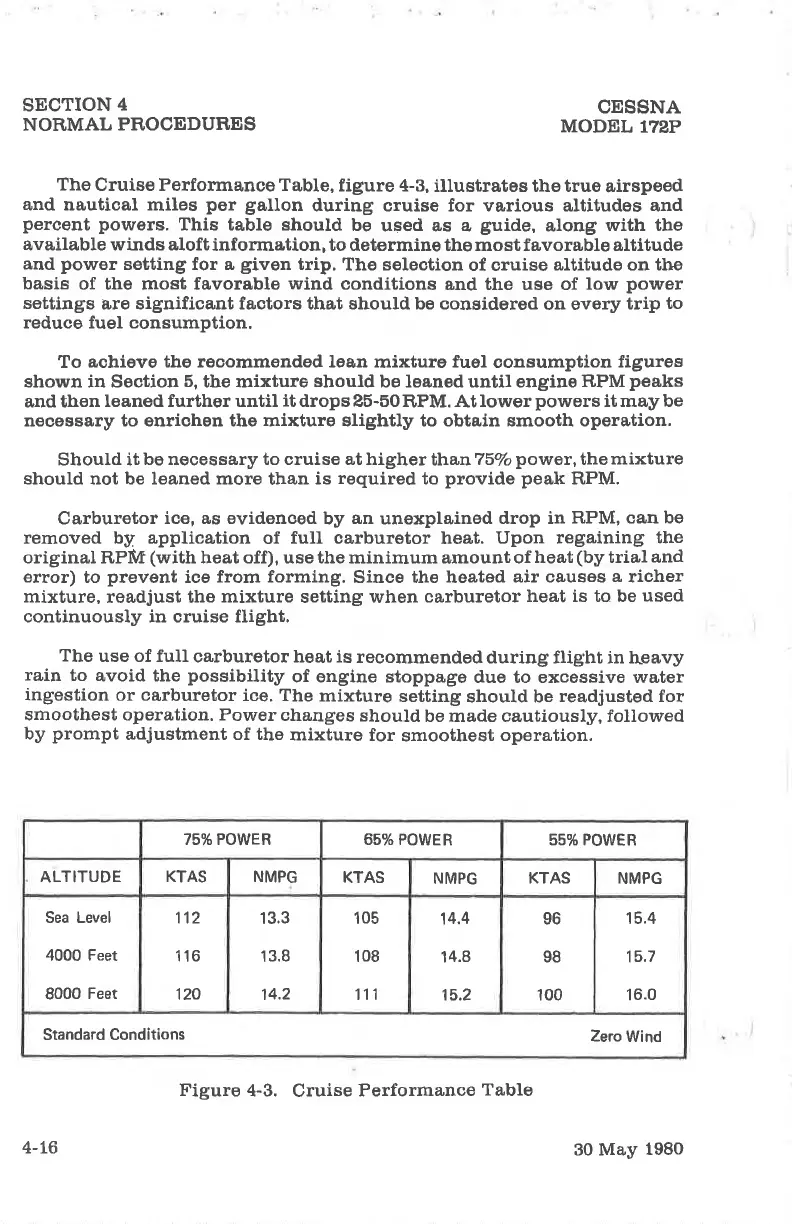
Cruise Performance Table,
figure 4-3,
illustrates the ttuo
a,irspeed
and nautical
miles
per
gallon
during cruise for various altitudes and
percent
powers.
This table should
be
uÊed as a
guide,
along
with the
available winds aloft
information, to determine tho most favorable altitude
and
power
setting for a
given
trip.
The selection
of cruise
altitude on tho
basis
of the most favorable wind conditions
and the use of
low
power
settings
are significa,nt fa,ators that should be considered
on every
trip
to
reduce fuel consumption.
To
achieve the recommended lean
mixture
fuel
consumption
figures
shown in Soction
5,
the mixture
should
be leaned until engine
RPM
peaks
and then
leaned furthor until
it
drops 2õ-õ0
RPM. At
lower
powers
it may be
necessa,ry to enrichen the mixture slightly to obtain smooth operation.
Should it
be necessary to cruise at higher
thanTíVo
power,
the
mixture
should not be leaned more
than
is
required
to
provide peak
RPM.
Carburetor
ice, as evidenced
by
an
unexplained
drop in
RPM, can be
removed by application
of
full carburetor
heat.
Upon regaining
the
original RPIIf
(with
heat off), use the minimum
amount
of
heat
(by
trial and
error)
to
prevent
ice
from formÍng.
Since the heated
air causes
a
richer
mixture,
readjust the
mixture
setting when
carburetor
heat is to be
used
continuously in cruise flight.
The
use of full
carburetor heat is
recommended
during flight in tleavy
rain
to
avoid the
possibility
of engine stoppage
due to excessive water
ingestion
or carburetor
ice. The
mixture
setting
should be
readjusted for
smoothest operation. Power
changes
should
be made cautiously, followed
by
prompt
adjustment of the
mixture
for
smoothest
operation.
75% POWER 65% POWER
55% POWER
ALTITUDE
KTAS NMPG
KTAS
NMPG
KTAS
NMPG
Sea Level
4000
Feet
8000
Feet
112
116
120
13.3
't
3.8
14.2
105
108
111
14.4
14.8
15.2
96
98
100
15.4
15.7
16.0
Standard Conditions
Zero
Wind
4-t6
Figure
4-3.
Cruise
Performance
Table
30 May
1980


 To Next Page