EasyManua.ls Logo

Cessna 182 1973 - Maximum Cruise Speed Performance; Stalls

Cessna 182 1973
88 pages
Print Icon
To Next Page IconTo Next Page
To Previous Page IconTo Previous Page
Loading...
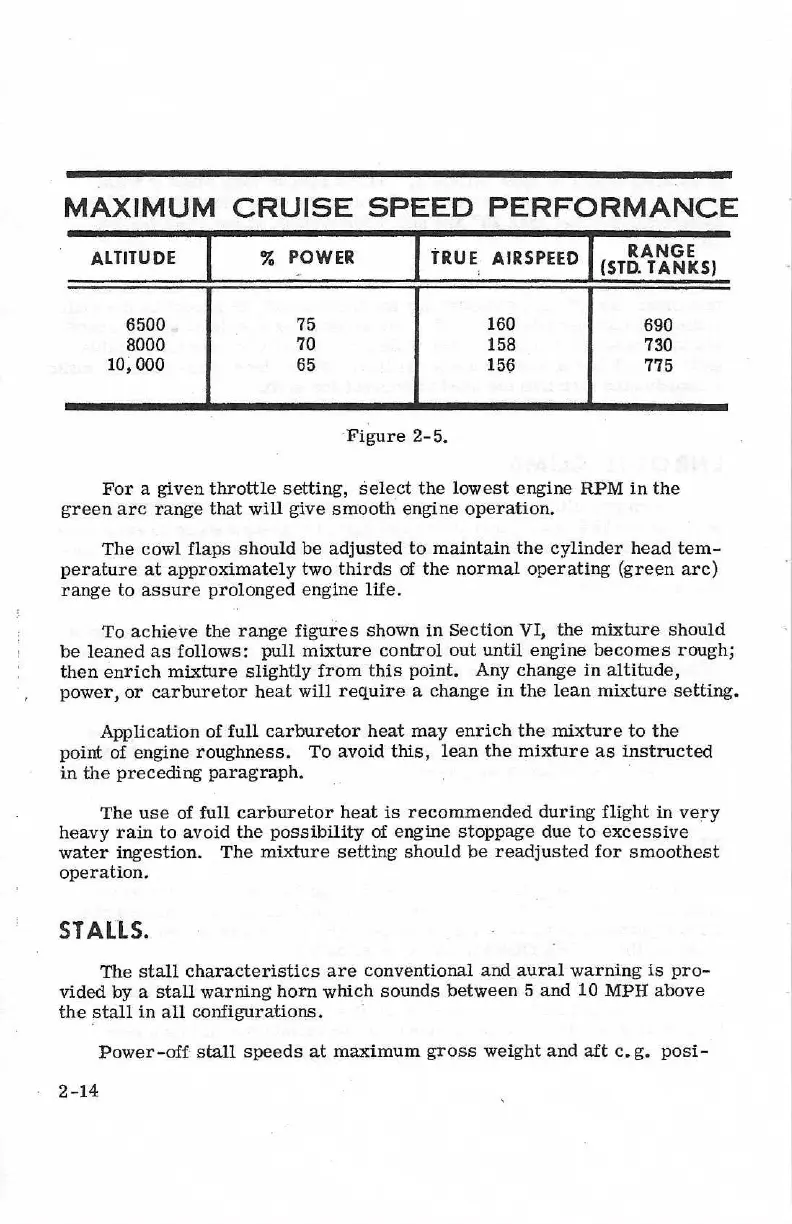
ETT
MAXIMUM
CRUISE
SPEED
PERFORMANCE
ALTITUDE
%
POWER
TRUE AIRSPEED
(STBTANKS)
6500
75
160
690
8000
70
158
730
10,000
65
156
715
Figure
2-5.
For
a
given
throttle
setting,
select
the lowest
engine
RPM
in
the
green
arc
range
that
will
give
smooth
engine operation.
The
cowl
flaps
should
be
adjusted
to
maintain
the
cylinder
head
tem-
perature
at
approximately
two
thirds
of
the
normal
operating
(green
arc)
range
to
assure
prolonged engine
life.
To achieve
the
range
figures
shown
in
Section
VI,
the mixture should
be
leaned
as
follows:
pull
mixture
control
out
until
engine
becomes
rough;
then
enrich
mixture
slightly
from this
point.
Any
change
in
altitude,
power,
or
carburetor
heat will
require
a change
in
the
lean
mixture
setting.
Application
of
full
carburetor
heat
may
enrich
the
mixture
to the
point
of
engine
roughness.
To
avoid
this,
lean the
mixture
as
instructed
in the
preceding
paragraph.
The
use
of
full
carburetor
heat
is
recommended
during flight
in
very
heavy
rain
to
avoid
the
possibility
of
engine stoppage
due
to
excessive
water
ingestion.
The mixture
setting
should be
readjusted
for
smoothest
operation.
STALLS.
The
stall
characteristics
are
conventional
and
aural
warning
is
pro-
vided
by
a
stall
warning
horn
which
sounds
between
5
and
10
MPH
above
the stall
in
all
configurations.
Power
-off
stall
speeds
at
maximum
gross
weight
and aft
c.g.
posi-
2-14

Table of Contents

Related product manuals