
 Need help?
Do you have a question about the Chamberlain TPD10-05 and is the answer not in the manual?
Key safety rules for installation and operation to prevent personal injury or property damage.
Verify all components are present and prepare for gate installation.
List and identification of optional accessories for the gate system.
Notes on space, windload, gate weight, temperature, and E-lock for proper installation.
Detailed technical data including voltage, power, thrust, and cycle limits.
Guidelines for motor installation based on different gate types and sizes.
Information on opening angles, gate pairs, and the necessity of gate stops.
Correct positioning of pillar fittings for optimal gate operation and angle.
Methods for securely attaching gate fittings to steel and wooden gates.
Precise measurement and setting of the tensioning distance for motor arms.
Steps for mounting and securing the motor arms to the gate.
Procedure for releasing the motor for manual gate operation during power failure.
Overview of components and their typical placement in a gate system unit.
Instructions for mounting the control box and preparing openings for cables.
Detailed procedure for mounting the control box, clips, control board, and transformer.
Technical data for the motor control unit, including voltage, output, and temperature.
Guide for connecting power supply, motor, and accessories to the control board.
Detailed descriptions of buttons, LEDs, and terminal functions for system operation.
Guidelines for installing and checking photocells for gate safety.
Instructions for connecting optional key switches, E-locks, and flashing lamps.
Configuration options using jumpers for motor selection and safety switch types.
Step-by-step guide to program remote controls for full or partial gate opening.
Procedure for deleting programmed remote controls from the system.
Initial setup and basic parameter configuration for gate movement.
Setting travel limits for gate opening and closing in simple modes.
Setting advanced travel parameters including soft-stop for gate movement.
Finalizing installation, programming remote controls, and setting the timer to close.
Adjusting motor torque and guidelines for disposal of the device and batteries.
Interpreting the diagnosis LED codes for troubleshooting system faults.
Answers to common problems like no response, stopping, or incomplete opening.
Resolving issues with remote control range, slopes, and post dimensions.
This document provides comprehensive instructions for the installation, operation, and maintenance of a Chamberlain gate drive mechanism, designed to automate swing gates. The system is engineered to offer safe and reliable service when installed and operated in strict accordance with the provided safety rules and local electrical codes.
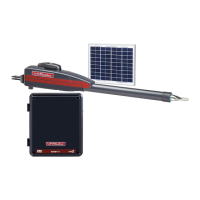
The Chamberlain gate drive mechanism is an automated system for opening and closing swing gates. It consists of two motor operators, a control board housed in an exterior installation box, and various optional accessories such as a flashing lamp, E-lock, remote controls, photocells, and a key switch. The system is designed to automate gates with specific dimensions and weights, and it can be configured for single or double wing operation.
The core function involves the motors extending and retracting a spindle to move the gate wings. The control board manages these movements, allowing for precise control over opening and closing angles, travel distances, and safety features. The system supports both partial and full gate opening, which can be triggered by remote controls or a key switch.
Safety is a paramount aspect of the design. The system incorporates features to prevent entrapment, such as the ability to connect safety edges or IR-sensors. The control board continuously monitors closing forces to comply with EU guidelines, ensuring that the gate operates safely, especially during the final stages of closing. In case of power failure, a manual release mechanism allows the gate to be operated by hand.
The system also includes a "Timer to Close" function, which automatically closes the gate after a set period, provided photocells are connected. This enhances convenience and security. The motor's thrust is automatically adjusted during programming, but it can be recalibrated if environmental factors or changes in gate condition affect performance.
The Chamberlain gate drive offers several user-friendly features for convenient and safe operation:
Proper maintenance is crucial for the longevity and safe operation of the Chamberlain gate drive mechanism. The manual highlights several key maintenance aspects:
By adhering to these installation, usage, and maintenance guidelines, users can ensure the safe, efficient, and long-lasting performance of their Chamberlain gate drive mechanism.
 General
| Type | Swing Gate Opener |
|---|---|
| Max Gate Length | 16 ft |
| Remote Control | Yes |
| Safety Features | Obstruction Detection |
| Motor Type | DC |



 To Next Page