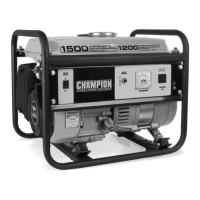
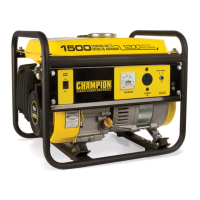
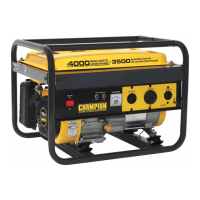
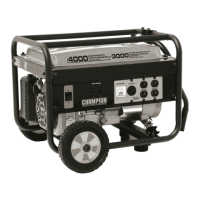
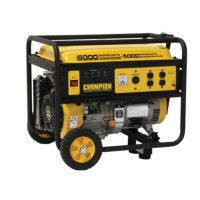
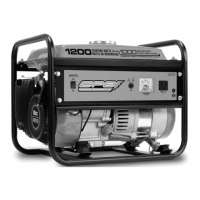
This document is an owner's manual and operating instructions for a Champion Global Power Equipment portable generator, Model Number 42455.
Function Description:
The Champion 42455 Portable Generator is a gasoline engine-driven, alternating current (AC) generator designed to supply electrical power for lighting, appliances, tools, and similar equipment. It is rated for continuous operation at ambient temperatures up to 40°C (104°F) and can be operated for short periods in temperatures ranging from -15°C (5°F) to 50°C (122°F). The generator is intended for outdoor use only, in a well-ventilated area, away from doors, windows, and other vents, to prevent the accumulation of carbon monoxide. It features a low oil shut-off mechanism that stops the engine if the oil level falls below a critical threshold, protecting the engine from damage. The generator's system ground connects the frame to the ground terminals on the power panel, and proper grounding is essential to prevent electric shock.
Important Technical Specifications:
- Starting Watts: 1200 Watts
- Max Rated Watts: 1000 Watts
- Continuous Use Watts: 900 Watts
- Engine Model: YF152FD-2-010
- Engine Displacement: 80cc
- Engine Type: 4-Stroke OHV
- Start Type: Recoil
- Voltage: 120 Volts
- Frequency: 60 Hz
- Fuel Capacity: 1.45 gallons (5.5 L)
- Gross Weight: 58.4 lbs. (26.5 kg)
- Net Weight: 52.9 lbs. (24.3 kg)
- Dimensions (H x W x L): 14.8 inches (37.6 cm) x 14.4 inches (36.6 cm) x 17.8 inches (45.3 cm)
- Oil Capacity: 0.42 qt (0.4 L)
- Recommended Oil Type: 10W-30 automotive oil
- Spark Plug (OEM): NHSP E6RTC
- Spark Plug (Replacement): NGK BPR6HS or equivalent
- Spark Plug Gap: 0.7 - 0.8 mm (0.028 - 0.031 in.)
- Maintenance Valve Clearance:
- Intake: 0.13 – 0.17 mm (0.005 – 0.007 in.)
- Exhaust: 0.18 – 0.22 mm (0.007 – 0.009 in.)
- Outlets: 120V/15A Outlet (NEMA 5-15R) protected by a circuit breaker.
Usage Features:
The generator includes several controls and features for ease of use and safety:
- Fuel Tank: 1.45-gallon capacity.
- Choke: Used to facilitate engine starting.
- Fuel Valve: Controls fuel supply to the engine.
- Air Filter: Protects the engine from dust and debris.
- Recoil Starter: Manual pull-start mechanism.
- Low Oil Sensor: Automatically shuts down the engine if oil levels are too low.
- Oil Filler Cap: For checking and filling engine oil.
- Power Panel: Contains the engine switch, circuit breaker, voltmeter, and outlets.
- Engine Switch: Toggles the generator between "On" and "Off" positions.
- Circuit Breaker: Protects against electrical overload.
- Voltmeter: Displays the output voltage.
- Ground Bolt: For connecting to an appropriate ground to prevent electric shock.
To start the engine:
- Ensure the generator is on a flat, level surface and all electrical loads are disconnected.
- Turn the Fuel Valve to "ON."
- Flip the Engine Switch to "ON."
- Move the choke lever to "CHOKE."
- Pull the recoil starter cord slowly until resistance is felt, then pull rapidly.
- Once the engine starts, move the choke lever to "RUN." Avoid over-choking to prevent spark plug fouling.
To connect electrical loads:
- Allow the engine to stabilize and warm up for a few minutes.
- Plug in and turn on 120 Volt AC, 60 Hz electrical loads.
- Connect loads in order from largest to smallest, allowing the engine to stabilize after each connection.
- Do not overload the generator.
To stop the engine:
- Turn off and unplug all electrical loads.
- Let the generator run at no-load for several minutes to stabilize temperatures.
- Turn the Fuel Valve to "OFF."
- Allow the engine to run until fuel starvation stops it.
- Press the Engine Switch to "OFF."
Maintenance Features:
Regular maintenance is crucial for the generator's longevity and performance.
- Oil Change: Change oil when the engine is warm. Recommended oil is 10W-30 automotive.
- Initial oil change: After the first 5 hours of operation.
- Subsequent oil changes: Every 50 hours or every season, or more frequently if operating under heavy load or in hot environments.
- Spark Plugs:
- Inspect the electrode for cleanliness and wear.
- Ensure the gap is 0.7 - 0.8 mm (0.028 - 0.031 in.).
- Clean/Adjust every 100 hours or every season.
- Air Filter:
- Clean every 50 hours or every season.
- Remove, wash in liquid detergent and water, squeeze dry, saturate with clean engine oil, and squeeze out excess oil before reassembly.
- Spark Arrester:
- Clean every 100 hours or every season.
- Allow the engine to cool completely before servicing.
- Remove carbon deposits with a wire brush. Replace if damaged.
- Fuel System:
- Use clean, fresh, regular unleaded fuel with a minimum octane rating of 85 and an ethanol content of less than 10%.
- Do not mix oil with fuel.
- When storing for more than 30 days, add fuel stabilizer, run the engine to circulate the treated fuel, turn the fuel valve to "OFF," and run until the engine stops from fuel starvation. Drain the tank if not in use for more than 30 days.
- General Cleaning: Use a damp cloth or soft bristle brush to clean exterior surfaces. An air compressor (25 PSI) can be used to clear dirt and debris. Do not spray the engine with water.
- Valve Clearance: Check/Adjust every 100 hours or every season (to be performed by knowledgeable owners or certified dealers).
- Fuel Tank and Filter: Clean every 100 hours or every season (to be performed by knowledgeable owners or certified dealers).
- Fuel Line: Replace every 3 years.
The manual emphasizes the importance of following all safety rules, including proper grounding, avoiding carbon monoxide exposure, and preventing electrical shock and fire hazards. It also provides contact information for Champion Power Equipment Customer Service and Technical Service for assistance with assembly, parts, and warranty inquiries.


 To Next Page
 General