10 F-POD USER GUIDE
Moorings
This section provides general information and guidelines that you should
consider carefully when designing your moorings.
Buoyancy
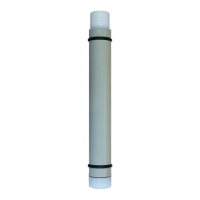
When deployed, F-PODs have a positive buoyancy of approximately
0.7 kg with alkaline batteries and 1.2 kg with lithium batteries.
This means that PODs can be moored and allowed to float with the
hydrophone housing upwards.
Location
The seabed is a source of noise from sand movement and crustaceans
and the surface is a source of ultrasound from rain and breaking waves.
In shallow water, PODs should be moored midway between the bottom
and the surface. In deep water, any position between 10 metres up and
10 metres down is good. The POD’s polypropylene housing can be used
down to 100 metres.
Deep diving cetaceans can be heard by a shallow water POD set to point
downwards. Please contact us for more information.
Directionality
All PODs show lower sensitivity directly along the long axis of the housing,
especially in the battery pack direction.
Security
The main problems with moorings are theft, being moved by trawlers or
storms and abrasion of lines.
Theft
This is a serious risk in many areas. Some possible solutions are
suggested below:
▪
Get cooperation and advice from local fishermen, who may allow you to
use their gear.
▪
Use a very small marker, for example, a single fishing float on a thin
line that is only at the surface at low slack tide. The disadvantage is that
it may wind itself around weed or anything else and sink.
▪
Do not use buoys. Use a line between two anchors that can be located
via GPS using a grapple.
▪
Use pop-ups. These are commercially available acoustic releases.
However, currently they are very expensive.


 To Next Page
 Loading...