Need help?
Do you have a question about the Chicago Pneumatic CP7300C and is the answer not in the manual?
Specifies the product's design for drilling/reaming, for professional use only.
Details connecting the tool, fixing accessories, and operating controls like trigger and reverse lever.
Outlines requirements for motor and clutch lubrication using specific oils and greases.
Covers safe handling, qualified personnel, regular inspection, and service kits for tool longevity.
Provides guidance on disposing of equipment according to national legislation and safety standards.
States conformity with EU directives and lists applicable harmonized standards and issuing authority.
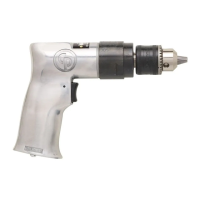
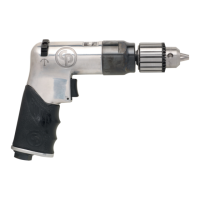
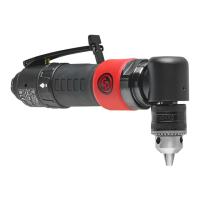
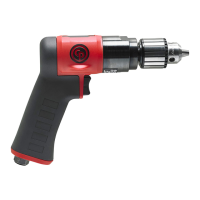
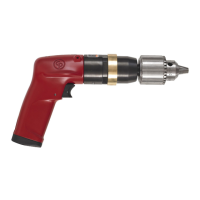
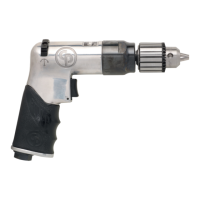
The Chicago Pneumatic CP7300C, CP7300RC, and CP7300RQCC are pneumatic drills designed for professional use, specifically for drilling or reaming holes. These tools are powered by compressed air and are built to provide reliable performance in various applications.
At its core, this device is a pneumatic drill, meaning it uses compressed air to rotate a drill bit or reamer. The primary function is to create holes in various materials or to enlarge existing holes. The drill's operation is controlled by a trigger mechanism, allowing the user to regulate the machine's speed by varying the pressure applied to the trigger. Releasing the trigger stops the machine.
A key feature of these models is their reversibility. This allows the user to change the direction of rotation, which is particularly useful for backing out drill bits, removing fasteners, or when the tool becomes jammed. The direction of rotation is typically controlled by a lever or switch, clearly indicating the forward and reverse positions.
The tool is designed for precision and control, making it suitable for tasks that require careful handling and consistent performance. Its pneumatic nature ensures a constant power output, which is often preferred over electric drills in certain industrial environments due to safety considerations (e.g., no electrical sparks) and power-to-weight ratio.
To ensure safe and efficient operation, the drill requires proper setup and connection to an air supply system. An air diagram illustrates the recommended setup, including the use of an air line lubricator, filter, and regulator to ensure clean, lubricated air at the correct pressure. This setup is crucial for the longevity and optimal performance of the pneumatic motor. The air inlet size is typically 1/4" NPT, and a 3/8" (10mm) inner hose diameter is recommended for the air supply.
Before operation, accessories such as drill bits or reamers must be properly fixed to the tool's chuck. The chuck capacity is typically 1/4 inch (6mm), accommodating a range of common drill bit sizes. The assembly and disassembly processes for the chuck are straightforward, as depicted in the manual, involving specific steps to secure or release the accessory.
The tool's ergonomic design, as shown in the figures, suggests a comfortable grip, which is important for prolonged use and reducing user fatigue. For applications requiring higher torque, the use of a side handle is recommended. This provides additional stability and control, especially when dealing with resistant materials or larger hole sizes, thereby enhancing user safety and precision.
The operation is intuitive: pulling the trigger starts the machine, and the speed increases with trigger pressure. This variable speed control allows the operator to match the drill's speed to the specific material and task, preventing damage to the workpiece or the drill bit. The reverse rotation feature is activated by pushing a lever in the indicated direction, providing versatility for various drilling and fastening applications.
Regular maintenance is critical for ensuring the drill's reliability, performance, and extended lifespan. The manual emphasizes several key maintenance aspects, starting with lubrication. For the motor, an air line lubricator set to deliver two drops of SAE #10 oil per minute is recommended. If an air line lubricator is not feasible, adding air motor oil to the inlet once a day is advised. Specific part numbers for different quantities of air motor oil are provided, ensuring users can easily obtain the correct lubricant.
For the clutch mechanism, the use of Mobilux EP-2 Moly or an equivalent grease is specified. Proper lubrication of both the motor and clutch components minimizes friction, reduces wear, and prevents overheating, which are common causes of tool failure.
Beyond lubrication, the manual outlines a comprehensive maintenance schedule and guidelines. It stresses that all maintenance and repair work should be performed by qualified personnel using only original spare parts. This ensures that the tool's integrity and performance are maintained according to manufacturer standards. Users are advised to contact the manufacturer or an authorized dealer for technical service or spare parts.
A crucial safety measure highlighted is to always ensure the machine is disconnected from its energy source (the air supply) before performing any maintenance or repair work. This prevents accidental operation and potential injuries.
Regular inspection is also recommended: the tool should be disassembled and inspected every three months if it is used daily. During these inspections, any damaged or worn parts should be replaced immediately. To minimize downtime, the use of tune-up kits, which typically include common wear parts, is suggested.
Finally, the manual addresses the disposal of the equipment, stating that it must follow the legislation of the respective country. Damaged, badly worn, or improperly functioning devices must be taken out of operation and repaired only by technical maintenance staff, reinforcing the importance of professional servicing and responsible disposal practices. This comprehensive approach to maintenance ensures the tool remains safe, efficient, and durable throughout its operational life.
 General
| Free Speed | 2800 rpm |
|---|---|
| Weight | 0.9 kg |
| Length | 175 mm |
| Air Inlet Thread Size | 1/4" NPT |
| Min. Hose Size | 10 mm |
| Vibration | 2.5 m/s² |
| Vibration Uncertainty | 1.5 m/s² |
| Drilling Capacity Steel | 10 mm |
| Air Inlet Size | 1/4" NPT |
| Type | Pistol |
| Air Consumption | 14.2 l/s |
| Chuck Size | 1/4 " |

 To Next Page