
 Need help?
Do you have a question about the Chicago Pneumatic CP835 and is the answer not in the manual?
Details tool's air supply needs, lubrication, die adjustment, noise/vibration, and maintenance procedures.
Comprehensive safety guidelines covering air supply, projectiles, operation, workplace hazards, and additional topics.
Illustrates the correct air line connections and fittings for the tool.
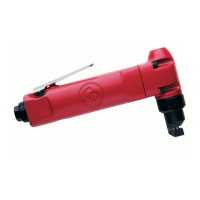
The Chicago Pneumatic CP835 Air Nibbler is a power tool designed for cutting sheet metal. Its primary function is to efficiently and precisely cut through various gauges of sheet metal, making it suitable for professional use in environments where such tasks are common. The tool operates on a pneumatic system, requiring a clean and dry air supply to function optimally.
The CP835 Air Nibbler utilizes a punch and die mechanism to cut sheet metal. The punch rapidly reciprocates, creating small, overlapping cuts that effectively remove material along a desired line. This nibbling action allows for intricate cuts and curves that might be difficult to achieve with other cutting methods. The tool is specifically designed for cutting sheet metal and should not be used for any other purpose to ensure safety and prevent damage.
To operate the CP835 Air Nibbler, it must be connected to an air supply providing 90 psig (6.2 bar) of clean, dry air. Maintaining the correct air pressure is crucial, as higher pressures can drastically reduce the tool's lifespan. The air line connection should adhere to the specified pipe, hose, and fitting sizes to ensure proper airflow and prevent leaks.
Lubrication is an important aspect of the tool's operation. An air line lubricator with SAE #10 oil, adjusted to two drops per minute, is recommended. If a lubricator cannot be used, air motor oil should be added to the inlet once a day. This ensures the internal components, particularly the motor, remain well-lubricated, reducing wear and extending the tool's operational life.
The die adjustment feature allows users to fine-tune the cutting mechanism. By loosening the clamp nut, the die can be rotated to align its slot with a pin at the desired position. Once adjusted, the clamp nut must be tightened before operation. This adjustment capability ensures precise cutting and accommodates different cutting requirements.
During operation, it is essential to maintain a balanced body position and secure footing to prevent slips, trips, and falls, which are major causes of serious injury. The tool's cutting edges and saw blades can become hot during use, so direct contact with the accessory and work surface should be avoided during and after work. Users should never force the tool to cut faster or through heavier gauge material than its rated capacity, as this can damage both the tool and the accessory. To prevent damage, the accessory must be held firmly against the work surface while cutting.
The tool generates noise during operation, and high sound levels can cause permanent hearing loss. Therefore, hearing protection, as recommended by employers or OSHA regulations, should always be used. Repetitive work motions, awkward positions, and exposure to vibration can be harmful to hands and arms. If symptoms such as numbness, tingling, pain, or skin whitening occur, users should stop using the tool and consult a physician.
The cutting process can create sharp edges on the sheet metal, so wearing gloves to protect hands is recommended. Additionally, the tool's operation can generate dust and debris, which may be harmful to health. Users should employ dust extraction methods and wear respiratory protective equipment when working with materials that produce airborne particles. Awareness of the work environment is crucial, especially in unfamiliar surroundings, to identify and mitigate potential hazards created by the work activity.
Regular maintenance is key to the longevity and safe operation of the CP835 Air Nibbler. For tools used daily, disassembly and inspection of parts should be performed every three months. Any damaged or worn parts should be replaced immediately. High-wear parts are specifically identified in the parts list to guide users on components that require more frequent attention.
Punch replacement is a straightforward process. It involves removing the clamp nut and die, loosening a set screw, and then removing the punch. The new punch is installed by reversing these steps. This ease of replacement ensures that the cutting performance can be maintained over time without extensive downtime.
Before performing any maintenance, changing accessories, or making repairs, the air supply to the tool must be shut off, the hose drained of air pressure, and the tool disconnected from the air supply. This prevents accidental activation and ensures user safety. Air under pressure can cause severe injury, and whipping hoses due to damaged or loose connections can also be dangerous. Therefore, all hoses and fittings should be regularly checked for damage. Quick disconnect couplings should not be used at the tool, and if universal twist couplings are employed, lock pins must always be installed.
The tool and its accessories must not be modified, as this can compromise its safety and performance. The CP835 Air Nibbler is not designed for use in explosive atmospheres and is not insulated for contact with electric power sources. Operators and maintenance personnel must be capable of handling the tool's power and performing the job tasks safely and effectively.
 General
| Length | 190 mm |
|---|---|
| Chuck Size / Drive Size | 1/2 inch |
| Impacts per minute | 1200 |
| Air inlet thread size | 1/4" |
| Bolt capacity | 16 mm |
| Air Inlet Size | 1/4" |


 To Next Page