17
frontal airbag has been deactivated: check
with the car manufacturer or on the owner’s
manual for instructions on how to disable
the airbag. It is always recommended to
slide the vehicle seat as back as possible
depending on whether passengers are
travelling on the back seat or not.
• Make sure that all the passengers within
the vehicle know how to release the child
from the child car seat in case of emergency.
• Pay attention when tting the child car seat
into the car to avoid that a vehicle’s car seat
or car door may interfere with it.
• Always check that the child
car seat is secured correctly to the vehicle’s
seat in the event of an accident, but the use
of this product reduces the risk of serious
injuries or death.
• The risk of serious injuries to the child in-
creases, not only in the case of accidents,
but also in other circumstances (i.e.: sudden
braking, etc.) if these instructions are not
followed carefully: always check that the
child car seat is secured correctly to the
vehicle’s seat.
• If the child car seat is damaged, deformed
or worn out, it must be replaced: it may
no longer meet the original safety stand-
ards. Even if not visible with eyes, after an
accident (even minor ones) the car seat
will suer permanent damages. It must
therefore be replaced.
• Do not use second-hand child car seats:
they may have suered structural damage
not visible to the naked eye but liable of
compromising the safety of the product.
• This product must not be modied in any
way unless the modication has been ap-
proved by the manufacturer.
• Do not t any accessories, spare parts or
components not supplied or approved by
the manufacturer.
• Never leave the child unattended in the
child car seat for any reason.
• Never leave the child car seat unsecured
in the car seat, it may hurt or harm the
passengers.
• Never place anything except an approved
accessory between the vehicle seat and
the child car seat or between the child car
seat and the child: in case of accident, the
car seat may not work properly.
• It is recommended to cover the child car
seat if the vehicle is left exposed to direct
sunlight. The seat fabric must only be
replaced with another approved by the
manufacturer as it forms an integral part of
the child car seat. To ensure child car seat’s
safety, never use it without its fabric cover.
• Check that the safety harness strap is not
twisted to avoid that the strap or any parts
of the child car seat remain trapped be-
tween the car doors, or rub against cutting
edges. If the safety harness is cut or frayed,
it must be replaced.
• Do not transport loose or unsecured objects
or baggage on the back shelf of the vehicle:
they may injure the passengers in case of
accident or sudden braking.
• Make sure that all car passengers fasten
their seat belts, for their own safety and
because, during the journey, they may harm
the child during an accident or sudden
braking of the car.
• On long journeys make frequent stops.
Children get tired easily. Never, for any rea-
son, remove your child from the child car
seat whilst the car is moving. If your child
needs attention, nd a safe place and stop.
• Premature babies born before the 37th
week of pregnancy can be at risk if placed
in a child car seat. These babies might in-
cur in breathing problems when sat in a
child car seat. We therefore recommend
you to contact your doctor or the hospital
sta, before leaving the hospital. They can
recommend the most suitable type of child
car seat based on your child’s situation.
• Artsana declines all responsibility for any
inappropriate use of the product.
1.2 PRODUCT FEATURES
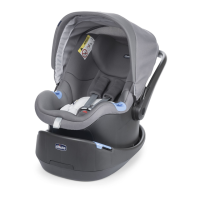
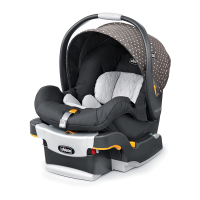
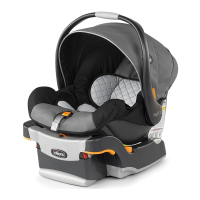
• This child car seat is approved for “Group
0+”, for the safe transportation of babies
from birth up to 13 Kg in weight (from 0 to
10/12 months approximately), in accord-
ance with European Standard ECE R 44/04.
WARNING
1. This is a “Universal” child restraint system.
It is approved according to Regulation No.
44/04 for general use in vehicles, and it will
t most, but not all car seats.
2. A correct t is likely if the vehicle man-
ufacturer has declared that the vehicle
is capable of tting a “Universal” child
restraint for this age group.
3. This child restraint device has been clas-
sied as “Universal” under more stringent
conditions than those that were applied
to earlier designs that do not display this
notice.
4. It is only suitable for vehicles which fea-
ture a 3-point static or 3-point retracta-
ble seat belts approved according to UN/
ECE Regulation No.16, or other equivalent
standards.
5. In case of doubts, contact the manufacturer
of the restraint device or reseller.
1.3 DESCRIPTION OF THE PARTS
Fig. 1 (3/4)
A. Carry Handle
B. Canopy
C. Fabric lining
D. Booster cushion
E. Base
Fig. 2 (Front)
F. Child car seat restraint harness
G. Shoulder straps
H. Buckle
I. Harness adjustment button
J. Adjustable headrest
Fig. 3 (Prole)
K. Abdominal car safety belt slot on the child
car seat
L. Abdominal car safety belt slot on the base
M. Buttons to rotate the carry handle
N. Slot for coupling to the stroller or base
Fig. 4 (Back)
O. Diagonal car safety belt slot
P. Release handle (from the base and stroller)
Fig. 4A (Tray open)
Q. Headrest and belt adjustment button
R. Compartment for storing the instruction manual
1.4 POSITIONS OF THE HANDLE
The child car seat carry handle can be ad-
justed in 6 dierent positions (Fig. 5).
A. Position in car without base.
A1. Position in car with base (WARNING:
positions A and A1 are the only positions
allowed during use in the car).


 To Next Page
 Loading...