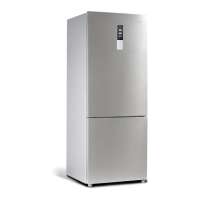
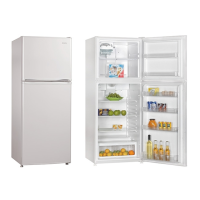
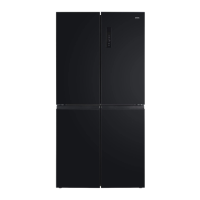
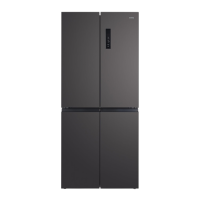
Need help?
Do you have a question about the ChiQ CSS602WD and is the answer not in the manual?
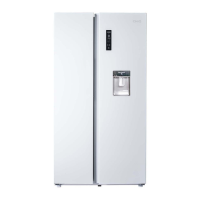
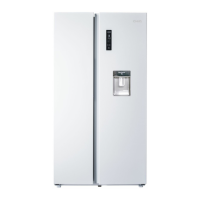
This document serves as a user manual for CHiQ side-by-side frost-free refrigerators, specifically models CSS602WD, CSS601SD, and CSS600BD. It provides essential safety instructions, details on product features, preparation for use, operational functions, food storage guidelines, maintenance, and troubleshooting.
The manual emphasizes safety, particularly warning against unauthorized servicing due to the risk of electric shock. It highlights the danger of fire and flammable materials, advising against storing containers with flammable gases or liquids, or carbonated drinks in the freezer. Users are cautioned not to remove items from the freezer with damp hands to avoid "Frost/Freeze burns" and to adhere to manufacturer-recommended storage times. Children should be supervised to prevent tampering with controls or playing with the appliance. The appliance is heavy, requiring care when moving, and any alteration or modification is dangerous. Inflammable gases or liquids should not be stored inside. If the power cable is damaged, it must be replaced by authorized personnel. The appliance is suitable for use by children aged 8 and above, and persons with reduced physical, sensory, or mental capabilities, provided they receive supervision and understand the hazards. It is intended for household and similar applications, including staff kitchen areas, farmhouses, hotels, motels, and bed and breakfast environments. Ventilation openings must be kept clear, and mechanical devices or other means not recommended by the manufacturer should not be used to accelerate defrosting. The refrigerant circuit should not be damaged, and electrical appliances not recommended by the manufacturer should not be used inside food storage compartments. Explosive substances like aerosol cans with flammable propellants should not be stored in the appliance.
The manual further warns that servicing or repairs involving cover removal should only be performed by authorized personnel. It reiterates the risk of fire from flammable materials. Users are advised not to use electrical appliances like hair dryers or heaters for defrosting. Containers with flammable gases or liquids can leak at low temperatures, and such items, including spray cans and fire extinguisher refills, should not be stored in the freezer. Carbonated or fizzy drinks should not be placed in the freezer compartment, as ice lollies can cause "Frost/Freeze burns" if consumed directly. Removing items from the freezer with damp hands can cause skin abrasions or "Frost/Freezer burns." Bottles and cans must not be placed in the freezer as they can burst when contents freeze. Manufacturer's recommended storage times must be followed. Children should not tamper with controls or play with the appliance. The appliance is heavy, so care must be taken when moving it. Altering or modifying the product is dangerous. Inflammable gases or liquids should not be stored inside. If the power cable is damaged, it must be replaced by the manufacturer, service agent, or similarly qualified persons. The appliance can be used by children aged 8 and above, and persons with reduced physical, sensory, or mental capabilities, or lack of experience and knowledge, if supervised and instructed on safe use. Children should not play with the appliance or perform cleaning and user maintenance without supervision. The appliance is intended for household and similar applications, including staff kitchen areas, farmhouses, hotels, motels, and bed and breakfast environments. Ventilation openings must remain unobstructed. Mechanical devices not recommended by the manufacturer should not be used for defrosting. The refrigerant circuit must not be damaged. Electrical appliances not recommended by the manufacturer should not be used inside food storage compartments. Explosive substances like aerosol cans with flammable propellants should not be stored.
The appliance is not intended for use by persons with reduced physical, sensory, or mental capabilities, or lack of experience and knowledge, unless supervised. Children should be supervised to ensure they do not play with the appliance. Ventilation openings must be kept clear. Mechanical devices not recommended by the manufacturer should not be used to accelerate defrosting. The refrigerant circuit must not be damaged. Electrical appliances not recommended by the manufacturer should not be used inside food storage compartments. Refrigerating appliances, particularly refrigerator-freezer Type I, might not operate consistently in cold temperatures. Keys for locks on doors or lids must be kept out of children's reach to prevent entrapment. The refrigerant and insulation materials require special disposal procedures. The supply cord must not be trapped or damaged during positioning. Multiple portable socket-outlets or power supplies should not be located at the rear. Children aged 3 to 8 years are allowed to load and unload refrigerating appliances. To avoid food contamination, open doors for short periods, clean surfaces regularly, clean water tanks if unused for 48 hours, flush water systems if unused for 5 days, store raw meat and fish in suitable containers, and use two-star frozen-food compartments for pre-frozen food, ice-cream, and ice cubes. One-, two-, and three-star compartments are not suitable for freezing fresh food. If left empty for long periods, switch off, defrost, clean, dry, and leave the door open to prevent mold.
The appliance must be properly grounded for safety, with a three-prong plug. The third ground prong should not be cut or removed. It requires a standard 220-240VAC 50/60Hz electrical outlet with three-prong ground and is not designed for use with an inverter. The cord should be secured behind the appliance to prevent accidental injury. Never unplug by pulling the power cord; always grip the plug firmly. An extension cord should not be used; if the cord is too short, a qualified electrician should install an outlet nearby. Improper use of the grounded plug can result in electric shock. A damaged power cord must be replaced by an authorized service center.
The climate range on the rated plate indicates the optimal ambient temperature for the appliance's operation. This includes SN (from +10°C to +32°C), N (from +16°C to +32°C), ST (from +16°C to +38°C), and T (from +16°C to +43°C). Internal temperatures can be affected by factors like location, ambient temperature, and door opening frequency, so temperature control settings may need adjustment.
If the refrigerator has a lock, the key should be kept out of children's reach to prevent entrapment. When disposing of an old refrigerator, any old locks or latches should be broken off as a safeguard.
The refrigerator uses freon-free R600a refrigerant and cyclopentane foaming insulation material, which are environmentally friendly, causing no damage to the ozone layer and having minimal impact on global warming. R600a is flammable and sealed within the refrigeration system. In case of refrigerant leakage due to circuit damage, keep the appliance away from open flames and ventilate the area quickly.
This side-by-side inverter fridge-freezer features electronic control. The upper part is for fresh food storage (fruits, vegetables, eggs, milk, cooked foods), and the lower part is for long-term frozen storage (fish, meat).
Installation location:
Preparations for use:
If installed in a moist place, check ground wire and leakage circuit breaker. If vibration noises occur or the wall blackens from air convection, move the refrigerator away from the wall. If the refrigerator causes jamming or image chaos to mobile phones, fixed-line telephones, radios, or televisions, keep it as far away as possible.
The display panel is on the fridge door and includes icons for Freezer zone, Fridge zone, Digital temperature display, "Smart" icon, "Inverter" icon, "Fast freeze" icon, "Temp.Zone" button, "Function" button, "Temp" button, "OK" button, and "Unlock" button.
Function Setting: When first powered on, all icons illuminate for 2s, and the system defaults to Smart mode. The display extinguishes automatically after 3 minutes of no key operation when doors are closed. It lights up if any door is opened or a key is pressed. Key operations are valid only when keys are unlocked and illuminated. "Inverter" is the frequency conversion indicator, lighting up when the compressor is working.
Temp. setting:
Fast Freeze:
Smart:
Child Lock (for PCM plate door models only):
Door open alarm: If any door is open for more than 3 minutes, a buzzer alarm sounds continuously. It stops when any key is pressed but resumes after 3 minutes if the door remains open. The alarm lifts only when the door is closed.
Power cut memory: The refrigerator maintains its pre-power outage running state when power is restored.
Power-on delay: To protect the compressor from short-time power failure (less than 5 minutes), the compressor will not start immediately after power-on.
Over-temperature alarm (only after power outage): If the freezer sensor temperature is above -10°C when powered on, freezer zone digits flicker. Pressing any key displays the freezer temperature, and normal display resumes after 10s or another key press.
Fault alarm: E0, E1, E2, EH, or EC on the operation panel indicates a fault. Contact after-sales service.
Precautions for use:
Food storage location: Due to cold air circulation, different areas of the refrigerator have different temperatures.
Use of the fresh food compartment: Set temperature between 2°C and 8°C for short-term storage.
Cautions for food storage: Clean and dry foods before storing. Seal foods to prevent water evaporation and odor taint. Avoid putting too many or too heavy foods; leave enough space for cold air circulation. Do not store excessive or overweight foods to avoid crushing shelves. Keep a distance from the inner wall, and do not place water-rich foods too close to the fridge rear wall to prevent freezing.
The freezer temperature is controlled below -18°C for long-term preservation. Adhere to storage durations indicated on food packaging. Freezer drawers store food to be frozen. Cut large fish and meat into small pieces, pack in fresh-keeping bags, and distribute evenly in drawers.
Fast freezing:
The refrigerator includes a water dispenser with a 5.5-liter tank.
Moving the refrigerator/freezer:
When you are out for a long time:
Before cleaning: Unplug the power plug first. Do not plug in or out with wet hands to avoid electric shock. Do not spill water directly on the refrigerator to avoid rust, electricity leakage, and accidents. Do not stretch hands into the bottom to avoid scratches from sharp metal corners.
Internal cleaning and external cleaning: Food residuals can cause bad odor, so clean regularly, usually once a month for the fresh food compartment. Remove all shelves, crisper box, bottle racks, cover board, and drawers. Clean with a soft towel or sponge dipped in warm water or neutral detergent. Clear dust from the rear panel and side plates. Rinse with clean water and wipe dry after using detergent.
Do not use bristle brush, steel wire brush, detergent, soap powder, alkaline detergent, benzene, gasoline, acid, hot water, or other corrosive/soluble items to clean the cabinet surface, door gasket, or plastic decorative parts, as this can cause damage. Carefully wipe the door gasket, clean the groove with a wooden chopstick wrapped in cotton string. After cleaning, fix the four corners of the door gasket, then embed it segment by segment into the door groove.
Interruption of power supply or failure of the refrigerating system:
Defrosting: This appliance has an automatic defrosting function, so manual defrosting is not needed.
Changing the lamp: The LED lamp is used for lighting, offering low energy consumption and long service life. If abnormal, contact after-sales personnel. Lamps can only be replaced by the manufacturer.
Safety-check after maintenance:
How to disassemble the parts:
The manual provides a table for common faults, inspections, and solutions, indicating that not every failure requires technical service.
| Case | Inspection | Solutions
 General
| Model | CSS602WD |
|---|---|
| Category | Refrigerator |
| Defrosting Type | Frost Free |
| Number of Doors | 2 |
| Color | White |
| Voltage | 220-240V |
| Frequency | 50Hz |
| Weight | 95 kg |
| Total Capacity | 602L |
| Cooling Technology | Multi Air Flow |

 To Next Page