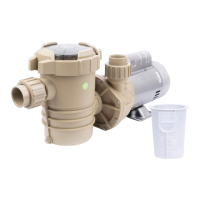
This document is a user manual for CIPU Pool Pumps, specifically models CSPPD704 and CSPPD705. It provides comprehensive instructions for installation, operation, maintenance, and troubleshooting, emphasizing safety precautions throughout.
Function Description
The CIPU Pool Pumps are designed for the pre-filtering and re-circulation of water in swimming pools and spas. They are intended to work with clean water at temperatures not exceeding 104°F (40°C). The manual highlights that these pumps are not a substitute for properly installed and secured pool drain covers, and emphasizes the importance of using ANSI/ASME A112.19.8 approved anti-entrapment drain covers. For installations not in single-family dwellings, a clearly labeled emergency switch, readily accessible and installed at least 5 feet (1.52 m) away and within sight of the pump, is required.
Important Technical Specifications
The technical data section provides specific details for both models:
- Item: CSPPD704, CSPPD705
- Input Power: CSPPD704: 816W; CSPPD705: 1072W
- H. Max (Maximum Head): CSPPD704: 34ft; CSPPD705: 42ft
- Q. Max/min (Maximum Flow Rate): CSPPD704: 283L; CSPPD705: 316L
- V (Voltage): 115V for both models
- HZ (Frequency): 60Hz for both models
- IP (Ingress Protection Rating): IPX5 for both models, indicating protection against low-pressure water jets from any direction.
The pump is designed to operate within a temperature range of >32°F (0°C) and <104°F (40°C). Operating outside these temperatures can cause damage. The manual also specifies that the pump must be supplied through a residual current device (RCD) with a rated residual operating current not exceeding 30mA. For models with power input greater than 1kW, the power cord, including the ground wire, must be of quality 245 IEC66 (HO7RN-F). For models less than 1kW, the quality must be 245 IEC57 (H05RN-F).
Usage Features
The pumps are designed for ease of use with several features:
- Two-Speed Operation: Two-speed models are recommended for optimal filtration. High speed is used for maximum filtration during peak periods, high turbidity levels, backwashing, vacuuming, and to attain full performance in hydro-therapy mode for spas and hot tubs. Low speed is used during other times, such as filter/heat cycle mode, providing sufficient flow for filtration and activating most spa heaters. In jetted tubs, low speed is used for priming.
- Priming: The pump is designed to self-prime, provided there is sufficient water supply from the suction point and in the filter tank. If water is lost from the filter tank, it needs to be refilled by removing the translucent lid, filling the filter tank with water, and then replacing the lid, ensuring the o-ring is correctly located.
- Check Valve: For inground swimming pools where the water level is lower than the pump's water inlet, the pump is equipped with a check valve to prevent backflow. An adapter is screwed into the water inlet, and then the connector assembly is installed.
- Safety Features: The manual emphasizes several safety features, including the requirement for a circuit breaker to separate the pump from the electrical supply, with an open contact distance of no less than 3mm. A single-phase motor has a built-in thermal overload switch. The pump must not be used when people are in the water.
Maintenance Features
Regular maintenance is crucial for the longevity and safe operation of the pump:
- Strainer Basket Cleaning: The strainer basket in the filter tank should be inspected and cleaned at regular intervals. This involves removing the lid, lifting out the basket, removing debris, and hosing it off with clean water.
- Lid Gasket Inspection: The lid gasket should be inspected and lubricated with silicon-based grease if needed. If damaged, it must be replaced.
- O-Ring Placement: When replacing the lid after cleaning or priming, ensure the o-ring is correctly located. The lid should be hand-tightened only.
- Winterization: In climates exposed to frost or freezing, the pump should be drained completely and stored in a dry location if not used during winter. The drain plug should not be replaced during storage. Before re-activation, all seals and o-rings should be checked, re-greased if necessary, and replaced if unsure of condition. The motor shaft should also move freely.
- Electrical Connection Checks: Regularly verify the correct position, attachment, and condition of the supply cables and insulating parts.
- Motor Temperature and Vibration: Periodically check the motor's temperature and vibration. In case of excessive heat or vibration, the pump should be stopped immediately and repaired.
- Troubleshooting Guide: The manual includes a comprehensive troubleshooting guide for common issues such as low flow, pump not running, pump not priming, motor overload, and noise. Solutions range from cleaning components and checking electrical connections to contacting a qualified electrician or supplier.
- Warranty: The manual advises contacting the supplier for any faults within the warranty period, as failure to do so may void the warranty. All electrical work must be carried out by a qualified electrician.


 To Next Page
 General