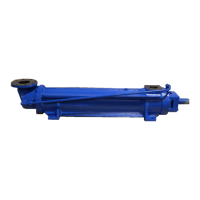
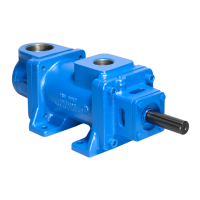
This document is a product service manual and parts list for CIRCOR IMO 3E Series pumps, specifically covering rotor sizes 143, 143J, and 162. It provides essential information for the installation, operation, maintenance, and troubleshooting of these pumps.
Function Description:
The CIRCOR IMO 3E Series pumps (models 3E-143, 143J, and 162) are positive displacement, rotary screw pumps. Their primary function is to move fluid axially from an inlet port to an outlet port. This is achieved through precision-bored housings that enclose a driven screw (power rotor) and intermeshing following screws (idler rotors). As these screws rotate, they form a succession of closures or cavities, ensuring a continuous, uniform flow with minimal fluid pulsation and pump noise. These pumps are designed for applications where reliable and consistent fluid transfer is critical.
Important Technical Specifications:
The manual outlines several critical operating and structural limits for the 3E Series pumps, which must not be exceeded without specific approval from Imo Pump.
Usage Features:
The manual emphasizes several important usage features and limitations:
- Liquid Limitations: Pumps are designed for liquids having general characteristics of oil. They should never be operated with thin liquids such as solvents or water.
- Operating Limits: Operating conditions (speed, fluid viscosity, temperature, inlet pressure, discharge pressure, filtration, duty cycle, drive type, mounting) are interrelated. Users must verify that the system's operating requirements are within the pump's capabilities before operation.
- Model Identification: Each pump's specific model is identified on the pump nameplate. Figure 1 provides a detailed definition of model designators for 3E Series pumps, including information on seal design, mounting type, rotor size, and material/construction.
- Ordering Instructions: When ordering renewal parts, users must provide the instruction manual number with revision level and date, the pump's serial number (found on the nameplate), and identify the required kit (Minor or Major).
Maintenance Features:
The manual provides comprehensive instructions for pump maintenance, including disassembly, assembly, and parts identification.
- General Instructions: All parts should be cleaned and inspected for nicks and burrs during assembly. Worn or damaged parts, O-rings, mechanical seals, and ball bearings should be replaced when disturbed from their installed positions. Light lubricating oil should be applied to all parts to assist in assembly. The power rotor shaft should be inspected for nicks, burrs, rust, or oxidants.
- Safety Precautions: The manual uses "DANGER," "WARNING," "CAUTION," and "ATTENTION" labels to highlight safety-critical information. Users are warned about potential bodily injury, loss of life, equipment damage, and slippery floors due to fluid leakage. It is crucial to disconnect and lock out all power to the equipment before any maintenance.
- Tools Required: Common mechanics' hand tools, a torque wrench, dial indicators for alignment, and a suitable lifting device (slings, straps) are necessary for maintenance.
- Disassembly Procedure: Detailed steps are provided for disassembling the pump, including removing bearing retainer bolts, pulling the power rotor assembly, and disassembling the power rotor itself (removing retaining rings, pressing off the ball bearing, removing seal seat adapters, and disassembling the mechanical seal). Specific instructions are given for different seal types (single spring and multi-spring).
- Reassembly Procedure: The reassembly process is outlined in reverse, with emphasis on proper installation of O-rings, housing components, the power rotor assembly, idlers, and covers. Torque values for bolts are specified in the assembly drawings.
- Seal Replacement: Specific steps are provided for replacing only the seal, indicating when disassembly can be considered complete for this task.
- Bearing Installation: A "CAUTION" note warns against damaging the ball bearing by pressing on its inner race during installation.
- Startup: After reassembly, the pump should be primed to expel air prior to startup.
- Repair Kits:
- Minor Repair Kits: Available for pumps with mechanical seals and ball bearings. These typically include O-rings, gaskets, shaft seal, and bearings.
- Major Repair Kits: Available for all steel case pumps. Items marked (1) in the parts list are included in Minor Repair Kits, and items marked (2) are included in Major Repair Kits for steel case pumps.
- Iron Case Pumps: Major repairs are not considered economical for iron case pumps. If extensive repair is needed, the pump should be discarded and a new one purchased. Repair parts for iron case pumps are only available in kit form.
- Troubleshooting: For troubleshooting assistance, users are directed to the General Installation, Maintenance and Trouble Shooting Manual, SRM00046.
- Field and Factory Service: Imo Pump offers trained service personnel for installation, startup, maintenance/overhaul, and training. Factory overhaul services are also available, with factory-overhauled pumps warranted "as-new" for one year from the date of shipment. Contact information for technical/customer service is provided.

 Need help?
 General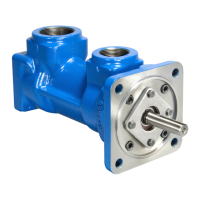

 To Next Page