Need help?
Do you have a question about the Cisco MERAKI MX250 and is the answer not in the manual?
Describes the LED status for power indication, including solid orange and shifting colors.
Details LED states for USB connectivity, indicating connection status and link integrity.
Explains the LED indicators for High Availability (HA) status, showing availability and link states.
Explains the operation of the reset button for rebooting or factory reset of the device.
Warns to disconnect power before accessing system components and cautions about optical transceivers.
Guides on configuring a static IP address for the MX250 appliance via its local management service.
Instructions for configuring VLAN tagging for WAN uplinks on a trunk port.
Details on configuring PPPoE authentication for DSL circuits, including username and password.
Explains how to enable and configure web proxy settings for fallback HTTP communication with the Cloud Controller.
The Meraki MX250 is an enterprise security appliance designed for distributed networks that require remote administration, making it ideal for network administrators who prioritize ease of deployment and a comprehensive feature set. This device serves as a central point for managing network security and connectivity, ensuring robust and reliable operation across various network environments.
The MX250 offers a range of features to enhance network performance and flexibility. It includes two dedicated uplink SFP+ 10GbE ports, providing high-speed connectivity for demanding network traffic. Additionally, it supports a versatile array of connections, including eight configurable GbE (RJ45) ports, eight GbE SFP ports, and eight 10GbE SFP+ connections. This diverse port configuration allows for flexible integration into existing network infrastructures and supports various types of network devices and speeds.
For enhanced reliability and failover capabilities, the MX250 is equipped with a USB port that supports approved 3G/4G cards. This feature enables seamless failover to cellular networks, ensuring continuous internet connectivity even if the primary WAN connection experiences an outage. This is particularly beneficial for critical applications where uninterrupted network access is paramount. The appliance also includes 128GB of SSD cache storage, which can be utilized for various caching purposes, potentially improving the performance of frequently accessed data and applications.
The MX250 features a dedicated management port, simplifying the process of initial setup and ongoing administration. This port allows network administrators to access the device's local management web service, which is crucial for configuring and monitoring basic ISP/WAN connectivity. The appliance is designed for rack mounting, with front-panel rack mounts included for easy installation in standard server racks. The package also includes two CAT6 Ethernet cables and a rack mounting kit, providing all necessary accessories for immediate deployment.
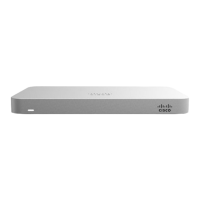
The device's status is clearly indicated by a series of LEDs on the front panel. When the MX250 powers on, all Internet LEDs flash twice, providing an initial visual confirmation of activity. The "Power" LED, labeled as Item 1, displays a solid orange when power is applied, shifts colors when the unit is attempting to contact the Cloud, flashes white when operation is in progress, and shows a solid white when fully operational. This color-coded system allows administrators to quickly ascertain the device's operational state.
The "USB connectivity" LED, labeled as Item 2, is off during boot or when a USB link is not active. It turns solid orange to indicate an initial link, flashes orange if Internet connectivity is not complete, and turns green when a USB connection is detected. This provides clear feedback on the status of USB-based connections, such as 3G/4G failover devices.
The "HA status" LED, labeled as Item 3, indicates the high availability status of the device. It is off when no HA is available, turns orange for an initial link, flashes orange if high availability is not complete, and turns green when HA is available. This allows administrators to monitor the redundancy status of their network setup.
For maintenance and troubleshooting, the MX250 includes a reset button located on the back panel. This button can be accessed by inserting a paper clip. A brief, momentary press will delete a downloaded configuration and reboot the device, which can be useful for quickly reverting to a previous state or resolving minor configuration issues. Pressing and holding the button for more than 10 seconds will force the unit into a full factory reset, erasing all configurations and restoring the device to its default settings. This is a critical feature for complete system recovery or when repurposing the device. The serial number of the device is conveniently located on a product label at the back panel, which is essential for support and inventory management.
The mounting hardware provided with the MX250 includes four sets of standard slot-head rack screws and nuts. Additional screws and nuts are supplied for optional rear brackets, should rear support be required in the rack. When installing the appliance, it is important to ensure sufficient space between the rear of the rack and any other obstacles to allow for adequate airflow, which is crucial for maintaining optimal operating temperatures and preventing overheating.
Safety guidelines are also provided to ensure safe handling and installation. A warning indicates that the system must be disconnected from all power sources and the power cords removed from the power supply modules before accessing or removing system components. This prevents electrical shock and damage to the device. A caution notes that optical transceiver products used with the MX250 should be UL listed and rated Laser Class I, 3.3Vdc, ensuring compatibility and safety for optical connections.
Connecting the MX250 to a WAN involves configuring its IP address. By default, all Meraki MX devices are configured to obtain a DHCP address from upstream WAN/ISP servers. To set up a static IP address, a client machine (such as a laptop) needs to be connected to the management port of the MX. It is important to disable all other network services (e.g., Wi-Fi) on the client machine to ensure it is redirected to the local web service. The appliance's built-in web service can then be accessed via a browser by navigating to http://setup.meraki.com. The default credentials for accessing the uplink configuration under the "Local status" tab use the device serial number as the username, with a blank password field. From there, administrators can choose "Static" for the IP Assignment option and enter the IP address, subnet mask, default gateway IP, and DNS server information. When the WAN connection is fully enabled, the Internet LED will turn green, providing a visual confirmation of successful connectivity.
Additional settings, accessible only via the local management console, include configuring VLANs. If the WAN uplink is on a trunk port, administrators can choose "VLAN tagging" and "Use VLAN tagging," then enter the appropriate VLAN ID for their network. For PPPoE authentication, which may be required for DSL circuits, administrators can select "Connection Type > PPPoE," choose their authentication option, and if "Use authentication" is selected, enter the username and password provided by their ISP.
Web proxy settings can also be configured if the MX device needs to fall back to using HTTP to contact the Cloud Controller. By default, the web proxy is disabled. To enable it, administrators can choose "Web proxy > Yes," enter the hostname or IP and port, and if authentication is required, select "Authentication > Use authentication" and enter the username and password. After making all configuration changes, it is essential to click "Save Settings" at the bottom of the page to apply them to the appliance.
Physical link settings for the Ethernet ports can be configured by navigating to "Local status > Ethernet configuration." Here, administrators can enable half duplex, full duplex, and autonegotiation, as well as set 10 or 100-Mbps data rates, allowing for fine-tuning of network performance based on specific requirements.
 General
| Model | MX250 |
|---|---|
| Category | Firewall |
| Firewall Throughput | 4 Gbps |
| Maximum VPN Throughput | 1 Gbps |
| Maximum Concurrent VPN Tunnels | 1000 |
| Max Concurrent Connections | 2, 000, 000 |
| High Availability | Yes |
| Operating Temperature | 0°C to 40°C |
| Form Factor | 1U Rack Mount |
| Security and SD-WAN Capabilities | Yes |
| Auto VPN | Yes |
| Cloud Management | Yes |
| WAN Interfaces | 2x 10 GbE SFP+ |
| Power Supply | Dual, hot-swappable |
| Ports | 2 x 10G SFP+ |
| Interfaces | 2 x 10G SFP+ |

 To Next Page