20 21
and feet when you’re standing up or sitting down. So the veins have to
work extra hard to get that blood back up to the heart, and some of those
veins can wear out over time.
e primary cause of varicose veins is a breakdown of the valve system in
the veins. Blood carrying nutrients to the cells is pumped from the heart
through the arteries to the legs. e depleted blood then returns to the
heart through the venous system – veins having one-way valves. When
the valves cannot close properly, veins become varicose, blood backs up,
causing the veins to widen and become distended.
Age, strenuous activity and extra weight are some of the contributing
factors to the development of varicose veins. With age, the valves and
veins become weaker, and muscle mass and tone tend to decrease, thereby
impeding the return of blood to the heart and increasing the risk of
developing varicose veins. ese factors may cause the valve to leak or fail,
allowing blood to accumulate in the veins, causing them to stretch.
Since varicose veins swell because blood pools in them, the best treatment
is to empty blood from the veins. Any program of regular exercise
stimulates circulation, and helps prevent varicose veins. However, most
intense activity may increase blood pressure in the legs and accentuate
varicose veins. Low impact or passive exercise are excellent therapy as they
are gentle to the joints and lower extremities yet very eective.
How Exercise Can Help With the
Lymphatic & Cardiovascular System
e human body has two circulatory systems, which are your body’s delivery
systems. One is the cardiovascular system and the other is the lymphatic
system.
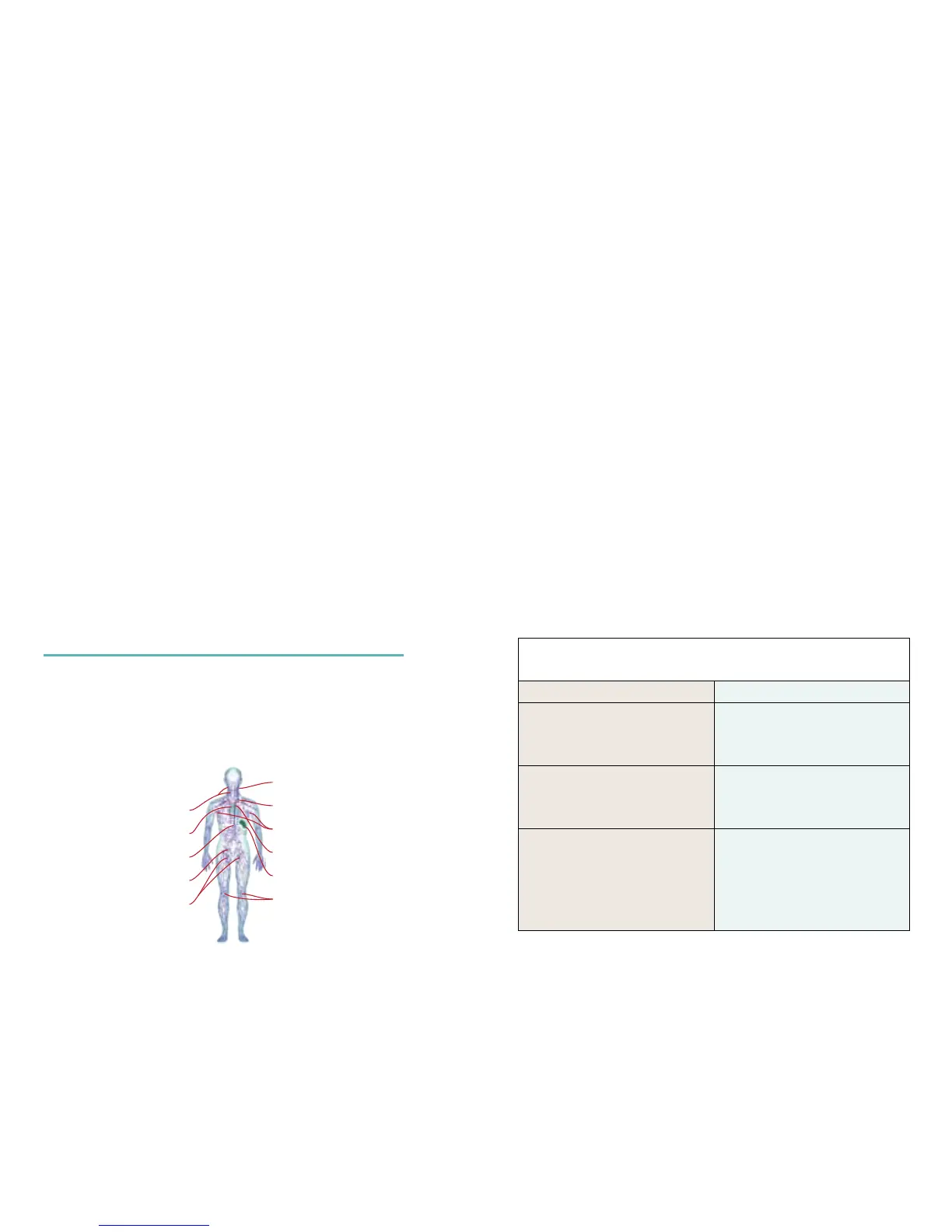
Lymph & Immune System
Lymph Nodes of the Neck
ymus Gland
Lymph Vessels of the Abdomen
Appendix
Lymph Nodes of the Groin
Tonsils
oracic Duct
Lymph Vessels of the Chest
Spleen
Lymph Nodes Behind the Knee
e cardiovascular system is made up of the heart, blood and blood vessels.
Blood moving from the heart delivers oxygen and nutrients to every part
of the body. On the return trip, the blood picks up waste products so that
your body can get rid of them. Increased blood circulation helps your body
eliminate waste products and deliver oxygen-rich blood to oxygen-depleted
muscles, helping them recover faster. e lymphatic system is also connected
to every part of the body, but its function is completely dierent from that of
the cardiovascular system.
e lymphatic system is made up of the spleen, thymus, tonsils, adenoids,
lymph nodes and lymph uid. Lymph vessels branch through all parts of
the body like blood vessels, except the lymphatic system carries a colorless
liquid called lymph instead of blood. Lymph circulates through the lymph
system, around body tissues to the lymph vessels. As blood circulates, uid
leaks out into the body tissues. e leaked uid drains into the lymph vessels
where it is ltered; the old worn out red blood cells are replaced with new
ones and returned to the bloodstream. Increased lymph ow helps the body
eliminate waste products and helps kill pathogens and some cancer cells more
eectively.
Being aware of the dierences between these two systems makes it easier to
understand the special diculties encountered when any part of these systems
are not functioning properly.
Comparison of the
Cardiovascular and Lymphatic System
Cardiovascular System (Blood) Lymphatic System (Lymph)
Blood is responsible for collecting and
distributing oxygen, nutrients and
hormones to the tissues
of the entire body.
Lymph is responsible for collecting
and removing waste products
left behind in the tissues.
Blood ows in a closed continuous
loop throughout the body via the
arteries, capillaries, and veins.
Lymph ows in an open circuit
from the tissues into lymphatic
vessels. Once within these vessels,
lymph ows in only one direction.
Blood is pumped. e heart pumps
blood into the arteries that carry it
to all of the body. Veins return blood
from all parts of the body to the heart.
Lymph is not pumped. It passively
ows from the tissues into the
lymph capillaries. Flow within
the lymphatic vessels is aided by
other body movements such as
deep breathing and the action of
nearby muscles and blood vessels.
Chart continued on page 22


 To Next Page