EasyManua.ls Logo

Clark GCS 20 - Page 71

Clark GCS 20
128 pages
Print Icon
To Next Page IconTo Next Page
To Previous Page IconTo Previous Page
Loading...
Know
Your
Truck
How To
Start
Your
Truck
Before
starting
a
lift
truck
it is
good
practice
to
always start from
a
safe
condition.
Check
to see
that:
1
Parking
brake
is
applied
2
Forks
are
fully lowered
to the
floor
3
You are
familiar with
how all the
controls
function
4
All
controls
in
neutral
or
other
correct position
5
Truck
has
been checked
and is
ready
to
operate
This
is a
good time
to
adjust
the
seat
to
a
comfortable
position
for
you.
Adjust
the
seat
by
moving
and
holding
the
release
lever
at the
left
front edge
of
the
seat.
Put the
seat
in a
position
which will provide easy reach
to all
controls. Release
the
seat lever. Make
sure that
the
seat locking mechanism
is
engaged.
84M281
84
M
238
Put
the
directional control lever
in the
"N"
(neutral)
position.
The
truck
should
start only
in the
"neutral" position.
83M416
Before
Operation
How
To
Perform
The
Daily
Inspection
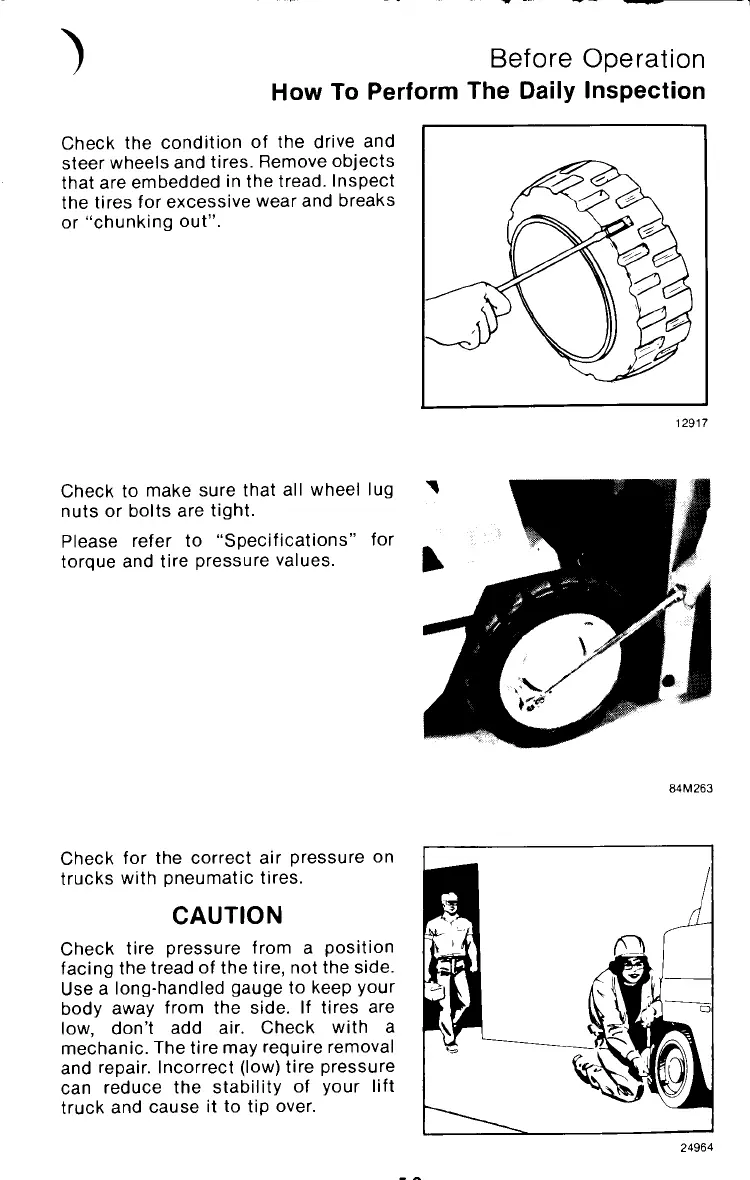
Check
the
condition
of the
drive
and
steer
wheels
and
tires. Remove objects
that
are
embedded
in the
tread. Inspect
the
tires
for
excessive wear
and
breaks
or
"chunking
out".
12917
Check
to
make sure that
all
wheel
lug
nuts
or
bolts
are
tight.
Please
refer
to
"Specifications"
torque
and
tire pressure values.
for
84
M
263
Check
for the
correct
air
pressure
on
trucks
with
pneumatic
tires.
CAUTION
Check
tire
pressure
from
a
position
facing
the
tread
of the
tire,
not the
side.
Use
a
long-handled gauge
to
keep your
body away from
the
side.
If
tires
are
low, don't
add
air. Check with
a
mechanic.
The
tire
may
require removal
and
repair. Incorrect (low) tire pressure
can
reduce
the
stability
of
your
lift
truck
and
cause
it to tip
over.
24964
5.3

Related product manuals